
We may earn a commission if you buy through links on this page. It never changes a score or a ranking. How we make money
The bottom line
A wide observability and security platform, with usage costs and telemetry hygiene to manage.
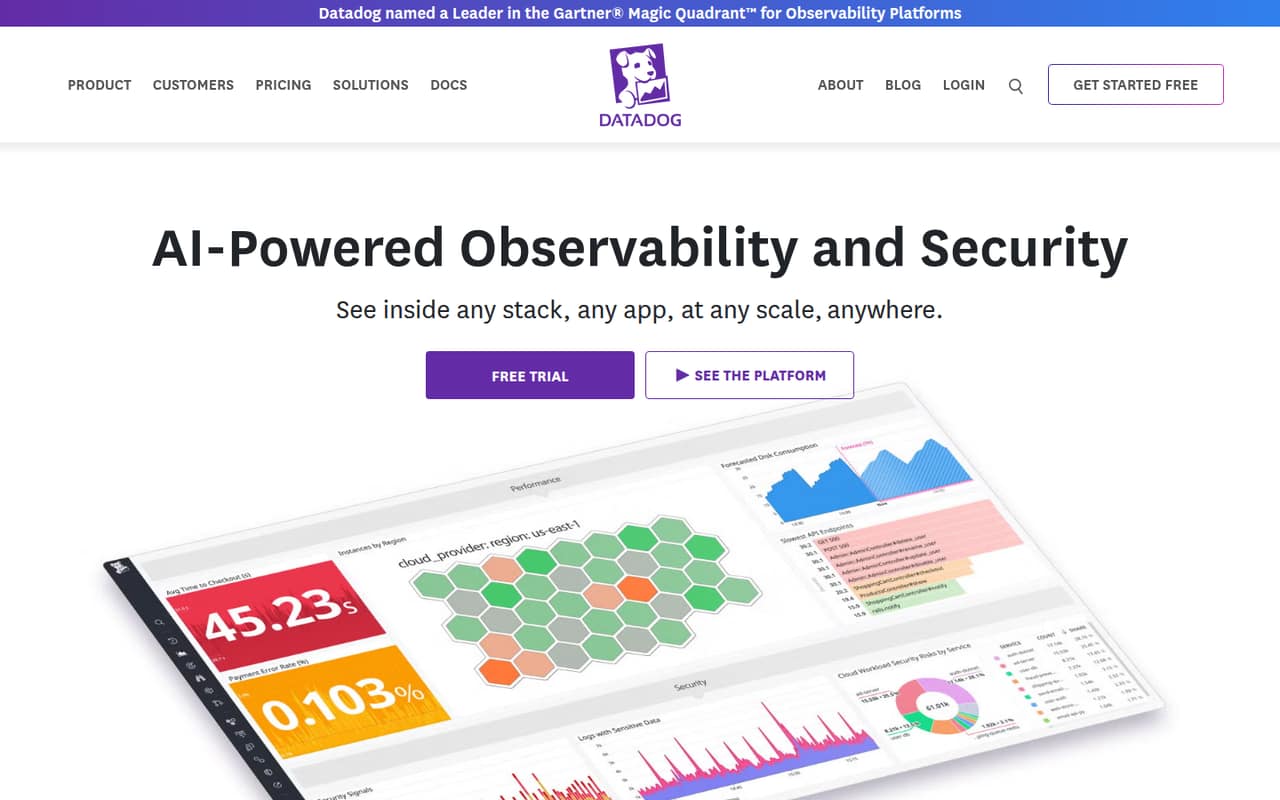
Datadog is a hosted platform spanning infrastructure, application and log monitoring, security, digital experience, and software delivery. Its API, OpenTelemetry support, integrations, IDE plugins, and Pup CLI give teams several ways to connect it to a stack.
The breadth comes with operational and budget work: Reddit users report manual cleanup of unused metrics and logs, and one commenter describes an agent conflict. The vendor lists AI Credits at $500 per 500 credits per month on annual billing; that is not a platform-wide starting price.
Good fit if
- Teams consolidating observability and security
- Kubernetes and cloud infrastructure operators
- Teams building AI operations workflows
Skip it if
- Teams requiring self-hosted observability
- Projects with strict fixed-cost budgets
- Teams wanting a narrow monitoring tool
ScoresHow it rates
What works
- Covers infrastructure, applications, data, logs, and user experience
- Includes security and software delivery products
- Provides an API, OpenTelemetry, and integrations
- Offers IDE plugins, MCP Server, and Pup CLI
- AI Credits include chat, investigations, and code fixes
What doesn't
- No free plan is listed
- Platform-wide starting price is not published
- AI Credits monthly billing price is not listed
- SDK and language support needs verification
- Reddit users report cost audits can be manual
01What Datadog is, technically
Datadog is a hosted monitoring, security, and software delivery platform, rather than a library or self-hosted server. It sits alongside the systems a team runs and collects or presents information about infrastructure, applications, data, logs, and user experience. The platform groups infrastructure monitoring, application performance monitoring, log management, cloud and code security, real user monitoring, CI visibility, and service management.
That breadth is useful when teams want related telemetry and workflows in one product: the homepage also lists dashboards, alerts, incident management, workflow automation, and a software catalog. For an application stack, Datadog can cover infrastructure and service health alongside logs, security findings, and user-facing performance. The trade-off is that a broad platform needs deliberate configuration: teams must choose what to instrument, what to retain or index, and which features they actually need. It is a service to integrate into an existing stack, not a replacement for the systems that generate its telemetry.
02Datadog API, SDKs and docs
The homepage lists an API, OpenTelemetry, integrations, IDE plugins, MCP Server, Datadog Apps, and Pup CLI as extension points. It also links to Docs and lists product coverage for systems including AWS, Azure, Google Cloud, Kubernetes, OpenAI, and SAP. This gives teams multiple routes to connect services and tooling, but the homepage does not name a specific API protocol or programming language.
The vendor also lists Agent Observability, Bits Agent Builder, and a software catalog; these fit workflows that need to connect application telemetry with AI agents or service ownership. Confirm SDK and language support in the vendor docs before selecting an instrumentation approach. Check which integrations cover the exact services and versions in your stack, and whether their configuration suits your deployment model. Pup CLI and IDE plugins can sit in developer workflows, while OpenTelemetry offers a named instrumentation surface. The docs should be the reference for implementation details and compatibility.
03Datadog pricing for developers
Datadog has no free plan listed, though its homepage advertises a free trial; the trial length and terms are not published. The vendor doesn't publish a platform-wide starting price in the pricing details available here. Those details list AI Credits at $500 per 500 credits per month when billed annually. A monthly price for that plan is not listed. On-demand AI Credits cost $1.30 per credit.
The AI Credits plan includes 500 credits per month, Bits Chat for telemetry search, Bits Investigation for automated investigations, and Bits Code for code fixes. Teams should distinguish that package from the price of core observability, security, and other products: the AI Credits figure is not a quoted price for the whole Datadog platform. The credit model makes usage an explicit budget concern, particularly for on-demand work. Before production adoption, ask Datadog for product-specific rates, what counts toward usage, and how billing changes when you add services or increase telemetry volume. The pricing details here do not list rate limits or other product overages.
04Datadog: open source, self-hosting and lock-in
Datadog is presented as a hosted platform, not as a self-hosted server. The vendor doesn't publish an open-source license or self-hosting option in its homepage information, so teams that require either should confirm availability and terms before adopting it. The homepage lists OpenTelemetry, an API, integrations, and a Marketplace, which provide connection points but do not by themselves establish a complete data-export or migration path.
The platform spans dashboards, monitors, logs, service catalogs, security workflows, and incident management. That can create switching work in both configuration and day-to-day processes. Before committing, ask how to export telemetry, historical data, dashboards, monitors, and security findings, and which formats remain usable outside Datadog. Keep instrumentation and alerting configuration in version control where possible, and document dependencies on Datadog-specific features. Those steps reduce migration friction without assuming that every product has a portable equivalent.
05Datadog in production
The broad product set can put infrastructure, application, log, security, and user-experience signals in one place. Production readiness still depends on deciding which data to collect and retain, validating agent behavior against your applications, and confirming the usage and support terms for the products you plan to run. The vendor homepage does not state rate limits or availability figures; ask for the limits and reliability commitments that apply to your account and integrations.
Cost control is a recurring operational concern in Reddit discussions. One r/devops post describes removing unused custom metrics, indexed health-check logs, and orphaned dashboards through manual review; commenters suggest filtering logs before ingestion and automating cleanup. Another commenter reports that an agent caused an infinite loop in an older proof of concept. These are individual reports, not a measure of general reliability, but they are reasons to stage agent upgrades, watch application behavior, and audit telemetry volume. The vendor also lists access control and a Governance Console, which teams can evaluate against their security requirements.
From the threadsWhat users say
Reddit sentiment is mixed but leans negative around cost management and an agent-related incident. Some commenters describe practical ways to reduce log volume and automate configuration reviews.
We do filter logs through proxy before they even hit datadog, reduces noise and cost about 90%
Ended up cutting like 30% just from the obvious stuff but it was all manual
Put in some automated scripting to cleanup high cardinality metrics and alert the responsible team
The POC? Their agent literally broke our app because we made use of some of the methods the agent also uses, leading to an infinite loop
Questions people ask
Is Datadog a reputable company?
Datadog sells a broad platform for monitoring, security, digital experience, and software delivery, and its homepage says it was named a Leader in the Gartner Magic Quadrant for Observability Platforms. Reddit feedback includes cost-control complaints and one report of an agent conflict, so evaluate the products and support terms relevant to your stack.
Is Datadog hard to integrate?
The homepage lists an API, OpenTelemetry, integrations, IDE plugins, and Pup CLI as connection points. Integration effort depends on your services, instrumentation choices, and deployment. Confirm SDK and language support in the vendor docs and validate agent behavior with your applications before rolling out broadly.
Does Datadog have a free plan?
Datadog's pricing details list no free plan, while the homepage advertises a free trial. The trial length and terms are not published in the pricing details here. Ask Datadog what products, usage limits, and billing transition apply to the trial before using it for a production evaluation.
Can Datadog be self-hosted?
Datadog is presented as a hosted platform, not a self-hosted server. The vendor doesn't publish a self-hosting option in its homepage information. Teams with a self-hosting requirement should confirm that directly with Datadog and review data export and migration paths before adoption.
How much does Datadog cost?
The listed AI Credits plan costs $500 per 500 credits per month when billed annually, or $1.30 per credit on-demand. That is an AI Credits price, not a platform-wide quote. Ask Datadog for pricing on the observability, security, and other products your team needs.