
We may earn a commission if you buy through links on this page. It never changes a score or a ranking. How we make money
The bottom line
Dash0 pairs OpenTelemetry-native observability with portable data, but budget for stored telemetry.
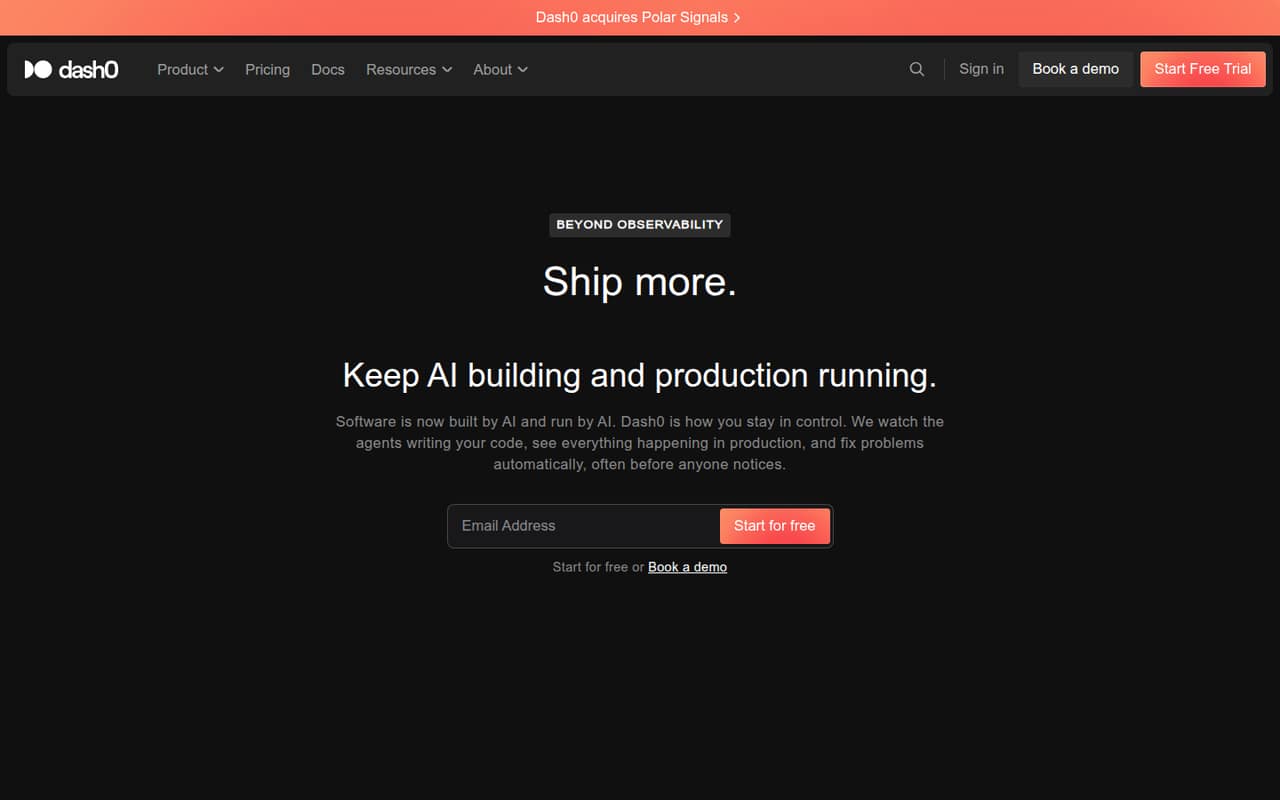
Dash0 is an OpenTelemetry-native observability platform for logs, metrics, traces, profiles, events and RUM data. It combines signal exploration with AI development insights and production automation, and says SignalStore keeps data in your cloud. PromQL, SQL, a CLI, an API and an MCP server are listed as access surfaces.
We see its strongest case in teams that want to standardize on OpenTelemetry and avoid a vendor-specific telemetry format. Pricing is usage-based, with separate ingestion and storage charges for several signal types and no permanent free plan. One Reddit user reports switching from Datadog and paying less, while also missing some features.
Good fit if
- Teams standardizing on OpenTelemetry
- Teams consolidating logs, metrics and traces
- Engineers who want portable telemetry
Skip it if
- Teams needing a permanent free tier
- Teams requiring published rate limits
- Teams looking for a documented self-hosted server
ScoresHow it rates
What works
- OpenTelemetry-native signals and interfaces
- PromQL and SQL query access
- Data export is advertised as available anytime
- Ingestion and storage are priced separately
- Configuration as Code fits existing release pipelines
What doesn't
- No permanent free plan is listed
- Storage charges add to ingestion costs
- Dash0 SDK and language support needs confirmation
- Vendor does not publish numeric rate limits
- Dash0's licence and self-hosting options are unclear
01What Dash0 is, technically
Dash0 is an observability platform, not an instrumentation library. Its product combines a web interface and query surfaces with SignalStore, an OpenTelemetry-native data platform that Dash0 says stores signals in your cloud. The listed signal types are logs, metrics, traces, profiles, events and RUM data. Dash0 also presents AI software development insights and production automation as parts of the same platform.
In a stack, applications and agents send telemetry through OpenTelemetry-compatible tools; engineers and AI agents then query and explore that data through PromQL, SQL, a CLI, an API or an MCP server. Dash0's stated goal is to connect production signals to code and support live insights, root-cause analysis, automatic fixes and auto-tuning. SignalControl lets teams select telemetry to keep, with storage costs applying to what they retain. The architecture is designed to reduce dependence on proprietary telemetry formats, but teams should validate how their existing collectors, dashboards and alerting fit before switching.
02Dash0 API, SDKs and docs
Dash0 lists an API, CLI and MCP server as ways for people and AI agents to access the same signal store. It also supports PromQL and SQL query access, and describes compatibility with OTel-compatible tools, agents and SDKs. Configuration as Code is intended to put dashboards, rules and other configurations in editors and existing release pipelines.
The homepage does not name specific Dash0 SDKs, programming languages, API protocols or CLI commands. Confirm SDK support, authentication, API versioning, pagination and query limits in Dash0's documentation before you build a production integration. The same applies to whether your current OpenTelemetry collector, instrumentation libraries and deployment setup are supported as configured.
Dash0's product pages include documentation, guides, integrations and a changelog, but teams should check those references for the exact setup path for their stack. The key integration proposition is using OpenTelemetry and open query interfaces rather than adopting a proprietary instrumentation format.
03Dash0 pricing for developers
Dash0 lists one usage-based plan, Telemetry, and no permanent free plan. A 14-day unlimited free trial is available without a credit card. The pricing page describes monthly usage pricing and lists no annual billing option.
For spans, logs and web events, the listed rate is $0.060 per million ingested and $0.540 per million stored, with 30-day retention. Metric data points cost $0.020 per million ingested and $0.180 per million stored, with 13-month retention. Synthetic API checks are $0.20 per thousand stored, with 13-month retention; session replays are $2.00 per thousand stored, with 30-day retention. These separate ingestion and storage meters mean a production estimate needs both signal volume and retention. Agent0 Credits are a metered monthly add-on at $0.60 per credit. The pricing page does not list a starting monthly price, seat charge or annual discount. Model each signal type separately and confirm how your expected usage will be measured before committing.
04Dash0: open source, self-hosting and lock-in
Dash0 describes the platform as OpenTelemetry-native and says it uses open interfaces rather than a proprietary telemetry format. It also says customers can export data anytime. Those claims support portability at the signal level, but do not establish that Dash0's application is open source or that its full service can be self-hosted.
The vendor does not publish a Dash0 software licence or a self-hosted-server option on the vendor's site. SignalStore is described as storing data in your cloud; that is distinct from running the Dash0 service yourself. Ask Dash0 what components run in your cloud, what data must pass through its service, and what export formats and query definitions are available.
Using OpenTelemetry can make a backend migration easier, but dashboards, alerts, automation and AI features may still need to be recreated. A commenter on Reddit notes that UIs and alerts can be a source of lock-in across observability tools.
05Dash0 in production
Dash0's pricing lists retention periods by signal type, but the vendor does not publish numeric rate limits on the vendor's site. Before production use, ask about ingest and query quotas, service availability commitments, data residency, access controls, encryption, incident response and compliance certifications. The homepage links to a security section, but teams should review its current details rather than assume a specific control or certification.
Cost control also needs attention: ingestion and storage are separate meters for spans, logs, web events and metrics, while checks and replays have their own stored-data rates. Set a forecast using representative signal volume and retention, then confirm how SignalControl changes billing.
A Reddit user who switched from Datadog reports paying half as much, while missing some minor features. Another commenter says standardizing OpenTelemetry across .NET services can be confusing. Treat both as individual reports, not guarantees; validate your own instrumentation, workflows and feature requirements.
From the threadsWhat users say
The limited Reddit feedback is positive about cost and OpenTelemetry portability, but one user misses some features after leaving Datadog. Another describes friction standardizing OpenTelemetry across .NET services, so integration effort is stack-dependent.
Very good actually! Switched from DataDog because cost. Do miss some minor features from there, but all in all it more than covers our needs while costing half of Datadog
It also pushed us to go fully OTEL, which is a nice bonus considering we could move from Dash0 to any other platform basically
Do miss some minor features from there, but all in all it more than covers our needs
Is it just me or is otel really confusing for both .net8/10 support azure monitor export w/ service bus, event hub, sql, azfuncs, etc
Questions people ask
What telemetry can Dash0 store?
Dash0 lists logs, metrics, traces, profiles, events and RUM data for SignalStore. Its pricing also names spans, logs, web events, metric data points, synthetic API checks and session replays. Check the current documentation for the exact instrumentation and ingestion path for each signal type in your stack.
Does Dash0 work with OpenTelemetry?
Yes. Dash0 describes itself as OpenTelemetry-native and says it works with OTel-compatible tools, agents and SDKs. It also lists PromQL and SQL as query interfaces. Confirm specific SDK versions, collector configuration and language support in the vendor's docs before changing a production pipeline.
Does Dash0 have a free plan?
Dash0 lists no permanent free plan. It offers a 14-day unlimited free trial without a credit card. After the trial, the Telemetry plan is usage-based, with listed ingestion and storage charges for several signal types. Check the pricing page for current rates and ask the vendor how your usage will be counted.
Can I self-host Dash0?
Dash0 says SignalStore keeps data in your cloud, but that does not by itself mean the Dash0 service can be self-hosted. The vendor does not publish a self-hosted-server option on the vendor's site. Ask which service components run in your cloud and what operational responsibilities that deployment requires.
Can I export data and move away from Dash0?
Dash0 says customers can export data anytime and emphasizes OpenTelemetry and open interfaces. Those features can help with signal portability, but dashboards, alert rules and automations may need to be rebuilt in another tool. Confirm export formats and whether configuration can be exported before relying on a migration path.