
We may earn a commission if you buy through links on this page. It never changes a score or a ranking. How we make money
The bottom line
Daily combines hosted WebRTC infrastructure with Pipecat; production costs scale by participant-minutes.
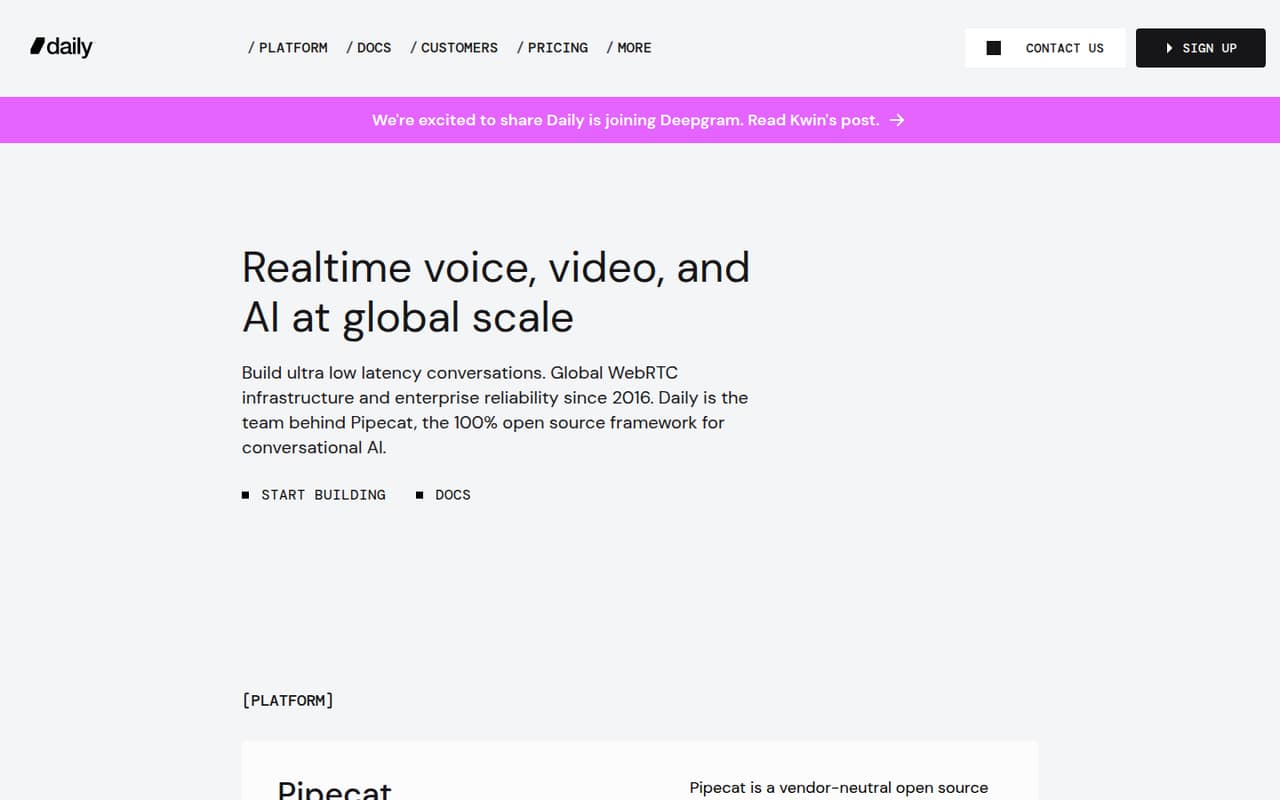
Daily is hosted WebRTC infrastructure for human calls and Pipecat-built voice agents, with WebRTC-native SDKs and a global network. Pipecat is a vendor-neutral, open-source framework for realtime voice and multimodal AI; Pipecat Cloud deploys agents on Daily infrastructure.
The pricing page lists 10,000 free participant minutes monthly, then graduated per-minute rates. That is a straightforward starting point for prototypes, but teams should confirm SDK support, billing details and the scope of security commitments before production use.
Good fit if
- Teams building realtime voice calls
- Developers deploying Pipecat agents
- Products needing hosted WebRTC infrastructure
Skip it if
- Teams requiring a named SDK language
- Projects needing confirmed self-hosting
- Buyers needing published audio-only rates at scale
ScoresHow it rates
What works
- WebRTC-native SDKs for realtime calls
- Pipecat is vendor-neutral and open source
- 10,000 free participant minutes each month
- Graduated rates fall at higher video and audio volumes
- Homepage lists 99.99% service uptime
What doesn't
- Homepage does not name SDK languages
- Pipecat's license is not named on the homepage
- Self-hosting and data export details need confirmation
- Higher audio-only pricing tiers are not listed
- Rate limits and minute-counting rules need confirmation
01What Daily is, technically
Daily is hosted WebRTC infrastructure, not a self-hosted calling server or a standalone agent framework. Its infrastructure and WebRTC-native SDKs sit beneath realtime voice and video products: an application uses Daily to run human-to-human calls or transport for agents built with Pipecat. The homepage also presents Pipecat Cloud as a deployment service for Pipecat-built voice agents on Daily’s infrastructure.
Pipecat is a separate architectural layer: a vendor-neutral, open-source orchestration framework for realtime voice and multimodal AI agents. Daily maintains it, but the framework and the hosted infrastructure serve different purposes. Teams can evaluate the framework for agent orchestration and Daily for call infrastructure and deployment. The homepage lists 75+ global points of presence. Daily says its service has operated since 2016, and lists 99.99% service uptime. Those figures describe the vendor’s claims; confirm the applicable service commitments and architecture for your use case.
02Daily API, SDKs and docs
The stated integration surface is WebRTC-native SDKs for realtime calls, plus Pipecat transport for deploying agents on Daily infrastructure. The homepage links to Docs and Start Building, identifies Pipecat as a Python project, and points to video integration information. It does not name the languages supported by Daily’s SDKs or describe a REST API, CLI, webhook system or authentication flow. Confirm those details and current SDK support in Daily’s docs before choosing a client architecture.
For an agent application, Pipecat provides the orchestration framework; Pipecat Cloud is the hosted deployment path described on the homepage. For human calls, Daily’s infrastructure supports building and hosting calls directly. Daily calls Pipecat vendor-neutral, which can help keep orchestration separate from transport, but the homepage does not establish that every transport or SDK feature works identically across providers. Check the docs for supported platforms, call lifecycle, media controls, error handling and integration requirements. The homepage also says Daily contributes to Mediasoup and GStreamer, but does not describe these as required integrations.
03Daily pricing for developers
The pricing material lists a Pay-as-You-Go / Usage-Based plan with no recurring base fee and 10,000 free participant minutes each month. Video and audio calls cost $0.0040 per minute for 10,001–100,000 minutes, $0.0037 for 100,000–500,000, $0.0034 for 500,000–1,000,000, and then fall through graduated volume tiers. Listed higher tiers are $0.0030 for 1,000,000–10,000,000 minutes, $0.0026 for 10,000,000–25,000,000, $0.0022 for 25,000,000–50,000,000, and $0.0015 for 50,000,000+.
Audio-only calls have a separate schedule: the first 10,000 minutes are free, then $0.00099 per minute for 10,001–100,000 and $0.00092 for 100,000–500,000. Higher audio-only tiers are not listed on the vendor’s site. No annual price is published. Before forecasting production spend, confirm how participant-minutes are counted, how graduated tiers apply to your monthly usage, and whether your workload qualifies for the published audio-only rates.
04Daily: open source, self-hosting and lock-in
Daily calls Pipecat a 100% open-source, vendor-neutral framework and maintains its source on GitHub. The homepage does not name Pipecat’s license, so check the repository’s license file before redistributing or modifying it. Daily’s WebRTC infrastructure and Pipecat Cloud are hosted services; the homepage does not establish a self-hosting option for Daily’s infrastructure.
The vendor-neutral framing of Pipecat can reduce dependence on a single orchestration layer, but deploying agents on Daily transport or Pipecat Cloud still ties those parts of the system to Daily’s service. WebRTC is the stated foundation for calls, but that alone does not guarantee a drop-in migration to another provider. Daily does not describe data export or migration tooling on the homepage. Ask how to retrieve call-related data, what formats are available, and what changes are required to move transport or deployment elsewhere.
05Daily in production
Daily’s homepage lists 75+ global points of presence and 99.99% service uptime, and says the platform provides end-to-end encryption, signed HIPAA BAAs and operates under the EU-US Data Privacy Framework. It also lists SOC 2, GDPR and HIPAA. Treat these as starting points for review: confirm which products and configurations each statement covers, and whether the uptime figure is a contractual SLA for your plan.
The pricing material makes participant-minutes the key cost driver, but does not describe rate limits or how billing handles reconnects, concurrent participants or partial minutes. Confirm those rules, along with production capacity and any plan-specific limits, with Daily. For regulated workloads, verify the applicable BAA and security controls with the vendor. The listed points of presence indicate a distributed network, but teams should still validate latency and call quality across their own target regions, devices and network conditions before setting service objectives.
Questions people ask
What does Daily provide?
Daily provides hosted WebRTC infrastructure and WebRTC-native SDKs for realtime voice and video, including human-to-human calls. It also maintains Pipecat, an open-source framework for realtime voice and multimodal AI agents, and offers Pipecat Cloud to deploy Pipecat-built voice agents on Daily infrastructure.
Can I use Pipecat without Daily?
Daily describes Pipecat as vendor-neutral and open source, which indicates it is intended to work beyond a single provider. Check the current Pipecat documentation and repository for supported transports, integrations and license terms before selecting an alternative deployment.
Which programming languages does Daily support?
Daily’s homepage identifies WebRTC-native SDKs but does not name their supported languages. It identifies Pipecat as a Python project. Confirm current SDK language and platform support in Daily’s documentation before committing to a client or backend design.
Does Daily support end-to-end encryption and HIPAA?
Daily says it offers true end-to-end encryption and provides signed HIPAA business associate agreements. The homepage also lists SOC 2, GDPR and HIPAA. Confirm which product configurations and controls apply to your workload, and review the relevant terms with Daily.
How is Daily billed?
The listed Pay-as-You-Go / Usage-Based plan has no recurring base fee and includes 10,000 participant minutes each month. After that, video and audio rates are graduated by monthly volume. Audio-only calls have a separate listed rate schedule through 500,000 minutes.