
We may earn a commission if you buy through links on this page. It never changes a score or a ranking. How we make money
The bottom line
Cypress pairs local browser testing with a hosted Cloud service; costs rise with test volume and premium features.
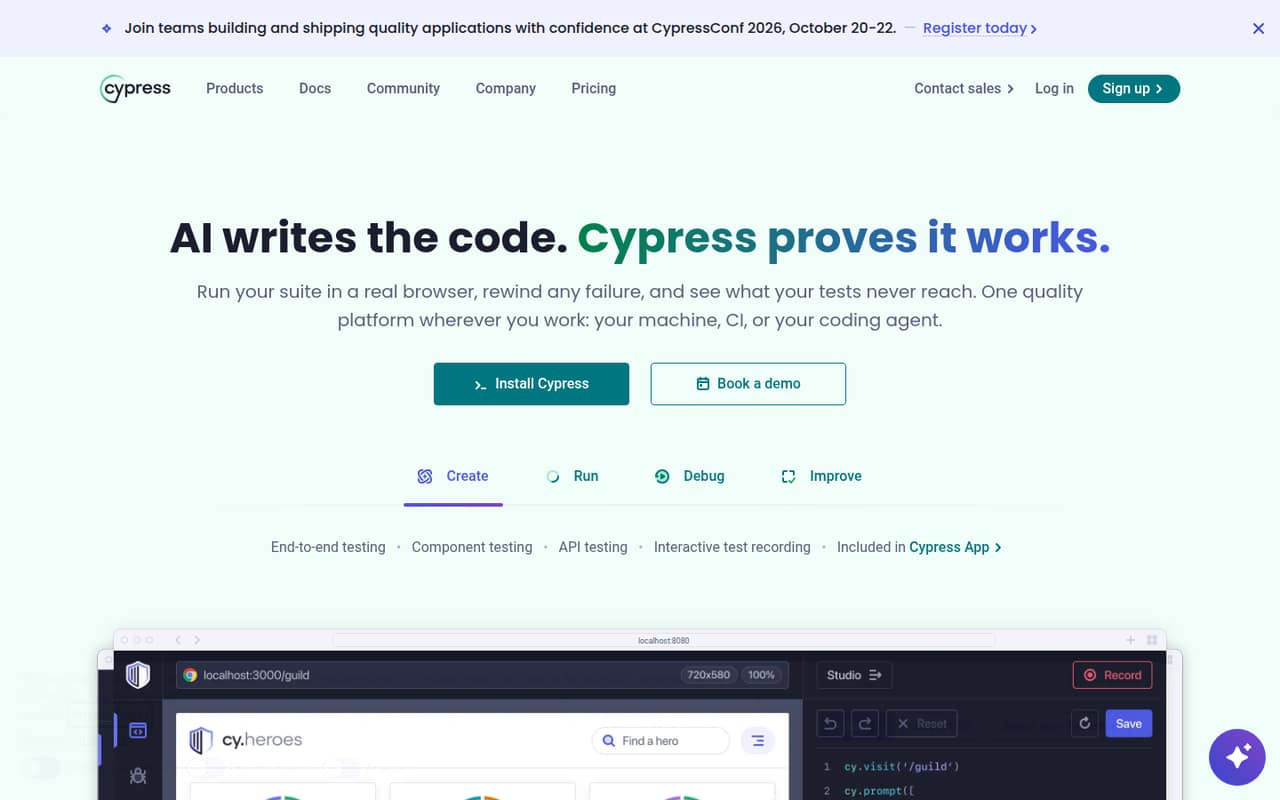
Cypress is an open-source application for end-to-end, component, and API testing in a real browser. Cypress Cloud adds CI orchestration, failure replay, coverage insights, and team workflow integrations.
We rate it highly for browser-focused teams that want tests and CI results in one workflow. The main checks are Cloud usage allowances, paid add-ons, and whether its browser-testing model fits your test suite.
Good fit if
- Frontend teams writing browser tests
- CI teams needing failure replay
- Teams coordinating tests through pull requests
Skip it if
- Teams needing broad language coverage
- Projects avoiding hosted test services
- Teams requiring published compliance details
ScoresHow it rates
What works
- Runs end-to-end and component tests in a real browser
- Supports API testing alongside browser tests
- Test Replay captures DOM, network events, and console logs
- Orchestration can parallelize, prioritize, and cancel runs
- Integrates results with pull requests, Jira, and webhooks
What doesn't
- Cloud usage has monthly or annual result allowances
- Extra test results incur per-1,000 charges on paid plans
- UI Coverage and Accessibility are paid add-ons
- The vendor does not name a license in the published product details
- Cloud data export and compliance terms need confirmation
01What Cypress is, technically
Cypress is an open-source application for end-to-end, component, and API testing in a real browser. It runs tests on a developer’s machine or in CI; Cypress Cloud is the hosted service for coordinating runs and inspecting results. That puts the test runner alongside the application code and build pipeline, with Cloud as a separate service for teams that need shared reporting and orchestration.
The Cypress App provides interactive execution and debugging. In CI, teams can use an official Docker image or bring their own, and the homepage shows a GitHub Actions workflow using cypress-io/github-action@v7. Cloud adds Smart Orchestration, Test Replay, UI Coverage, and team notifications. The split matters: teams can run the open-source application locally, but Cloud features, including shared results and replay, form a hosted dependency. Cypress targets browser behavior and user flows rather than serving as a general-purpose test-management platform.
02Cypress API, SDKs and docs
Cypress exposes test commands for browser, component, and API tests, plus cy.prompt for generating and adjusting tests. Studio AI turns recorded interactions into runnable, editable Cypress tests. The homepage does not name supported programming languages or SDKs; confirm language and SDK support in the vendor’s docs before choosing it for a mixed-language test stack.
The documented integration surfaces include the Cypress App, the cypress terminal command, the cypress-io/github-action@v7 GitHub Action, official Docker images, Cloud MCP and Cloud CLI, and the newer cypress tap terminal workflow for coding agents. Cypress Cloud sends status checks and pull request comments to GitHub, GitLab, or Bitbucket; notifications to Slack or MS Teams; and issues to Jira. Webhooks deliver run events to other tools. The homepage links a continuous integration guide, but teams should confirm the exact APIs, SDKs, and configuration options in the docs before building integrations.
03Cypress pricing for developers
The pricing page lists a free Starter plan with 10 users, 500 test results per month, 100 prompt executions per month, and 30-day data retention. Team costs $67 per month when billed annually ($799 per year) and includes 50 users, 120,000 test results and 9,000 prompt executions per year, plus 90-day retention, Flake Detection, and Jira integration. Business is $267 per month billed annually ($3,199 per year), with the same user and result allowances, 24,000 prompt executions, SSO, and Spec Prioritization. Standalone monthly rates are not published.
When included test results run out, additional results cost $5.28 per 1,000 bundled or $6 per 1,000 on-demand for Team; Business rates are $4.40 bundled or $5 on-demand. Enterprise is custom-priced, with additional results at $4 per 1,000 bundled or custom on-demand. UI Coverage and Accessibility are paid add-ons with unpublished prices. Check annual volumes against CI runs before budgeting.
04Cypress: open source, self-hosting and lock-in
Cypress describes its application as open source, and its homepage says teams can run it on a machine or in CI. The vendor’s product details do not name the open-source license; check the repository and license terms before redistributing or embedding it. Cypress Cloud is a hosted service, not a self-hosted Cloud deployment described on the homepage.
The local runner reduces dependence on Cloud for executing tests, but Cloud features such as orchestration, Test Replay, and shared reporting create service-specific workflows. Cypress lists data-retention periods by plan, but does not publish data-export details here. Ask how to export test results, replay data, and coverage history before adopting Cloud, and whether exports remain available after a subscription ends. Tests themselves are Cypress tests, so moving them to another framework may require rewriting commands and assertions.
05Cypress in production
Cypress Cloud’s plan allowances and retention periods are the operational limits to budget first: Starter includes 500 test results per month and 30 days of retention, while Team and Business include 120,000 results per year and 90 days. Enterprise lists 1.8 million results per year and 180 days. Extra results are billed per 1,000 on paid plans. Confirm how results are counted, what happens at the allowance, and whether your CI volume fits the plan.
The homepage describes parallelization, failure prioritization, cancellation, selective reruns, and Test Replay, but does not publish service uptime, rate limits, security certifications, or compliance terms. Ask Cypress for those details if Cloud handles production data or is part of a release gate. Reddit discussion is mixed: one commenter says their company switched from Cypress to Playwright, while another describes Cypress as useful for frontend and component testing. A separate shutdown claim in a Reddit thread is speculation, not evidence of a company decision.
From the threadsWhat users say
Reddit comments show mixed views: some developers report switching away or hitting framework limitations, while others describe Cypress as a useful fit for frontend and component testing. A thread predicting a shutdown drew requests for evidence and skepticism, so it should not be treated as verified news.
Our company just switched off cypress to playwright
Source?
Cypress is more suitable for single user e2e tests, for system test (mocking the backend) and component tests (web frameworks)
I started my career as a software automation engineer using cypress and javascript to provide all the solutions I did
Questions people ask
Is Cypress free?
The pricing page lists a free Starter plan with 10 users, 500 test results per month, 100 prompt executions per month, and 30-day data retention. Cypress also lists a 30-day free trial. Check with the vendor which paid-plan features the trial covers and what happens when it ends.
What does Cypress Cloud add to the Cypress App?
Cypress Cloud adds CI orchestration, shared results, Test Replay for CI failures, coverage insights, and workflow integrations. It can parallelize specs, prioritize likely failures, cancel broken runs, and selectively rerun failed tests. The Cypress App is used for local interactive execution and debugging.
Can Cypress run in CI?
Yes. Cypress says it runs in the CI provider a team already uses and offers an official Docker image or the option to bring a custom image. Its homepage shows a GitHub Actions example using cypress-io/github-action@v7. Cloud can add orchestration and shared CI result inspection.
Does Cypress support API and component testing?
Yes. Cypress lists end-to-end, component, and API testing as supported test types. Component and end-to-end tests run in a browser. Confirm the languages and frameworks your application uses against the vendor’s current documentation before adopting it.
Can Cypress Cloud be self-hosted?
The homepage describes Cypress Cloud as a service and does not describe a self-hosted Cloud deployment. Cypress says the Cypress App can run on a machine or in CI. Ask the vendor about deployment options, data handling, and export requirements if hosted Cloud is unsuitable.