
We may earn a commission if you buy through links on this page. It never changes a score or a ranking. How we make money
The bottom line
CustomGPT makes grounded business assistants simple to deploy, but pricing and developer access need scrutiny.
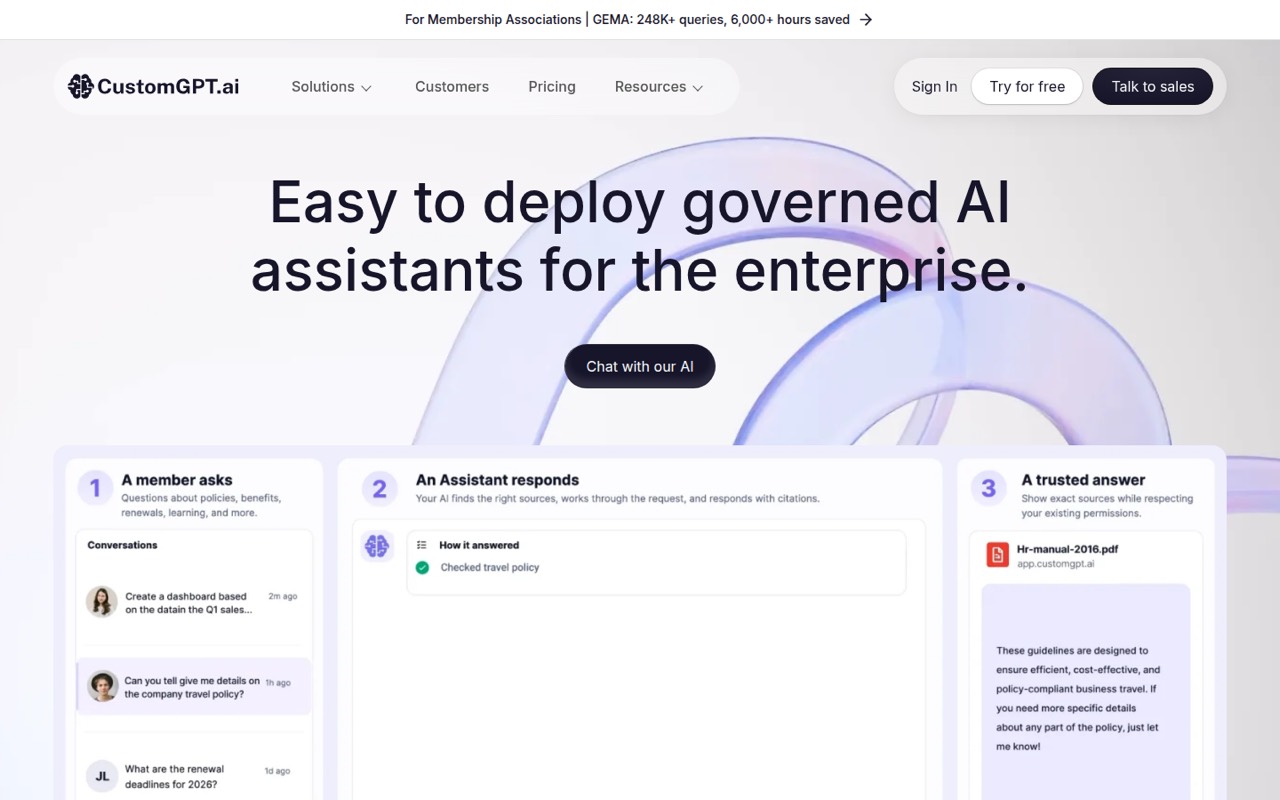
CustomGPT is a hosted, no-code platform that turns an organization’s documents, websites and knowledge bases into assistants for customer and staff questions. It cites sources, supports website widgets and connects with tools including Google Drive, HubSpot and Notion. The vendor says it supports more than 1,400 document types and does not use customer data to train AI models.
There’s no free plan. Standard starts at $89 per month with annual billing, or $99 monthly, and includes 1,000 queries per month. A seven-day trial is available. CustomGPT is a fit for teams that value no-code deployment over a clearly documented API or self-hosted option; confirm data export and integration requirements before building around it.
Good fit if
- Teams building content-grounded support assistants
- Organizations that want no-code setup
- Businesses deploying assistants on websites
Skip it if
- Developers requiring a documented public API
- Teams needing self-hosted deployment
- Projects with tight per-query budgets
ScoresHow it rates
What works
- No-code agent setup and one-click deployment
- Citations link responses to their sources
- Supports more than 1,400 document types
- Website widgets are available out of the box
- Vendor says customer data is not used for training
What doesn't
- No free plan; the trial lasts seven days
- Standard includes 1,000 monthly queries
- Additional queries cost $375 per 2,500 monthly
- Public API and SDK details are not published
- No published self-hosting or data-export option
01What CustomGPT is, technically
CustomGPT is a hosted SaaS application for building AI assistants grounded in an organization’s content. It is not presented as a library, CLI or self-hosted server. Teams add documents, websites and knowledge-base content, configure an agent without code, then deploy it through a website widget or other listed integrations.
The product sits between an organization’s content sources and its customer or staff interfaces. Its job is to retrieve answers from approved business material and cite the sources behind them, rather than serve as a general-purpose model endpoint. The vendor says it supports more than 1,400 document types, along with websites, videos, podcasts and audio. It also names integrations including Google Drive, HubSpot and Notion, with real-time sync described for multiple data sources.
That architecture suits teams seeking a managed knowledge assistant. It gives developers less control over the underlying retrieval and serving stack than a self-hosted system would. The vendor says agents can be deployed on websites, in help centers or internally.
02CustomGPT API, SDKs and docs
CustomGPT’s advertised build path is a no-code SaaS interface: connect content, configure an agent and deploy it. The named integration surfaces are connectors such as Google Drive, HubSpot and Notion, plus out-of-the-box website widgets. The homepage also describes one-click deployment and real-time sync from multiple data sources.
The vendor doesn’t publish public API endpoints, SDKs, supported programming languages, a CLI or webhooks in its homepage product information. Developers who need programmatic agent creation, conversation management or custom deployment should confirm API access and SDK support in the vendor’s technical docs before choosing it. Don’t assume a website widget or connector provides the same control as an API.
The cited answers and no-code setup help reduce frontend and retrieval work for basic deployments. For a custom application, check whether the available integration surface supports your authentication, event handling and data-update workflow. The homepage links to data connectors and tools, but an implementation plan should verify the exact behavior and limits of each connector.
03CustomGPT pricing for developers
CustomGPT has no free plan; it offers a seven-day free trial. Standard costs $99 per month on monthly billing or $89 per month with annual billing. It includes 10 agents, 1,000 queries per month, 5,000 documents per agent, 60 million words of storage and three team members.
Premium costs $499 monthly or $449 per month with annual billing. It includes 25 agents, 5,000 monthly queries, 20,000 documents per agent, 300 million words of storage and five team members. Enterprise pricing is custom, with flexible data, query and seat limits, custom SSO and role-based access, dedicated account and engineering support, and automated real-time data sync.
Add-ons can move the bill quickly: 2,500 extra queries per month cost $375, 300 million additional storage words cost $300, and 100,000 additional documents per month cost $100. Another 25 agents costs $100; five extra team seats also cost $100. Model query volume and content growth against these add-ons before production. The pricing page lists no pay-as-you-go rate, so confirm how usage is handled if an agent reaches its included query limit.
04CustomGPT: open source, self-hosting and lock-in
CustomGPT is presented as a hosted SaaS platform. The vendor doesn’t publish an open-source license or self-hosted deployment option, so teams should plan for a closed, vendor-operated service rather than a server they can run in their own environment.
The vendor also doesn’t publish data-export details. Before ingesting a large corpus, ask how to retrieve original uploaded files, processed content, agent configuration and conversation data, and whether exports preserve metadata or source links. Confirm what happens to stored data when an account ends.
Migration effort depends on how much of the workflow lives inside CustomGPT: source documents may be reusable, but agent settings, indexing and widget behavior may need to be rebuilt elsewhere. Keep a separate copy of source content and document the assistant’s configuration. If you need to retain control of the retrieval stack or move between providers, get export and exit terms in writing before rollout.
05CustomGPT in production
The production constraints to model first are the plan’s query, document, storage and seat allowances. Standard includes 1,000 queries per month; Premium includes 5,000. The listed query add-on is $375 for each additional 2,500 monthly queries, so forecast demand and confirm what users see when an agent reaches its limit. The vendor does not publish rate limits or service-level targets on its homepage; ask about both before using the service for a critical support path.
The homepage says responses cite sources and that customer data is not used to train or share AI models. It also states SOC 2 Type 2 and GDPR compliance, and describes access controls and encryption. Confirm which controls apply to your plan, how real-time sync behaves when a source changes, and what data is retained in logs.
Test answers against stale, conflicting and incomplete content before launch. Citations make it easier to inspect an answer, but teams still need a process for content ownership, escalation and correcting published material.
Questions people ask
What is CustomGPT?
CustomGPT is a hosted, no-code platform for building AI assistants grounded in an organization’s documents, websites and knowledge bases. It answers customer and staff questions using that content, cites sources and can be deployed through website widgets, help centers or internal channels.
Does CustomGPT have an API or SDK?
The vendor’s homepage describes no-code setup, integrations and website widgets, but does not publish public API endpoints, SDKs or supported programming languages there. If you need programmatic access, confirm API availability and SDK support in the technical docs before selecting a plan.
How much does CustomGPT cost?
Standard costs $99 per month, or $89 per month with annual billing, and includes 1,000 queries per month. Premium is $499 monthly or $449 with annual billing and includes 5,000 queries per month. Enterprise pricing is custom. There is no free plan, but a seven-day trial is available.
Can I self-host CustomGPT or export my data?
CustomGPT is presented as a hosted SaaS platform, and the vendor doesn’t publish a self-hosted option or data-export details. If portability matters, ask how to export source files, agent settings and conversation data, and what happens to stored information when you close an account.
Does CustomGPT train AI models on my data?
The vendor says it does not use customer data to train or share AI models. Its homepage also states SOC 2 Type 2 and GDPR compliance and describes access controls and encryption. Confirm the applicable terms, data retention and plan-specific controls with the vendor for your deployment.