
We may earn a commission if you buy through links on this page. It never changes a score or a ranking. How we make money
The bottom line
Cryptomus combines crypto payments, trading and staking, but verify API details and custody safeguards before relying on it.
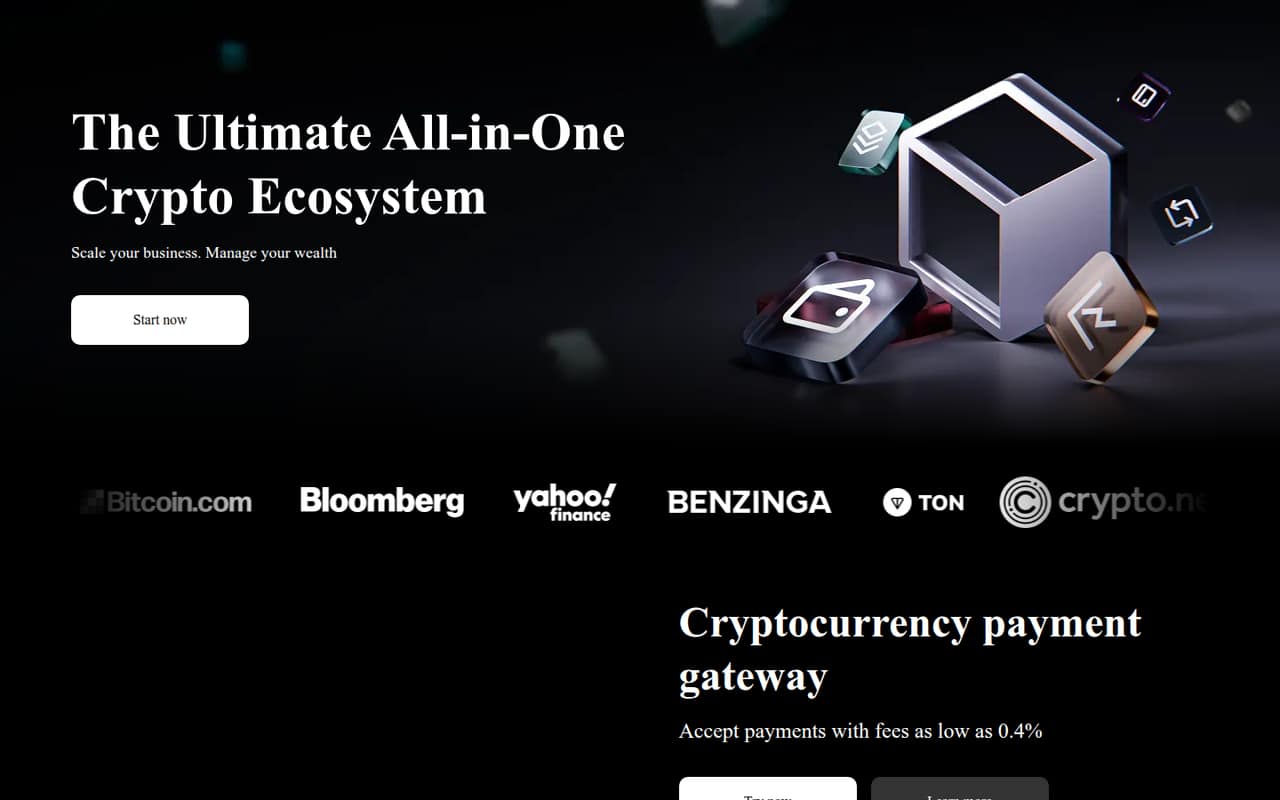
Cryptomus is a hosted crypto ecosystem for payment processing, trading and staking, with a dedicated API for each tool. Its payment gateway fees start at 0.4%, but the homepage offers little detail about API protocols, SDKs or production limits.
Reddit discussions include reports of inaccessible funds and slow support, alongside older allegations about an ICO. These are user reports, not verification of current service conditions; treat them as a reason to check withdrawal, support and compliance processes before committing funds.
Good fit if
- Merchants accepting crypto payments
- Teams needing several crypto tools
- Developers evaluating a hosted API
Skip it if
- Teams requiring self-hosted payment infrastructure
- Developers needing published SDK and rate-limit details
- Users storing large balances on one platform
ScoresHow it rates
What works
- Dedicated API for every tool
- Homepage says API documentation is complete
- Supports more than 100 cryptocurrencies
- Payment fees start at 0.4%
- No monthly or annual subscription listed
What doesn't
- SDKs and programming languages are not named
- API protocols and rate limits need confirmation
- No free plan is listed
- Source availability and self-hosting are not published
- Reddit users report fund-access and support problems
01What Cryptomus is, technically
Cryptomus is a hosted crypto-services platform, not a library, CLI or self-hosted server. It combines a cryptocurrency payment gateway, a trading platform and tools for earning passive income. The homepage describes a unified API, with a dedicated API for each tool, and says it is fully documented.
For a business, the payment gateway sits between a checkout or billing system and crypto payment processing. The trading and staking products sit alongside it as hosted services for managing crypto activity. Cryptomus says it supports more than 100 cryptocurrencies; its trading interface is powered by TradingView. The homepage advertises payment fees as low as 0.4% and trading fees as low as 0.04%, while the detailed spot schedule lists tiered maker and taker rates.
This is a vendor-dependent architecture: your application integrates with Cryptomus rather than running the payment service itself. Confirm which tools expose APIs, how transactions and account state are represented, and what happens to funds during withdrawals or service interruptions.
02Cryptomus API, SDKs and docs
The homepage describes a unified API for the ecosystem and a dedicated API for every tool. It calls the API simple, fast and fully documented. That is the available integration surface to evaluate if you want to connect payment processing or other Cryptomus tools to an application.
The homepage does not name an API protocol, SDK, programming language, CLI or plugin. Before implementation, confirm the API style and endpoints in Cryptomus documentation, along with authentication, payment-status updates, retries, idempotency and error handling. Ask specifically whether the service supports webhooks and whether official SDKs exist for your language; do not assume those features from the phrase “unified API.”
For a production integration, also confirm sandbox access, API versioning and backward-compatibility policy. Those details affect whether Cryptomus can fit an existing billing or order-management flow without custom polling and maintenance work. The stated documentation coverage is a useful starting point, but the homepage alone does not establish integration depth.
03Cryptomus pricing for developers
The pricing page lists no monthly or annual subscription and no free plan. Payment Gateway (Merchant) charges 0.4%–2% per incoming payment. Auto-Convert is free, as are internal Personal-to-Business wallet transfers. The headline “as low as 0.4%” is therefore the bottom of a range, not a guaranteed rate for every transaction.
Spot Exchange - Lvl 1 lists 0.08% maker and 0.1% taker fees at the $0 monthly-turnover tier. Lvl 2 lists 0.06% maker and 0.095% taker at the $100,001 tier; Lvl 3 lists 0.055% and 0.085% at $250,001; Lvl 4 lists 0.05% and 0.075% at $500,001. The homepage separately advertises trading fees as low as 0.04%, so confirm which product and conditions that rate applies to.
Virtual card issuance is $4, and top-ups cost 3.2%. Network withdrawal fees vary by cryptocurrency and blockchain. Model fees against incoming payment volume, trade mix and withdrawals; ask Cryptomus for the applicable merchant rate before forecasting production costs.
04Cryptomus: open source, self-hosting and lock-in
Cryptomus presents its products as hosted services accessed through dedicated APIs. The vendor does not publish an open-source licence or source-availability terms on the homepage, and it does not describe a self-hosting option. Treat it as a hosted dependency unless Cryptomus confirms otherwise in its contract and technical documentation.
The vendor also does not publish data-export or migration details on the homepage. Before storing business-critical payment records or balances, ask what transaction and account data you can export, in which formats, and whether exports remain available after account closure. Confirm how to reconcile pending payments and retrieve historical records if you leave.
Migration effort depends on how much of your payment flow relies on Cryptomus-specific APIs and account behavior. Keep your internal order and ledger records independent of the provider, and avoid making the provider's account view the only record of a transaction. Confirm withdrawal procedures and any restrictions before moving meaningful volume.
05Cryptomus in production
The homepage and pricing details do not publish API rate limits, uptime commitments or service-level terms. Confirm those limits, along with authentication controls, incident communication, withdrawal rules and compliance requirements, before making Cryptomus part of a checkout or treasury workflow. Ask how payment status is recovered after timeouts and how account reviews affect access to funds.
Reddit discussions include a user who said they could not access funds and had contacted support for weeks. Other commenters speculated about an account freeze; that explanation is unverified. Separate older threads contain allegations about an ICO and token listings. Those posts are not proof of current payment-gateway behavior, but the fund-access report makes withdrawal and escalation procedures worth checking directly.
Do not treat a hosted payment account as long-term cold storage. Keep independent transaction records, test support and withdrawal processes with limited exposure, and document a fallback payment path. Ask Cryptomus for current security and compliance documentation rather than inferring safeguards from the product range.
From the threadsWhat users say
Reddit sentiment is strongly cautious, with users reporting fund-access and support problems and raising doubts about the platform. Older ICO-related allegations also appear in discussions, but they do not establish the current service's behavior.
I been contacting support for weeks and keep getting nowhere
Their fees are obscenely higher than Coinbase
Sounds more like an AML freeze on their account
tokens are still not on exchanges and they still dont communicate about it
Questions people ask
What is Cryptomus?
Cryptomus is a hosted crypto ecosystem with a payment gateway, trading platform and tools for earning passive income. Its homepage says it supports more than 100 cryptocurrencies and provides a dedicated API for each tool. It is presented as an online service, not a self-hosted server or software library.
How much does Cryptomus charge for crypto payments?
The listed Payment Gateway (Merchant) fee is 0.4%–2% per incoming payment. Auto-Convert and internal Personal-to-Business wallet transfers are listed as free. The rate that applies to a merchant depends on the applicable terms, so confirm your rate with Cryptomus before estimating costs.
Does Cryptomus provide an API?
Yes. The homepage describes a unified API with a dedicated API for every tool and says it is fully documented. It does not name a protocol, programming language, SDK or CLI. Check Cryptomus documentation for supported endpoints and ask the vendor about SDKs, webhooks, authentication and rate limits.
Does Cryptomus have a free plan?
No free plan is listed. The pricing information lists transaction-based payment fees and volume-tiered spot-trading fees, but no monthly or annual subscription. Other costs include a $4 virtual card issuance fee, a 3.2% virtual card top-up fee and network withdrawal fees that vary by cryptocurrency and blockchain.
Is Cryptomus safe for storing crypto?
The available product details do not establish whether Cryptomus is suitable for long-term storage or explain its custody safeguards. Reddit users have reported difficulty accessing funds, though those reports do not verify the cause or establish typical outcomes. Ask Cryptomus about custody, withdrawals, account reviews, security controls and support escalation before depositing funds.
Sources
- Cryptomus homepage
- Cryptomus pricing, compiled via web search from webclaw.io, github.com, cryptomus.com, corefy.com, monocrypt.pro, reddit.com, bitdegree.org, cryptowisser.com
- Reddit: Cryptomus took my life savings $230k
- Reddit: Cryptomus took my life savings $230k
- Reddit: Cryptomus ICO is a SCAM
- Reddit: Cryptomus SCAM going live again