
We may earn a commission if you buy through links on this page. It never changes a score or a ranking. How we make money
The bottom line
Crawlbase combines hosted scraping APIs, proxies and storage, with usage pricing that starts free.
Crawlbase is a hosted web-data platform: call its APIs to fetch pages, use browser rendering and anti-bot handling, and route results through asynchronous crawling, storage or managed scrapers. Its SDKs cover Python, Node, Ruby, PHP and Go, and it also offers a Web MCP Server for AI agents.
Pay-as-you-go has no monthly fee, with initially free credits and graduated rates for successful requests. Subscriptions start at $99 monthly or $90.75 per month billed yearly. It suits teams that want managed collection infrastructure; clarify rate limits, data portability and service commitments before relying on it.
Good fit if
- Teams collecting web data through APIs
- Large asynchronous URL crawls
- AI agents needing current web pages
Skip it if
- Teams requiring self-hosted infrastructure
- Projects needing published rate limits
- Workloads that require a stated open-source licence
ScoresHow it rates
What works
- Crawling API supports HTML and structured data
- Python, Node, Ruby, PHP and Go clients
- Asynchronous crawls deliver results through callbacks
- Cloud Storage avoids recrawling stored results
- Pay-as-you-go has no monthly fee
What doesn't
- Rate limits are not published on the vendor's site
- JavaScript rendering costs two credits per request
- Cloud Storage accrues credits per page per month
- Self-hosting and open-source licensing are not established
- Export formats and retention terms need confirmation
01What Crawlbase is, technically
Crawlbase is a hosted web-scraping API and managed infrastructure, not a library or self-hosted server. It sits between your application and target websites: send a URL to its Crawling API to fetch HTML or structured data, with browser rendering and anti-bot handling available. For larger jobs, the asynchronous crawler queues URLs and delivers results through callbacks.
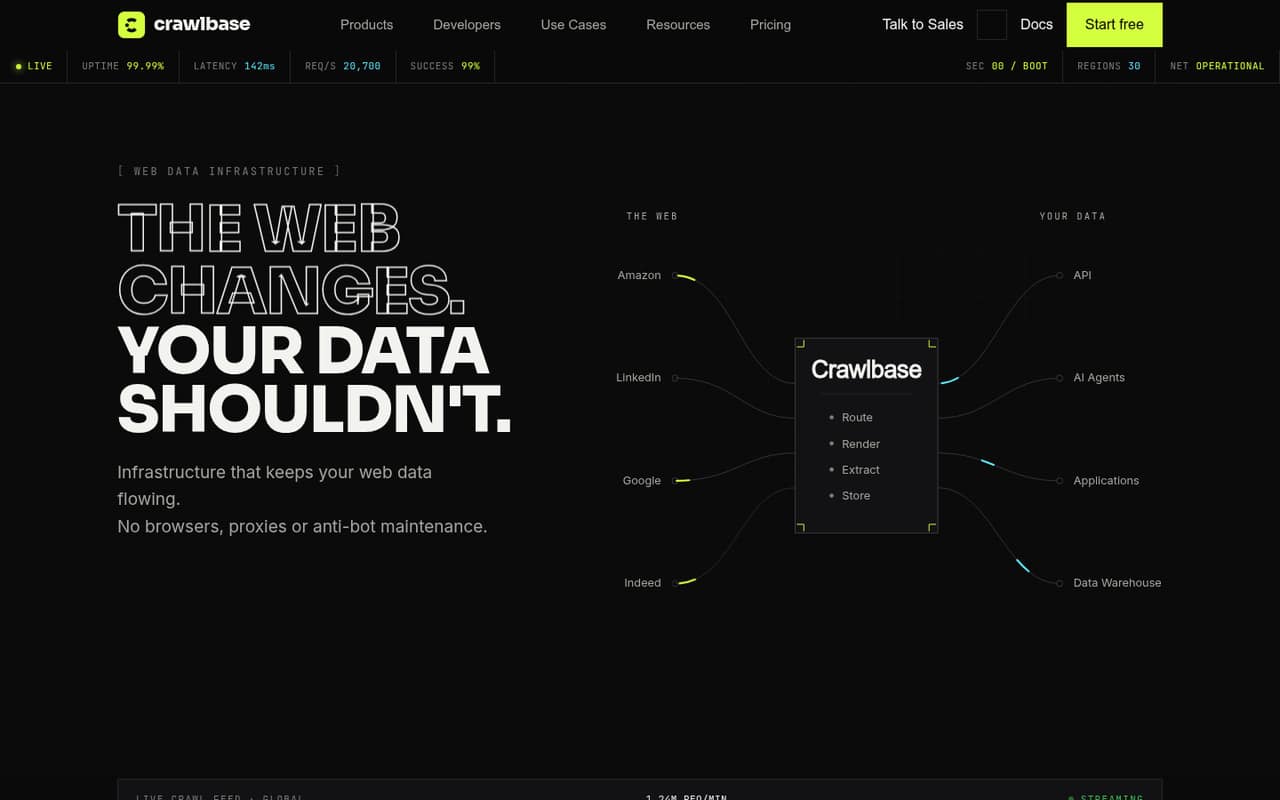
Other services cover rotating residential and datacenter proxies across 30 geographies, Cloud Storage for retrieving crawl results without recrawling, and a Web MCP Server through which AI agents can request current pages. Managed scrapers return structured data from selected sites. That makes Crawlbase a collection and delivery layer for data pipelines, search or price-monitoring systems, and agent tools. Your application still needs to validate returned data, handle failures and decide how to store or act on results.
02Crawlbase API, SDKs and docs
The main integration surface is the hosted API: provide a URL and receive HTML or structured output. The homepage links to API documentation and reference, a browser-based Playground, tutorials, a Scraping Cookbook with per-site recipes, and integrations. Official clients are listed for Python, Node, Ruby, PHP and Go. Confirm the client’s current methods and language-version support in the vendor’s docs before choosing one.
For batch work, the asynchronous crawler queues URLs and returns results through callbacks; the homepage describes delivery to storage. The MCP server offers a separate path for AI agents that need live web data over MCP. The homepage does not identify a CLI as a product surface, so teams planning command-line workflows should confirm the supported integration options with Crawlbase. The Playground can help explore requests, while the API reference and tutorials are the starting points for application code.
03Crawlbase pricing for developers
Pay as you go costs $0 per month, has no card requirement to start, and bills successful requests monthly in arrears. The pricing details list 1,000 free credits initially, up to 5,000 after setup; the homepage advertises up to 5,000 free requests. Graduated rates run from $3.00 to $0.02 per 1,000 successful requests, with an optional hard spend cap.
Subscriptions begin with Starter at $99 monthly, or $90.75 per month billed yearly, for 200,000 credits. Scale 500K is $199 monthly ($182.42 yearly) for 500,000 credits; Scale 1M is $349 ($319.92 yearly) for one million; Growth is $599 ($549.08 yearly) for two million. Credits reset monthly, and overage follows pay-as-you-go rates. Enterprise has custom volume, SLAs and invoicing.
JavaScript rendering costs two credits per request, Cloud Storage costs 0.5 credits per page per month, and screenshots cost two credits. Proxies, CAPTCHA handling and block handling have no separate charge. Model render and storage use alongside request volume.
04Crawlbase: open source, self-hosting and lock-in
Crawlbase presents its products as hosted services. The vendor does not publish an open-source licence or self-hosting option in the product details, so teams that require either should ask before adopting it. The listed products include managed APIs, proxies, storage and an MCP server; they do not establish that these components can run in your own environment.
Cloud Storage lets customers retrieve crawl results on demand, which is useful for avoiding repeat requests. The terms for exporting those results, including formats, retention and bulk retrieval, need confirmation. Integration lock-in is likely to sit in request handling, callback processing and any code built around managed-scraper output. To keep migration manageable, put Crawlbase behind an internal adapter, store needed results in your own system, and avoid making vendor-specific response fields your application’s only data contract.
05Crawlbase in production
The services cover common scaling paths: synchronous requests, queued asynchronous crawls, callbacks and stored results. The homepage displays an uptime figure of 99.99% and live operational metrics, but those dashboard figures are not a substitute for an SLA. Enterprise plans list SLAs; confirm the commitment, exclusions and incident process that would apply to your account.
The published pricing details do not publish request-rate limits, concurrency caps, callback retry behavior or storage retention. Ask for those limits and test how your pipeline handles timeouts, duplicate callbacks, partial crawls and target-site changes. Crawlbase advertises anti-bot and CAPTCHA handling, but that does not guarantee every URL will return usable data. Its homepage lists 30 regions for the network. Security and compliance requirements should be reviewed with the vendor, including what crawl data is stored and how it can be retrieved or deleted. Set spend caps or alerts and account for rendering and storage credits.
Questions people ask
What does Crawlbase do?
Crawlbase provides hosted web-scraping APIs and managed infrastructure. Its products cover page fetching, browser rendering, asynchronous crawling with callbacks, rotating proxies, Cloud Storage, managed scrapers and a Web MCP Server for AI agents. Applications use it to collect current web data without operating their own crawler infrastructure.
Does Crawlbase have a free tier?
Pay as you go has no monthly fee or card requirement to start. The pricing details list 1,000 free credits initially, rising to up to 5,000 after setup. The homepage advertises up to 5,000 free requests. Successful requests are then billed at graduated rates, so check how credits map to your planned requests.
Which programming languages have Crawlbase SDKs?
Crawlbase lists official clients for Python, Node, Ruby, PHP and Go. Its developer resources include documentation and API reference, a browser-based Playground, tutorials, a Scraping Cookbook and integrations. Check the vendor’s current docs for supported versions and the exact features available in each client.
How does Crawlbase charge for JavaScript rendering and storage?
JavaScript rendering costs two credits per request. Cloud Storage costs 0.5 credits per page per month, and screenshots cost two credits. Proxies, CAPTCHA handling and block handling have no separate charge. These costs apply alongside the selected plan or pay-as-you-go billing, so include them in usage estimates.
Can I self-host Crawlbase or export my data?
Crawlbase presents its products as hosted services, and its product details do not establish a self-hosting option or open-source licence. Cloud Storage lets customers retrieve crawl results on demand. Ask the vendor about export formats, retention, bulk retrieval and deletion before relying on it as your system of record.