
We may earn a commission if you buy through links on this page. It never changes a score or a ranking. How we make money
The bottom line
Use the Python crawler for control or the hosted API for scraping without running browsers.
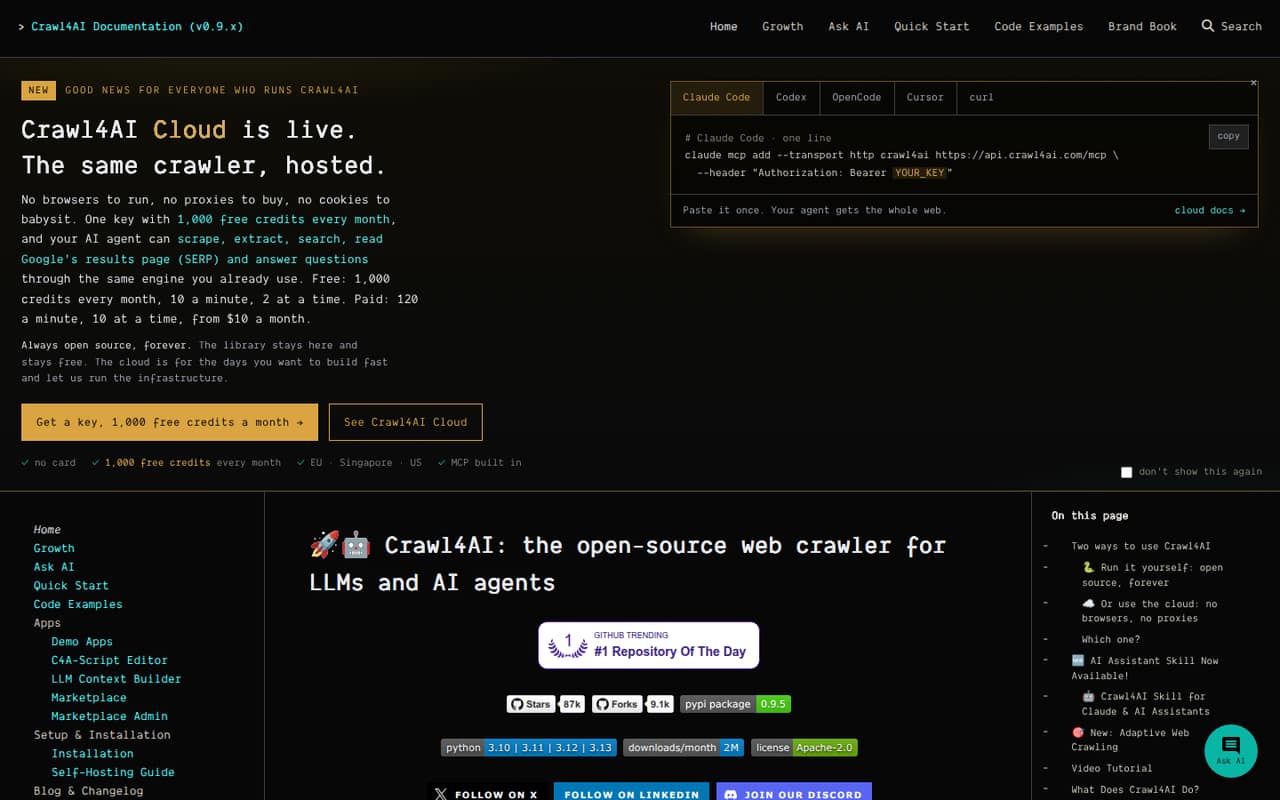
Crawl4AI is an open-source Python crawler and a hosted scraping API for turning web pages into Markdown and structured data. The cloud service adds search, Google SERP data and sourced answers, while the library and Docker server let teams run the crawler themselves.
The free self-hosted option has no usage meter, but you pay for infrastructure, proxies and any LLM use. Cloud starts at $10 monthly, with credit, request-rate and concurrency limits. Confirm how each endpoint consumes credits before putting a high-volume workflow on a paid plan.
Good fit if
- Python teams building RAG pipelines
- Agents needing scraping and web search
- Developers who want self-hosting
Skip it if
- Teams requiring published uptime guarantees
- Projects needing a named non-Python SDK
- Workloads with unpredictable credit consumption
ScoresHow it rates
What works
- Free, Apache 2.0 self-hosted library
- Python package, CLI and Docker server
- Cloud API covers scraping, extraction and search
- Markdown and JSON suit downstream pipelines
- Free cloud tier includes 1,000 monthly credits
What doesn't
- Cloud usage is metered in credits
- Free cloud tier caps requests and concurrency
- Credit cost by endpoint is not published
- Cloud data-export guarantees are not published
- Enterprise SLA requires a custom agreement
01What Crawl4AI is, technically
Crawl4AI is both an open-source Python crawler and a hosted scraping API. In a self-managed deployment, the Python library runs browser-based crawling in your process; the vendor also documents a Docker server and a command-line interface. Crawl4AI Cloud runs the browser and exposes scraping and data services over HTTP.
The crawler converts pages into Markdown for RAG, AI agents and data pipelines. Its extraction options include CSS, XPath and LLM-based approaches, and the cloud service adds web search, Google SERP data and answers with sources. The cloud endpoints include /scrape, /extract, /search, /serp and /answer, plus batch and job workflows for scraping multiple URLs. MCP is also available for connecting an agent.
In a stack, Crawl4AI sits between the web and the system that consumes page content: an ingestion pipeline, search index or agent. Choose the library or Docker route when you want to operate the browser infrastructure; choose Cloud when you want the vendor to run it.
02Crawl4AI API, SDKs and docs
For self-hosting, the documented integration starts with pip install -U crawl4ai, followed by crawl4ai-setup to install the browser. The Python example uses AsyncWebCrawler and its arun() method. The docs also cover a CLI, Docker server, multi-URL crawling and API reference topics such as arun_many() and CrawlResult.
The cloud example uses HTTP requests with a bearer token and JSON body: curl posts a URL to /scrape, then reads the Markdown response. The same key works with /extract, /search, /serp, /answer, /scrape/batch and /scrape/jobs. MCP uses HTTP transport at /mcp; the homepage gives setup commands for Claude Code and names Codex, Cursor and OpenCode. Confirm SDK support for your preferred language in the vendor's docs; the documented surfaces here are Python, HTTP and MCP.
The docs cover browser configuration, Markdown generation, extraction strategies, hooks, proxies, sessions and crawling strategies. That gives developers several ways to tune collection, but the range of options means teams should test their target sites and chosen extraction path.
03Crawl4AI pricing for developers
The self-hosted library is free under Apache 2.0 with unmetered use; you pay for infrastructure, proxies and LLM costs. Crawl4AI Cloud has a free tier with 1,000 credits monthly, 10 requests per minute and two concurrent requests. The pricing information also lists a separate 20-credit trial with no signup.
Paid monthly plans start with Starter at $10 for 10,000 credits, 120 requests per minute and 10 concurrent requests. Builder is $99 monthly for 125,000 credits, 600 requests per minute and 20 concurrent requests. Scale is $499 monthly for 750,000 credits, 1,500 requests per minute and 50 concurrent requests. Annual billing lowers the effective monthly prices to $8.33, $82.50 and $415.83, respectively; the Starter annual charge is $100.
Overages cost $1 per 1,000 credits on Starter, $0.79 on Builder and $0.67 on Scale. Enterprise has custom volume, regions and SLA, with pricing by sales contact. Because credit consumption by endpoint is not stated in the pricing information, ask for the credit schedule before estimating production spend.
04Crawl4AI: open source, self-hosting and lock-in
The Crawl4AI library is available under the Apache 2.0 license, and the vendor describes it as free forever. Developers can install it with pip, run its browser locally, or use the documented Docker server. Self-hosting removes the cloud credit meter, but infrastructure, proxy and LLM costs remain yours.
The hosted API returns content as Markdown or structured data, which can be stored in your own pipeline rather than tied to an agent interface. The vendor doesn't publish a cloud data-export guarantee, so ask how to retrieve stored job results and what retention rules apply before depending on cloud workflows.
Migration effort depends on how much of your application is built around Crawl4AI-specific extraction settings, job handling or MCP integration. Keeping a boundary around the crawler and storing its outputs in your own systems should make replacing the collection layer more manageable.
05Crawl4AI in production
Cloud capacity is bounded by plan-level request rates and concurrent requests: the free tier allows 10 requests per minute and two at a time, while Scale lists 1,500 per minute and 50 concurrent requests. For larger or region-specific workloads, Enterprise offers custom volume and regions. The vendor lists a custom SLA for Enterprise; confirm its terms and any uptime commitment before making the service a dependency.
The homepage says Cloud handles JavaScript-heavy pages and bot walls automatically. The self-hosted route leaves browser settings and proxies to your team. The feature set includes hooks, proxy and security controls, stealth modes and session reuse, but configure and validate these against your target sites. The vendor's MCP integration uses a bearer key, so protect credentials and check your own data-handling requirements.
Reddit discussion is limited and mixed in scope: one r/AI_Agents thread raises concerns about complex browser-agent tasks, while an r/n8n post shares a SERP-analysis workflow involving Crawl4AI. Neither establishes production reliability. Test representative sites, monitor credit use and verify retry behavior before scaling.
From the threadsWhat users say
The small amount of Reddit discussion is positive about workflow use but does not establish reliability or broad user sentiment. A separate agent discussion raises concerns about complex browser tasks, so production teams should validate their own workloads.
I wanted to share something I’ve been using in my own workflow that’s saved me a ton of time
free n8n templates for automating SERP analysis
If you're doing scraping with Fire Crawl to get Documentation, use "Crawl4AI" instead. It's better !
A bit more complex tasks seems to break often
Questions people ask
Is Crawl4AI free?
The self-hosted library is free under the Apache 2.0 license and has unmetered use, but you pay for infrastructure, proxies and LLM costs. Crawl4AI Cloud has a free tier with 1,000 credits each month, capped at 10 requests per minute and two concurrent requests. Paid cloud plans start at $10 monthly.
Does Crawl4AI have a hosted API?
Yes. Crawl4AI Cloud exposes HTTP endpoints for scraping pages, extracting structured data, web search, Google SERP results and answers with sources. The API also supports batch and job-based scraping. The homepage shows bearer-token authentication and JSON request bodies, and lists MCP over HTTP for agent connections.
What languages and SDKs does Crawl4AI support?
The documented self-hosted integration is a Python package, installed with pip and used through AsyncWebCrawler. The cloud example uses HTTP requests, and the service supports MCP over HTTP. The homepage does not name additional language SDKs; check the vendor's docs to confirm support for a specific language.
Can I run Crawl4AI on my own servers?
Yes. The open-source Python crawler can run with a browser installed locally, and the vendor also documents a Docker server. Self-hosting gives your team control of the runtime and avoids cloud credit limits, but you are responsible for hosting, browser configuration, proxies and any LLM costs.
How much does Crawl4AI Cloud cost?
The Free plan includes 1,000 monthly credits, 10 requests per minute and two concurrent requests. Starter costs $10 monthly for 10,000 credits; Builder costs $99 for 125,000; Scale costs $499 for 750,000. Annual billing lowers the effective monthly prices. Extra credits are charged by plan, starting at $1 per 1,000 on Starter.
Sources
- Crawl4AI homepage
- Crawl4AI pricing, compiled via web search from apis.io, crawl4ai.com, devtune.ai
- Reddit: Efficient SERP Analysis & Export Results to Google Sheets (SerpApi, Serper, Crawl4AI, Firecrawl)
- Reddit: If you're doing scraping with Fire Crawl to get Documentation, use "Crawl4AI" instead. It's better !
- Reddit: Browser-use vs Crawl4ai