
We may earn a commission if you buy through links on this page. It never changes a score or a ranking. How we make money
The bottom line
A usage-priced observability platform built around customer-cloud storage and AI investigations.
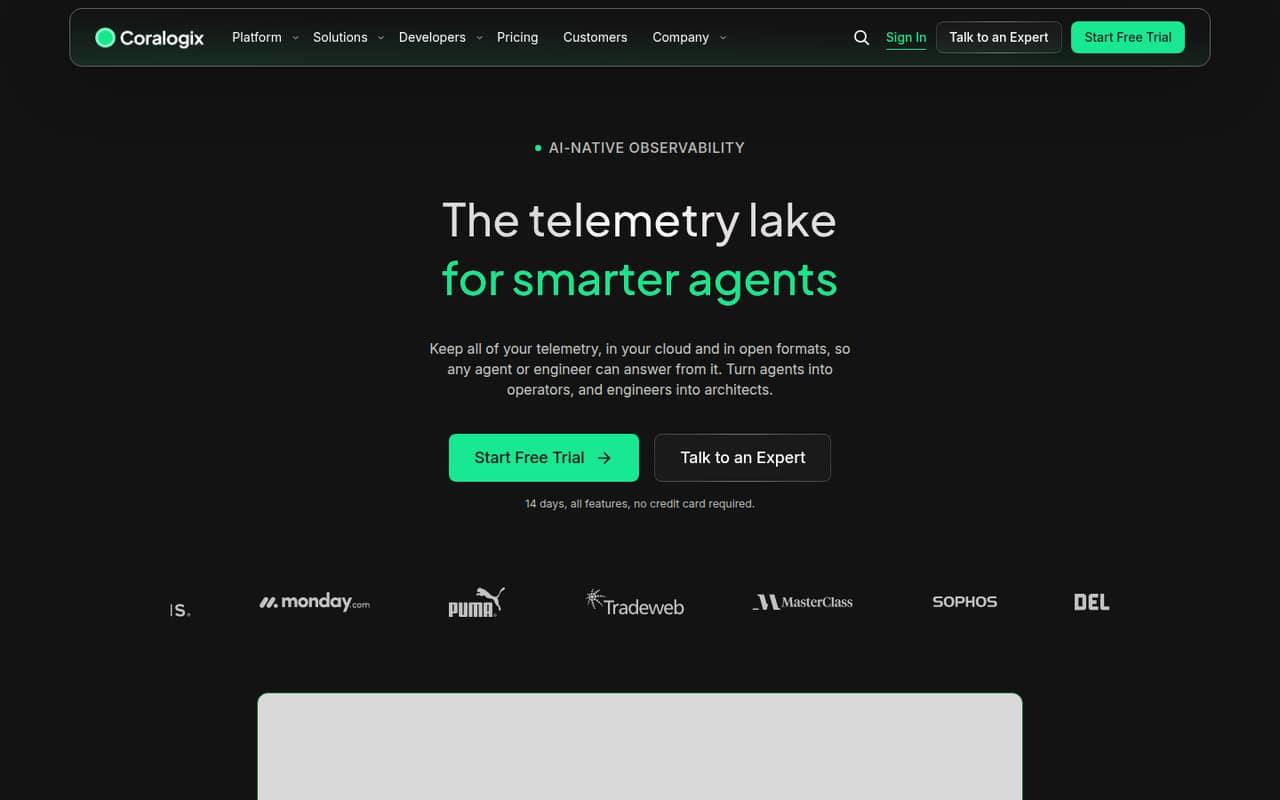
Coralogix ingests logs, traces, metrics and AI workload data, stores telemetry in your cloud in open formats, and offers cross-signal investigation through Olly, MCP and a CLI. Its per-unit pricing and customer-cloud storage are useful architectural distinctions; integration details and production limits need validation with the vendor.
Reddit discussion is limited and mostly compares observability approaches or describes migration planning, rather than evaluating Coralogix in detail. We would treat it as a candidate for teams prioritizing retained telemetry and AI-assisted investigation, then confirm its fit against their stack and expected volume.
Good fit if
- Teams keeping telemetry in their cloud
- Cross-signal investigation workflows
- CLI-driven investigation automation
Skip it if
- Teams requiring a published free tier
- Self-hosting as a hard requirement
- Buyers needing published rate limits
ScoresHow it rates
What works
- Stores telemetry in your cloud in open formats
- Logs, traces, metrics and AI have separate usage rates
- 14-day trial includes all features
- Unlimited sources and users on Logs and Traces
- Olly, MCP and CLI support different investigation workflows
What doesn't
- No ongoing free plan
- SDKs and supported languages need confirmation
- Pay-As-You-Go rate is not published
- License and self-hosting options are not published
- Security and compliance details need vendor confirmation
01What Coralogix is, technically
Coralogix is an observability platform that ingests telemetry, supports investigation across signals, and stores telemetry in the customer’s cloud in open formats. It sits between telemetry sources and the engineers or agents querying operational data: teams send data into the platform, then investigate it through Coralogix interfaces. The homepage describes an index-free design that stores the full record without indexing.
Investigation is available through Olly, a conversational interface for natural-language questions, follow-ups and related incidents; an MCP connector for surfaces such as Slack, PagerDuty or an IDE; and a CLI for scripted investigations and piping results into runbooks or CI/CD. The platform also supports cross-signal correlation and joins across live data or data in storage. Coralogix positions customer-cloud storage and open formats as a way to keep data portable. That is a vendor claim, not a guarantee that every query, workflow or dashboard migrates unchanged. Confirm how ingestion, access control and storage permissions fit your environment before adopting it.
02Coralogix API, SDKs and docs
The homepage names three developer-facing integration surfaces: Olly for conversational investigations, an MCP connector, and a command-line interface. MCP can surface Coralogix insights in Slack, PagerDuty or an IDE. The CLI is intended for scripted investigations, runbook output and CI/CD integration. These are practical ways to bring investigation into existing workflows without making the dashboard the only entry point.
The homepage does not name a REST API, SDKs, programming languages, package managers or specific CLI commands. Before implementation, check Coralogix’s documentation for supported SDKs and languages, authentication, ingestion protocols, query syntax, pagination and error handling. The homepage describes one unified syntax for querying data, but does not name it. It also describes reusable Datasets for dashboards and scoped data. Confirm their API and lifecycle behavior if you plan to manage them as code. For an initial evaluation, map your telemetry sources and the MCP or CLI workflows you need, then validate those against the vendor’s docs and your deployment requirements.
03Coralogix pricing for developers
Coralogix has no free plan. The vendor lists a 14-day trial with all features and no credit card required. After that, listed usage rates are $0.42 per GB for Logs, $0.16 per GB for Traces, and $0.06 per GB for Metrics. Metrics count 1 GB as 750 active time series. The AI plan costs $1.50 per 1 million tokens, measured monthly. These are usage charges, not monthly or annual subscriptions; usage units are counted daily except AI tokens.
Logs and Traces include infinite retention, storage in your bucket, and unlimited sources and users. Metrics include infinite retention and storage in your bucket. The pricing page lists S3 storage at an effective $0.003 per GB for logs and traces, and $0.000033 per GB for metrics. Pay-As-You-Go can allow ingestion up to twice the daily plan quota, but its rate is not published. Model costs using your expected daily ingestion and signal mix, plus storage; the listed rates do not provide a single monthly starting price. Ask Coralogix how quota enforcement and any additional infrastructure charges apply to your account.
04Coralogix: open source, self-hosting and lock-in
Coralogix describes itself as a platform that stores telemetry in your cloud in open formats of your choice. It says this keeps data portable and avoids lock-in. That can reduce dependence on a vendor-controlled storage format, but it does not establish that every Coralogix feature, query, dashboard or investigation workflow can be exported or recreated elsewhere.
The vendor does not publish an open-source license or a self-hosted server option on the vendor's site available here. Treat Coralogix as a vendor-operated platform integrated with customer-cloud storage, not as a self-hostable open-source project, unless the vendor confirms otherwise. Before adopting it, ask which formats are written, how to access and export stored records, whether you can query them without Coralogix, and what happens to platform-specific metadata when you leave. Also confirm whether data egress or migration support carries a charge. Open-format storage is a portability claim; it is not a complete exit plan.
05Coralogix in production
The homepage claims 99.9% platform uptime, alert detection under 1 ms and 10x data ingestion capacity. These are vendor-stated figures; confirm their definitions, measurement windows and contractual status before using them in an availability design. The pricing page describes daily usage units and a Pay-As-You-Go option that can allow ingestion up to twice the daily plan quota. Its rate is not published. Ask how the platform handles quota exhaustion, delayed ingestion and recovery, and request the applicable rate limits.
The homepage promotes customer-cloud storage and an index-free design, but it does not give security certifications, compliance coverage or specific access-control details. Confirm region availability, encryption, retention behavior, backups and responsibility boundaries with the vendor. Reddit discussion offers little direct product feedback: one r/devops post describes planning to migrate away from a legacy Coralogix and CloudWatch setup under a strict budget, while an r/kubernetes thread discusses other observability choices. Those comments are not enough to establish product reliability or typical cost. Test your own data volumes, query patterns and failure scenarios during the 14-day trial.
From the threadsWhat users say
Reddit discussion is sparse and does not establish a consensus on Coralogix itself. Comments mainly surface cost concerns and alternative observability approaches, so we would not treat them as a direct product verdict.
We’re currently planning a complete overhaul of our observability stack
Prometheus +Loki+Grafana. This is the way
Would recommend Fluent Bit in the cluster, which tails the pod logs and ships them to your log receiver of choice;
Any OpenTelemetry or OpenTelemetry-compatible agent can link the logs to the trace context
Questions people ask
What does Coralogix do?
Coralogix ingests telemetry for observability, stores it in your cloud in open formats, and provides tools to investigate and correlate data across signals. Its interfaces include Olly for conversational investigation, an MCP connector, and a CLI for scripted workflows.
How does Coralogix store telemetry?
Coralogix says it stores telemetry in your cloud in open formats you choose. Its homepage also describes an index-free design that stores the full record. Ask the vendor which formats, cloud regions and access controls apply to your deployment.
Does Coralogix have a free plan?
Coralogix does not list an ongoing free plan. It offers a 14-day trial with all features and no credit card required. After the trial, the listed Logs, Traces, Metrics and AI rates are usage-based.
Can I investigate Coralogix data from an IDE?
The homepage says Coralogix’s MCP connector can surface insights in an IDE, Slack or PagerDuty. It also offers Olly for chat-based investigations and a CLI for scripting investigations. Confirm specific IDE compatibility and setup requirements in the vendor’s documentation.
Where can I find Coralogix documentation?
Use Coralogix’s vendor documentation to verify setup and implementation details. Before building, look for the supported ingestion methods, SDKs and languages, authentication instructions, CLI commands, MCP setup, query syntax and limits relevant to your deployment.