
We may earn a commission if you buy through links on this page. It never changes a score or a ranking. How we make money
The bottom line
A capable TypeScript backend for reactive apps, with hosted-service lock-in and usage costs to weigh.
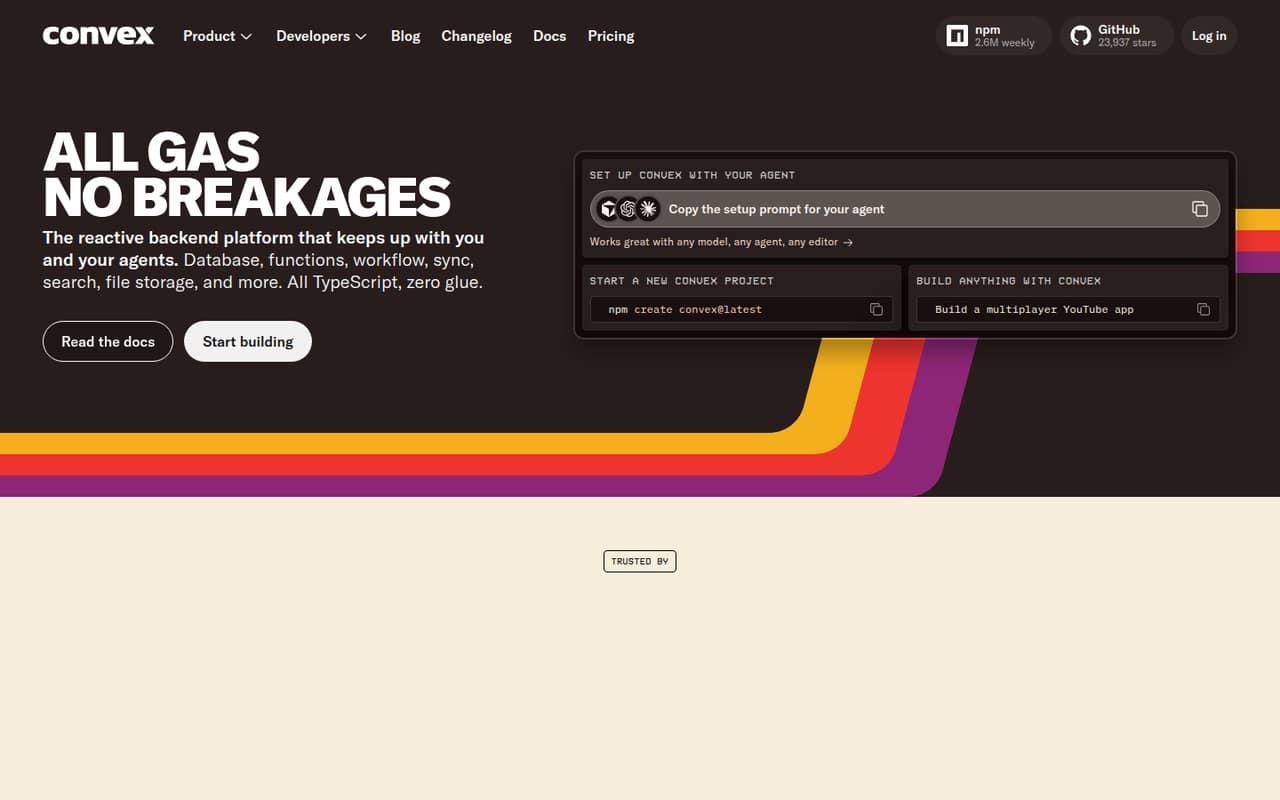
Convex is a hosted backend platform that combines a reactive database, TypeScript functions, real-time sync, workflows, search and file storage. It aims to replace pieces of a conventional stack with one backend and generated type-safe integration.
We’d consider it for apps that need live data and value keeping backend code in TypeScript. The free tier makes it accessible to start, but production costs depend on usage, and the hosted model raises questions about self-hosting, data export and migration.
Good fit if
- TypeScript apps with live data
- Teams consolidating backend services
- AI agents with multi-step workflows
Skip it if
- Teams requiring an open-source backend
- Workloads needing a documented self-host option
- Apps with strict infrastructure portability requirements
ScoresHow it rates
What works
- Reactive database with ACID transactions
- Backend functions written in TypeScript
- Real-time synchronization for current data
- Workflows can checkpoint, retry and resume
- Includes text and vector search
What doesn't
- A hosted platform creates vendor dependency
- Self-hosting and VPC availability need confirmation
- Usage overages add to plan costs
- Query scans can affect bandwidth costs, users report
- Data export and migration paths need clarification
01What Convex is, technically
Convex is a hosted backend platform: a reactive database and server-side TypeScript functions packaged with sync, workflows, search and file storage. It sits behind an app’s frontend, taking on work commonly split across a database, API layer, background-job system and storage service. The homepage describes ACID transactions for concurrent writes, automatic caching and scaling, and real-time sync that sends users the latest data.
That architecture is the main trade-off. A team can write backend logic in TypeScript and use Convex’s platform components rather than wiring separate services together. Workflows support multi-step processes that checkpoint, retry and resume; search includes text and vector search. Convex also presents tools for building AI agents, including built-in threads, context and vector search. It is not just a database library: the database, functions and platform services are part of a managed backend. Teams choosing it should account for that service boundary when they assess portability and operational control.
02Convex API, SDKs and docs
Convex uses TypeScript for backend functions. The homepage’s setup instructions use npm: start an empty project with npm create convex@latest . -- -t bare, or install convex in an existing project and add a convex dev script. For an existing Convex project, the instructions use npx convex ai-files install. The homepage also lists packages for work pools, workflows and agents: @convex-dev/workpool, @convex-dev/workflow and @convex-dev/agent.
The vendor describes an end-to-end type-safe stack and points developers to its docs. Its setup instructions include plugins for Claude Code and Codex. A Reddit commenter describes using Convex backend functions from React through useQuery and useMutation; confirm current client and framework support in Convex’s docs before choosing an integration. The homepage names TypeScript and npm-based setup, but does not enumerate other language SDKs or protocols. Teams that need a specific SDK, REST API, webhook or framework integration should verify its availability and support status with the vendor.
03Convex pricing for developers
Convex lists three monthly options. Free & Starter costs $0 and includes 1–6 developers, 40 deployments, 1M function calls and 0.5 GB of database storage. Starter is pay-as-you-go beyond the free tier. Professional costs $25 per developer per month and includes 1–20 developers, 300 deployments, 25M function calls and 50 GB of database storage. Business & Enterprise starts at a $2,500 monthly minimum, for 50+ developers, and lists unlimited deployments, dedicated deployments and SAML/SSO.
Overages can add up across function calls, action compute, database and search storage, database I/O, search queries and data egress. For example, Professional lists $2 per additional 1M function calls and $0.12 per GB of egress; Free & Starter lists $2.20 per 1M calls and $0.132 per GB of egress. The pricing page lists no extra developer-seat price. It gives monthly prices but no annual billing option. Check expected query scans and storage alongside function volume before estimating a production bill.
04Convex: open source, self-hosting and lock-in
Convex’s homepage presents a managed platform, not a self-hosting package, and marks “Convex in your VPC” as coming soon. A Reddit commenter describes Convex as not open-source; the homepage does not identify an open-source license. Treat it as a proprietary hosted service unless Convex confirms otherwise for your deployment and licensing needs.
The homepage and pricing details here do not describe a data-export format or a migration path. Ask the vendor how to export database records, files, indexes and application data, and whether exports preserve relationships and types. Moving away may also mean replacing Convex-specific functions, sync behavior, workflows and client integration, rather than swapping only a database driver. Those dependencies can be acceptable when the platform’s integrated backend is valuable, but they should be part of the architecture decision before production data accumulates.
05Convex in production
Convex’s homepage claims automatic caching and scaling, but those statements do not replace workload-specific capacity and reliability details. The homepage lists SOC 2 Type 2, HIPAA, and RBAC & SSO for enterprise; Business & Enterprise pricing lists SAML/SSO and dedicated deployments. Confirm which controls, regions, service commitments and support terms apply to your plan. The pricing details list usage allowances, not request-rate ceilings, so ask Convex about rate limits and what happens when a workload reaches them.
A commenter on r/nextjs reports that Convex charges bandwidth for documents scanned by queries and recommends .withIndex() and .withSearchIndex() over broad .filter queries. Treat that as a developer report and validate query-cost behavior with Convex’s current docs. Index design and usage monitoring matter if reads can touch many documents. Before launch, verify data export, recovery options, applicable compliance terms and the cost impact of peak traffic, search and egress.
From the threadsWhat users say
Reddit sentiment is mostly positive among developers who value consolidating backend work and integrating with React. Others question the hype, prefer open-source options, or report that query design and bandwidth costs were reasons to move on.
the integration with React is awesome
Less context switching, more shipping!
Convex incurs bandwidth costs for every document it scans
Questions people ask
What is Convex?
Convex is a hosted backend platform built around a reactive database and TypeScript functions. It also includes real-time sync, workflows, text and vector search, and file storage. It is designed to combine backend services that teams might otherwise assemble separately.
Is Convex like MongoDB?
Both provide database capabilities, but Convex is a broader hosted backend platform with TypeScript functions, real-time sync, workflows, search and file storage. Its homepage describes ACID transactions and a reactive database. Choose based on your data model, query needs and tolerance for a platform-specific backend.
Can I use Convex for free?
Yes. Free & Starter is listed at $0 per month and includes 1–6 developers, 40 deployments, 1M function calls and 0.5 GB of database storage. Starter is pay-as-you-go beyond the free tier, so check the listed overage rates before putting a workload on it.
Is Convex built on AWS?
Convex’s homepage does not identify its cloud provider. If your deployment depends on cloud-provider choice, region availability, data residency or subprocessors, ask Convex directly before committing. The homepage describes “Convex in your VPC” as coming soon.
Can I self-host Convex?
The homepage presents Convex as a managed backend and labels “Convex in your VPC” as coming soon. It does not list a self-hosting option. If you need to run the backend yourself, ask Convex about current deployment options and confirm what happens to your data if you later migrate.