
We may earn a commission if you buy through links on this page. It never changes a score or a ranking. How we make money
The bottom line
A capable hosted CMS platform; validate its complexity, limits and exit path before committing.
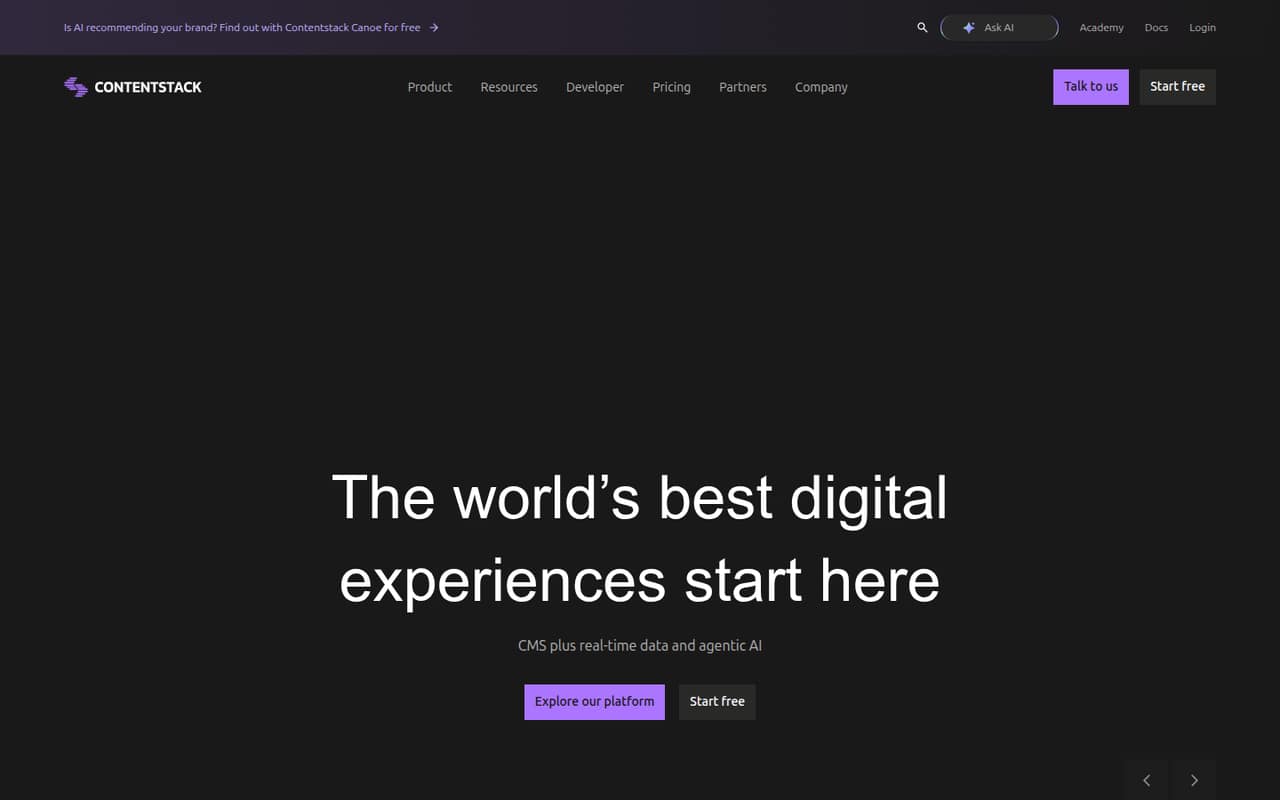
Contentstack combines a cloud-based, API-first headless CMS with personalization, customer analytics, asset management and front-end hosting. Its free tier and published usage allowances give developers concrete starting points, while the broader platform is aimed at teams managing more than content alone.
The trade-off is integration and operational uncertainty: the vendor’s homepage does not name SDKs, languages or API protocols, and details such as rate limits and data export need confirmation. One Reddit poster building a small Next.js project described the admin UI as clunky and more complex than needed; that is a single developer’s report, not a broad consensus.
Good fit if
- Teams managing content across channels
- Startups needing hosted CMS and hosting
- Enterprises adding personalization and analytics
Skip it if
- Small sites needing minimal CMS complexity
- Teams requiring self-hosted software
- Builders needing published SDK and rate-limit details
ScoresHow it rates
What works
- API-first, cloud-based headless CMS
- Free plan includes 100K API calls monthly
- Front-end hosting is built into the CMS
- Personalization uses AI and first-party data
- Integrated asset management and customer analytics
What doesn't
- Developer SDKs and languages are not named
- Small-project admin complexity concerns appear on Reddit
- Self-hosting and licence terms need confirmation
- Data export options need confirmation
- Rate limits and reliability terms need confirmation
01What Contentstack is, technically
Contentstack is a cloud-based, API-first headless CMS: a hosted content platform that separates content management from the front end. Applications retrieve and use content through Contentstack’s API rather than relying on a bundled page-rendering layer. It sits between editorial teams and the websites, apps or other experiences consuming that content.
The broader Contentstack AXP combines the CMS with customer data and AI agents. The platform also includes real-time personalization, customer analytics, asset management and front-end hosting. That makes its scope wider than a content repository: teams can manage content, use first-party data to personalize experiences, and deploy front ends through the platform.
For a developer, the basic architectural choice is whether a hosted CMS and related experience tools fit the existing stack better than a narrower CMS or a system the team operates itself. Contentstack is cloud-based; it is not presented as a library, CLI or self-hosted server. The vendor says its built-in front-end hosting lets content updates deploy without DevOps.
02Contentstack API, SDKs and docs
The homepage describes Contentstack as an API-first CMS and directs developers to its Docs, Developer learning space, Marketplace and Community. The practical integration surface is its API: model content in the CMS, then connect applications that consume it. The homepage does not name an API protocol, SDK, programming language, CLI, webhook or plugin interface. Confirm the supported SDKs, languages and integration methods in Contentstack’s developer docs before choosing it for a stack with specific requirements.
Contentstack also groups visual editing, asset management, front-end hosting and personalization into the platform. Those capabilities can reduce the number of separate services a team needs, but they also mean evaluating a broader platform than a content API alone. Ask how content models, environments and deployment workflows map to your application, and verify which capabilities are included in the plan you expect to use.
One Reddit poster building a Next.js project with roughly 40 landing pages called the admin UI clunky and more complex than needed. That is one developer’s account, but it is a reason to test the editorial workflow against the project’s actual content model.
03Contentstack pricing for developers
Contentstack has a Free plan at $0 per month. It includes one production stack, three users, 100K API calls per month, 100 GB bandwidth, 10 content types, 1K entries and 1K assets. Build costs $29 per month and raises those limits to 250K API calls, 250 GB bandwidth, 20 content types, 2.5K entries and 2.5K assets, with one production stack and three users.
Growth is $299 per month for one Launch project, 10 included users, 1M API calls, 1 TB bandwidth, 20K entries and 10K assets. Additional Growth users cost $25 per user per month. Enterprise is quote-based in the published plan table and starts at one or more Launch projects, 50 or more users, 500 custom roles, 6M or more API calls, 5 TB or more bandwidth, 150K entries and 500K assets.
Build offers pay-as-you-go overages, but rates are not published. Custom domains and Personalize may cost extra; those prices are also unpublished. Annual billing and its monthly equivalent are not published. Treat the included API and bandwidth allowances as quotas, and ask about overage costs and request-rate limits before launch.
04Contentstack: open source, self-hosting and lock-in
Contentstack is described as a cloud-based CMS, not as software to install and operate on your own infrastructure. The vendor should confirm whether any component is open source, which licence applies and whether self-hosting is available; do not plan around a self-hosted deployment without that confirmation.
The vendor should also explain how to export content, assets, customer data and content models, and whether exports preserve relationships and metadata. Those details affect the effort required to move to another CMS. Contentstack’s API-first architecture gives applications an integration surface, but API access alone does not establish that a complete migration export is available.
Before adopting it, ask for a sample export and document how the front end, personalization rules and data integrations would move. The broader the use of Contentstack’s hosting and data features, the more migration work may extend beyond copying CMS entries.
05Contentstack in production
The plans publish monthly API-call and bandwidth allowances, but those figures are not the same as per-second rate limits. Ask Contentstack for request throttling rules, overage behavior, uptime commitments, backup and recovery terms, and support response times. Confirm which security and compliance requirements apply to your deployment and plan; the homepage does not state those operational terms.
The platform’s cloud delivery and included front-end hosting can reduce infrastructure work, while the published quotas provide a starting point for capacity planning. They do not establish how the system behaves under a traffic spike or what happens when a quota is exceeded. Test your content model, delivery patterns and deployment process, and get the relevant limits in writing.
Developer sentiment in the available Reddit discussion is mixed but sparse. One poster said a Contentstack build for a relatively simple Next.js site felt more complex and less flexible than their PayloadCMS MVP. That is an individual report, not evidence of a general reliability problem, but it flags admin usability and project fit as practical risks.
From the threadsWhat users say
The available Reddit discussion is limited and mixed. One developer reported friction with Contentstack’s admin UI for a small Next.js project; the other post is a comparison question rather than a review.
At my day job, we are looking to migrate to a new CMS, and the two top options on the table are Contentful and Contentstack
the admin UI feels clunky, less flexible, way more complex for simple content management
clean, fast, flexible schema builder, great DX
I'll be happy to share our experience once we've decided
Questions people ask
Is Contentstack a headless CMS?
Yes. Contentstack describes its CMS as API-first, cloud-based and headless. It separates content management from the front end, so applications can consume managed content through its API. The platform also combines the CMS with personalization, customer analytics, asset management and front-end hosting.
What is Contentstack used for?
Contentstack is used to manage content for digital experiences, with additional platform capabilities for personalization, customer analytics, asset management and front-end hosting. Its AXP combines content, customer data and AI agents. Teams should confirm which features are included in their selected plan.
Does Contentstack offer a free plan?
Yes. The Free plan costs $0 per month and includes one production stack, three users, 100K API calls per month, 100 GB bandwidth, 10 content types, 1K entries and 1K assets. Build is the next listed plan at $29 per month.
Can I self-host Contentstack or export my content?
Contentstack is described as a cloud-based platform, not a self-hosted server. Confirm directly with the vendor whether self-hosting is available and what licence applies. Ask for export details covering content, assets, models, relationships and customer data before building a migration plan.
What should I check before using Contentstack in production?
Confirm API rate limits, overage behavior, uptime commitments, recovery terms, security requirements and support response times with Contentstack. The plan table lists monthly API-call and bandwidth allowances, but those do not explain per-second throttling or production reliability commitments.