
We may earn a commission if you buy through links on this page. It never changes a score or a ranking. How we make money
The bottom line
A hosted voice and messaging API with clear usage rates, but developer details need confirmation.
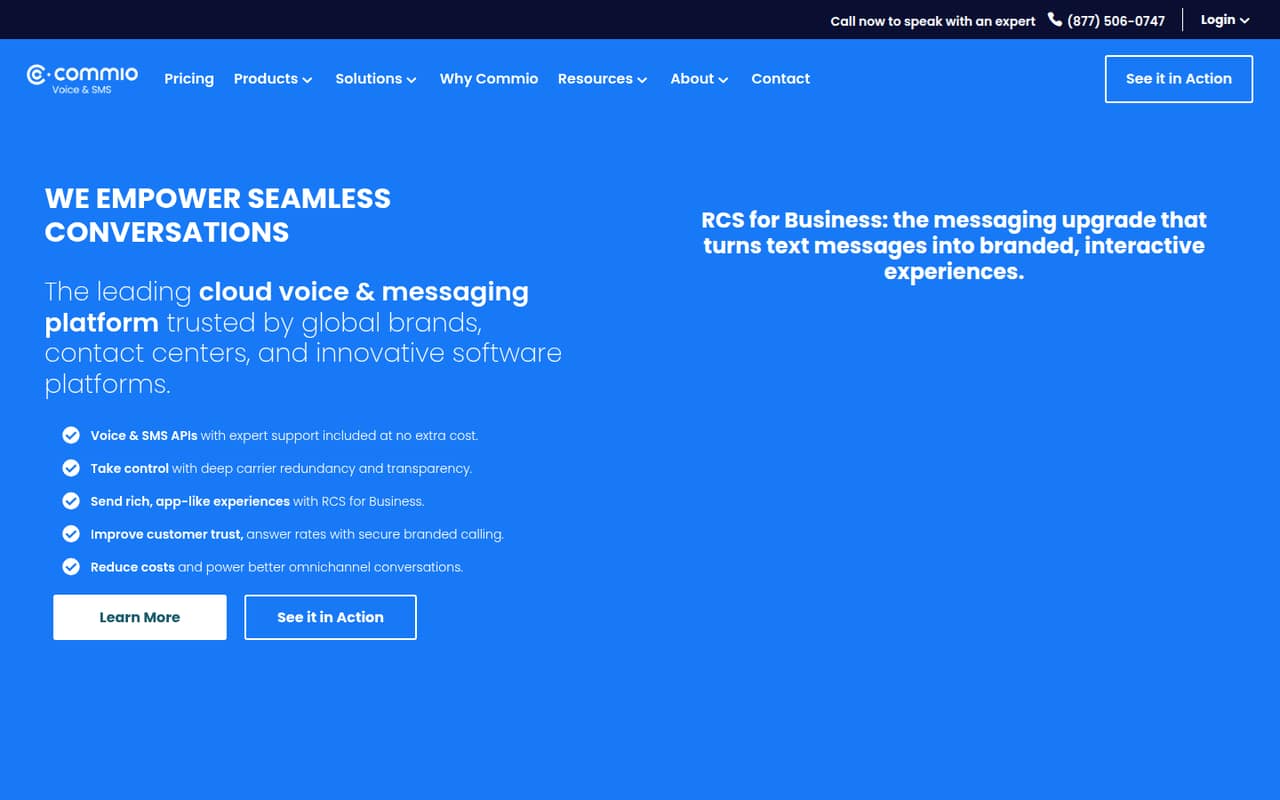
Commio is a hosted communications API for voice calls and messaging, with SMS/MMS, RCS for Business and branded calling. It also offers carrier redundancy, OneRate Voice and 24/7 U.S.-based support at no extra cost.
US48/Canada outbound voice starts at $0.007 per minute and long-code SMS at $0.0035 per segment. There is no free plan listed, and RCS setup, carrier surcharges, number activation and other services can add charges. Confirm API protocols, SDK support and production limits with Commio before building around it.
Good fit if
- Teams adding voice and messaging to software
- Contact centers needing branded calling
- Businesses that want carrier redundancy
Skip it if
- Projects that need a free tier
- Teams requiring self-hosted communications
- Developers needing published SDK details
ScoresHow it rates
What works
- Voice and SMS APIs for integrated conversations
- RCS supports images, buttons and product carousels
- Branded Calling ID supports Rich Call Data
- Published per-minute and per-segment rates
- 24/7 U.S.-based support at no extra cost
What doesn't
- No free plan or free trial is listed
- SDKs, languages and API protocols need confirmation
- RCS setup and brand vetting fees apply
- Carrier surcharges and campaign fees pass through
- Self-hosting and data export details are unpublished
01What Commio is, technically
Commio is a hosted cloud communications API platform, not a self-hosted server, library or standalone contact-center app. It provides voice and messaging services that an application can call to deliver phone calls and text conversations. SMS/MMS, branded calling and RCS for Business extend that communications layer beyond basic voice and text.
In a typical stack, Commio sits between your application and the carrier network. Your application decides when to contact a customer; Commio provides the communications service, with carrier redundancy and transparency as part of its offering. OneRate Voice is aimed at managing calling costs without negotiating with multiple carriers or managing call routes. SignatureCalling adds verified Branded Calling ID and Rich Call Data, while RCS supports branded, interactive messages with images, buttons and product carousels. Commio describes its platform as customizable and scalable, but teams should confirm the service boundaries and operating limits for their use case.
02Commio API, SDKs and docs
Commio describes its integration surface as voice and SMS APIs. Those APIs are the relevant building blocks for adding calls and text messaging to an application; the product also includes RCS for Business and branded-calling services. The vendor advertises an interactive walkthrough of its API platform, but the public product description does not establish an implementation workflow or code examples.
Before selecting a client library, confirm SDK support and API protocols in Commio’s docs. Ask which programming languages are supported and how authentication, callbacks or delivery events work. The vendor’s product description names no particular SDK, language, CLI, plugin or webhook interface, so do not assume support for a stack based on the API label alone. Also confirm whether your integration needs separate provisioning for local or toll-free numbers, RCS brand vetting, or caller ID. Commio advertises expert support around the clock at no extra cost, which can help answer integration questions, but it does not replace checking the API reference for your required operations.
03Commio pricing for developers
Commio lists usage-based Standard pricing, with no monthly subscription price, annual billing rate, free plan or free trial listed. US48/Canada outbound voice costs $0.007 per minute and inbound voice costs $0.005 per minute. Long-code SMS is $0.0035 per segment. Local numbers cost $0.25–$0.90 per month plus activation; toll-free numbers cost $0.99 per month plus activation.
RCS rich-text messages cost $0.006 per segment, both inbound and outbound, and setup and brand-vetting fees apply. Campaign fees and messaging carrier surcharges are passed through at cost. Other listed charges include E911 at $0.75 per month, unprovisioned E911/ECRC at $175 per incident, and Branded Calling ID at $0.08 per call plus setup and vetting fees. Local number activation is $0.25–$0.90; toll-free activation is $0.99. Porting and disconnect fees may also apply. Qualifying high-volume customers can request custom pricing. Model minutes, message segments, number rental and add-ons separately; ask sales for any unlisted setup or volume charges.
04Commio: open source, self-hosting and lock-in
Commio is presented as a hosted cloud platform. The vendor does not publish an open-source licence or a self-hosting option in its product materials, so teams should treat it as a proprietary service unless Commio confirms otherwise. The vendor also does not publish a data-export path there; ask what call, message, customer and configuration data can be exported, in which formats, and for how long it remains available.
Migration effort depends on how tightly your application couples itself to Commio’s APIs and service-specific features. Calls and messages may need to be routed through another provider, and branded calling, RCS interactions, number provisioning and carrier settings may need equivalents or redesign. Keep your own records of customer consent, messaging templates, call flows and delivery state where appropriate, and isolate provider-specific code behind an internal interface. Before committing, ask about number porting, data retention, account termination and any fees for disconnecting or moving numbers.
05Commio in production
Commio advertises carrier redundancy and transparency, but a production design still needs explicit details on failover behavior, service-level commitments and incident communication. Ask for API request limits, throughput limits, delivery guarantees, retry guidance and any limits that apply to voice, SMS, MMS or RCS. Those limits affect queue design and back-pressure; do not infer them from per-minute or per-segment pricing.
The published rates make variable charges visible, but production bills can also include carrier surcharges, campaign fees, number rental, activation, RCS setup and vetting, E911 and caller-ID services. Verify which charges apply to your traffic and how usage is reported. For security and compliance, confirm authentication, access controls, data handling, retention and relevant regulatory responsibilities with Commio. SignatureCalling is described as secure-by-design, but that claim does not establish the controls or compliance coverage for your wider application. The vendor lists U.S.-based support 24/7 at no extra cost; ask how to reach it and what response commitments apply.
Questions people ask
How much does Commio cost?
The Standard plan is usage-based. US48/Canada outbound voice costs $0.007 per minute, inbound voice $0.005 per minute and long-code SMS $0.0035 per segment. Monthly number fees, activation, carrier surcharges and optional services can add to the bill. Qualifying high-volume customers can request a custom quote.
Does Commio have a free plan or free trial?
Commio’s listed pricing has no free plan or free trial. Its Standard offer is usage-based, with per-minute voice and per-segment SMS charges, plus monthly number fees and activation where applicable. Ask Commio whether it offers a trial or evaluation arrangement for your intended use case.
What can developers build with Commio?
Commio offers voice and SMS APIs, including SMS/MMS messaging, branded calling and RCS for Business. RCS supports branded interactive messages with images, buttons and product carousels. The vendor also offers OneRate Voice for managing calling costs. Confirm the API operations and integration requirements with Commio before implementation.
Does Commio publish SDKs for specific languages?
Commio describes its integration surface as voice and SMS APIs, but its product description does not name SDKs or programming languages. Check Commio’s docs or ask the vendor which clients, protocols and examples are supported for your stack before choosing an integration approach.
Is Commio self-hosted, and can I export my data?
Commio is presented as a hosted cloud platform. The vendor does not publish an open-source licence, self-hosting option or data-export path in its product materials. Ask Commio about export formats, retention, number porting and the process for moving or disconnecting numbers before committing.