
We may earn a commission if you buy through links on this page. It never changes a score or a ranking. How we make money
The bottom line
Opik pairs agent tracing and evaluation with self-hosting; check its limits before production.
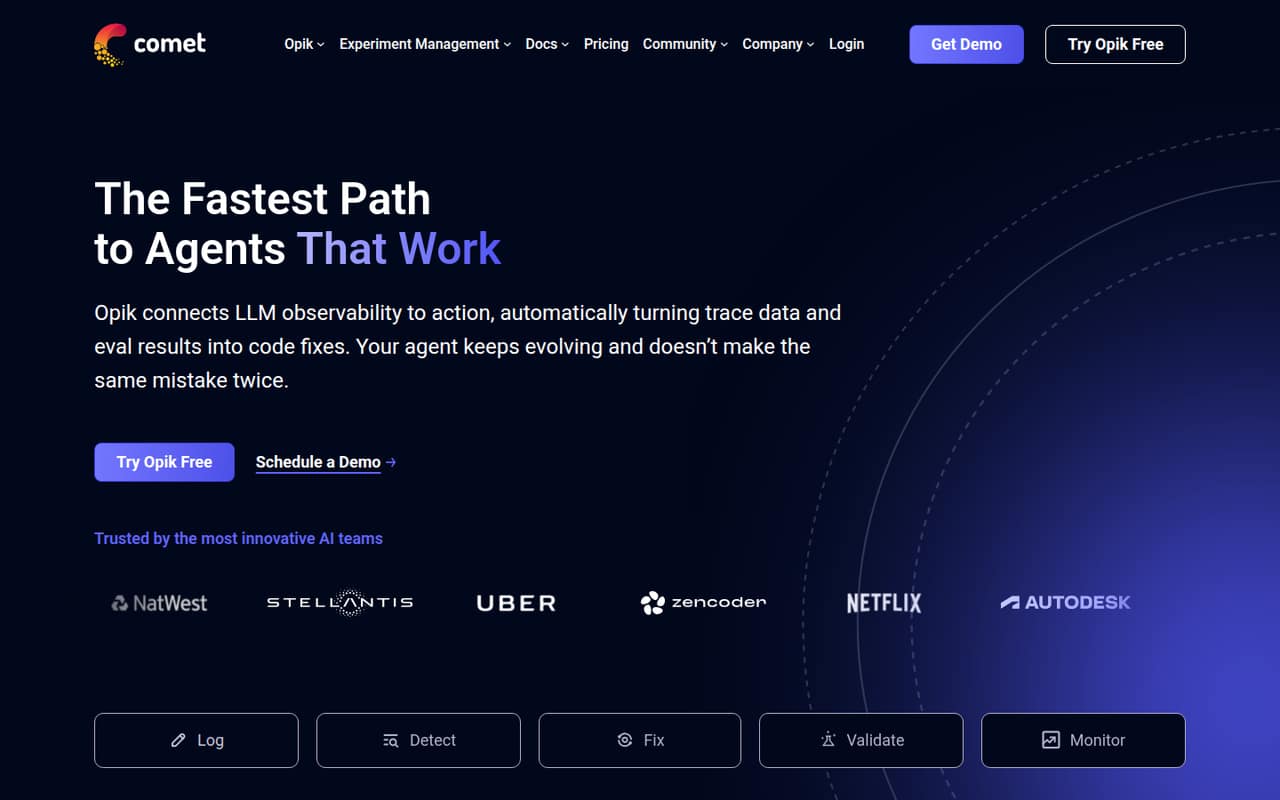
Comet’s Opik is an LLM observability and evaluation platform that sits alongside an application or agent. Its Python integration, LlamaIndex handler, 60+ integrations and MCP server connect trace data to debugging and evaluation workflows.
Teams can self-host the open-source version or use Opik Cloud. The free cloud tier caps usage at 25,000 spans per month and 10 team members; Pro starts at $19 per month for 100,000 spans and up to 50 members. Confirm deployment, retention and rate-limit requirements before relying on it in production.
Good fit if
- Teams debugging LLM agents
- Developers evaluating agent changes
- Teams needing self-hosted observability
Skip it if
- Projects needing published rate limits
- Teams requiring known licence terms
- Buyers seeking a general-purpose browser
ScoresHow it rates
What works
- Self-hosted open-source option
- Free Cloud tier includes 25,000 monthly spans
- Traces cover tool calls and retrieval
- Test Suites return pass/fail results
- MCP server connects trace data to coding agents
What doesn't
- Published rate limits are not available
- Exact open-source licence needs confirmation
- Ollie token prices are not published
- Enterprise pricing requires a custom plan
- MLOps add-on price is not published
01What Comet is, technically
Comet’s Opik is an LLM observability and evaluation platform: a hosted cloud service or open-source software teams can self-host. It sits beside an LLM application or agent, capturing traces of activity such as context retrieval, tool selection and user feedback. Teams use those records to inspect behavior, group recurring issues, test changes and monitor agents in production.
Opik also provides Test Suites with pass/fail results and dataset evaluations with LLM-as-a-judge metrics. Ollie analyzes traces and recommends fixes. These functions make Opik an operational layer around an application, not a model provider or a replacement for the application’s runtime. Comet’s broader product set includes MLOps tools for comparing training runs, model versions and datasets. The homepage also describes Cost Intelligence for Claude Code and Codex usage. Opik is available through Comet Cloud or as self-hosted open-source software, so teams can choose where the observability service runs.
02Comet API, SDKs and docs
The integration surface shown by Comet is a Python package and framework integrations, rather than a documented REST API workflow. The homepage’s Python example imports track from opik and uses decorators to instrument functions. It also shows a LlamaIndex integration configured with set_global_handler("opik"). The vendor says Opik supports 60+ integrations, but teams should confirm that their framework and SDK versions are covered in the Opik documentation.
Comet also offers an MCP server. The homepage presents it as a way for a coding agent to access trace information and says Diagnostics uses it to surface recurring problems. That puts traces into an agent-assisted debugging workflow without making MCP a substitute for application instrumentation. The homepage links to GitHub and shows code examples, but does not establish a CLI or enumerate supported programming languages beyond its Python examples. Confirm SDK support, deployment instructions and integration-specific setup in the vendor’s docs before choosing an instrumentation approach.
03Comet pricing for developers
Opik Open Source costs $0 per month for teams that self-host and includes observability and agent-testing features. Free Cloud is also $0, but is capped at 10 team members, 25,000 spans per month and 60-day data retention. Pro Cloud starts at $19 per month for up to 50 members and 100,000 spans, with 60-day retention; the plan allows customizable monthly span limits and retention.
Usage above Pro’s included span allowance costs $5 per additional 100,000 spans. Enterprise has unlimited members and custom usage plans, but its price is not published. Ollie’s coding harness has a free trial followed by token purchases; token prices are not published. The optional MLOps platform add-on is also unpriced. The pricing page lists monthly prices but does not state annual billing or discounts. Budget around spans first, then confirm custom limits, retention and any add-ons for the expected production workload.
04Comet: open source, self-hosting and lock-in
Comet describes Opik as open-source software and offers a $0 Open Source plan for teams that self-host. That gives teams a route to run the observability platform outside Comet Cloud. The vendor does not name the licence on the vendor's site available here, so confirm the current licence and its terms before adopting or modifying the software.
The cloud and self-hosted options reduce dependence on a single hosting model, but they do not by themselves establish how easily traces, datasets or evaluations can be exported. Ask Comet about export formats, API access and migration paths before storing long-lived operational history in Opik. If you self-host, the team takes on operating the service and its underlying infrastructure. The open-source option may reduce hosting lock-in, but a migration still depends on the portability of your data and evaluation workflows.
05Comet in production
Opik’s production features include dashboards, alerts, trace analysis and evaluation, and Comet says it can monitor agents across their production footprint. Its homepage says traces appear ready for debugging almost instantly, including at high volumes; treat that as a vendor claim and validate latency against your workload. Free Cloud and Pro Cloud both include 60-day retention by default. Pro allows teams to customize monthly span limits and retention, while Enterprise offers custom usage plans and flexible deployments.
The vendor does not publish request-rate limits on the pricing page, so ask about ingestion quotas, burst behavior and what happens when a span allowance is reached. Comet describes its platform as built for enterprise reliability and security, and lists SSO and dedicated support with SLAs for Enterprise. Confirm the applicable SLA, security controls, deployment architecture and compliance requirements with the vendor. Also check how alerts behave during ingestion delays and how usage is measured before putting the service on a critical debugging path.
Questions people ask
What is Comet AI?
Comet is a platform for machine-learning operations and AI application development. Its Opik product provides LLM observability, agent testing and evaluation. Teams instrument an application to capture traces, inspect behavior, test changes and monitor agents. Comet also offers MLOps tools for tracking model experiments and training runs.
Is Comet a browser?
Comet.com’s product is Comet’s Opik platform and MLOps tooling, not an agentic web browser. Opik is for tracing and evaluating LLM applications and agents. Teams considering it should assess its instrumentation, hosting and usage limits rather than browser features.
Can I self-host Opik?
Yes. Comet offers Opik as open-source software for self-hosting, with a $0 Open Source plan that includes observability and agent-testing features. Confirm the current licence, deployment requirements and data-export options with Comet before selecting it for a production stack.
What does Opik measure?
Opik records traces of LLM application and agent activity, including context retrieval, tool selection and user feedback. Teams can inspect traces, identify recurring issues, run Test Suites with pass/fail results and score datasets using evaluation metrics, including LLM-as-a-judge metrics.
Does Opik work with LlamaIndex?
Yes. Comet’s homepage shows a LlamaIndex integration configured through its global handler. It also provides a Python example using the opik package and says it supports 60+ integrations. Check the Opik documentation for current framework versions and setup instructions.