
We may earn a commission if you buy through links on this page. It never changes a score or a ranking. How we make money
The bottom line
Collaborator’s architecture, developer interfaces and product-specific capabilities are not established by SmartBear’s homepage.
SmartBear presents a portfolio of QA, API lifecycle, testing and observability products. Its homepage does not identify or describe Collaborator specifically, so we can’t confirm what role Collaborator plays in a software stack or what it does.
Pricing information lists Team and Enterprise plans and a 30-day free trial, but no prices. Before evaluating it, ask SmartBear for product-specific documentation, integration details, licensing terms and deployment options.
Good fit if
- Teams evaluating SmartBear products
- Buyers able to request product details
- Teams considering a 30-day trial
Skip it if
- Teams needing confirmed API documentation
- Buyers requiring published prices
- Teams requiring verified self-hosting
ScoresHow it rates
What works
- A 30-day free trial is listed
- Team plan is listed for up to 25 users
- Enterprise licensing is listed as unlimited based on licenses owned
- SmartBear describes a broad software-quality product portfolio
- SmartBear names GitHub, Jira, Jenkins and Azure DevOps integrations
What doesn't
- SmartBear’s homepage does not describe Collaborator
- Plan prices are not published
- Collaborator-specific API and SDK details are not established
- Collaborator’s licence and hosting options are unverified
- Product-specific limits and production requirements need confirmation
01What Collaborator is, technically
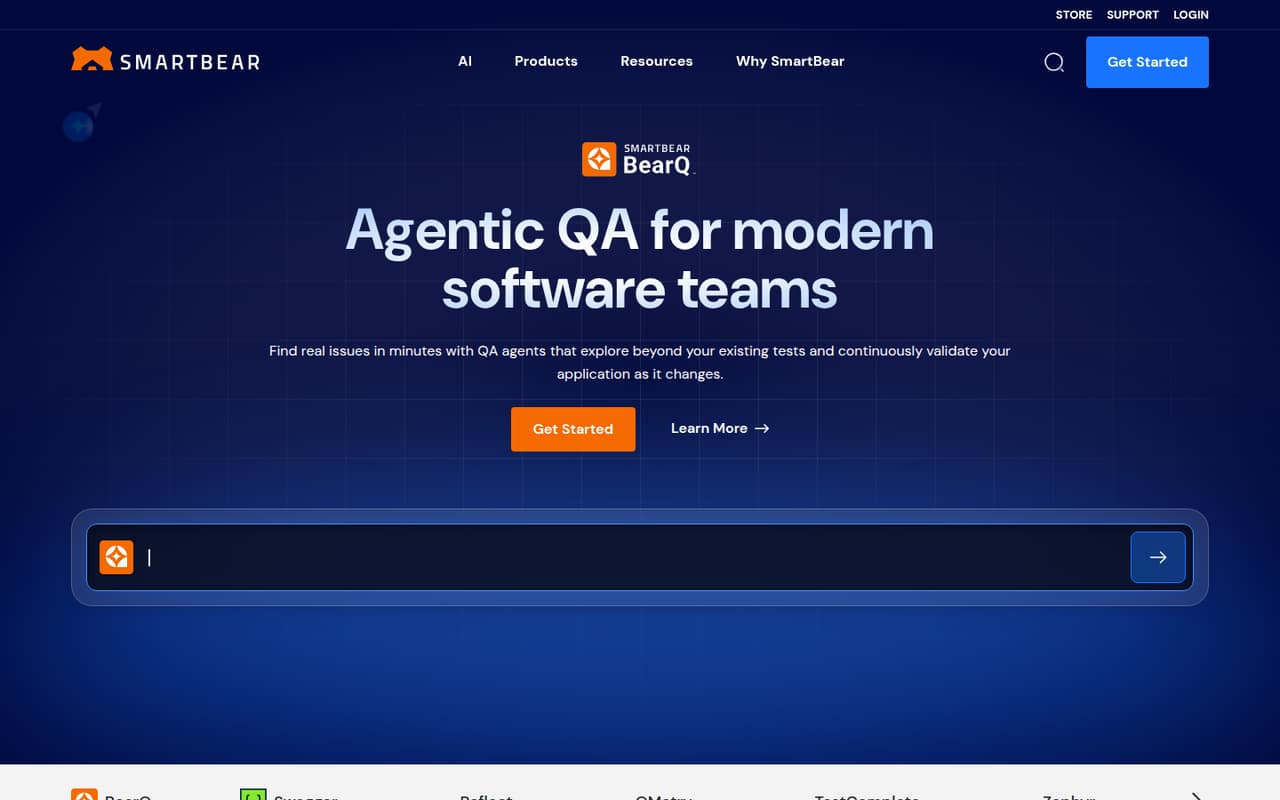
We can’t place Collaborator confidently in a stack from SmartBear’s homepage. The page presents SmartBear as a software-quality company with autonomous QA, API lifecycle management, web, mobile and API testing, and observability products. It names BearQ, Swagger, ReadyAPI, TestComplete, Reflect, Zephyr, QMetry and BugSnag, but does not identify Collaborator or describe its role.
That leaves the basic architectural questions open: whether Collaborator is a hosted SaaS application, a self-hosted server, a library or a CLI; what engineering problem it solves; and where it fits in development or CI/CD workflows. We should not treat capabilities attributed to SmartBear’s other products as Collaborator features. The homepage’s broad quality-workflow positioning is not enough to establish a Collaborator use case. Ask SmartBear for product-specific architecture and workflow documentation before deciding whether it belongs alongside code review, testing, API management or another part of your stack.
02Collaborator API, SDKs and docs
The SmartBear homepage names no Collaborator API, SDK, programming language, CLI, protocol or product-specific documentation. It also does not establish whether Collaborator offers REST endpoints, webhooks or plugins. Don’t assume that the API capabilities of Swagger or other SmartBear products apply to Collaborator; confirm SDK and API support in Collaborator’s documentation.
At the company level, SmartBear says its products integrate with GitHub, Jira, Jenkins, Azure DevOps and hundreds of other tools. That is a portfolio-wide statement, not confirmation that each integration is available in Collaborator. Before implementation, ask which integrations are supported by this product, whether they are configured through an API or UI, and what authentication and permission scopes they require. Also confirm documentation access, versioning and support for your languages and build system. Without those details, integration effort and maintenance cost cannot be estimated reliably.
03Collaborator pricing for developers
Pricing information lists a Team plan for up to 25 users and an Enterprise plan described as unlimited, based on licenses owned. Both list a 30-day free trial. It does not list a free plan, and prices are not published, so there is no confirmed starting price to compare with alternatives.
The available terms do not say whether billing is monthly or annual, how Enterprise licensing is counted, or whether pricing changes with seats, usage, requests or compute. They also do not identify add-ons or overage charges. That makes it impossible to model a production bill from the listed terms alone. Ask SmartBear for a written quote that covers expected users, license changes, trial conversion, renewal terms and any paid integrations or support. The Team ceiling is clear; the cost of reaching it, and the licensing steps beyond it, are not. Treat the plan names and trial as a starting point for a sales conversation, not a usable cost estimate.
04Collaborator: open source, self-hosting and lock-in
SmartBear says it supports open source and names Swagger, SoapUI, Stoplight and Pact in that context. Those are separate products; this company-level statement does not establish that Collaborator is open source or reveal its licence. The homepage also does not confirm whether Collaborator can be self-hosted, what data export options it provides or whether customers can access their stored data in a portable format.
We can’t responsibly characterize Collaborator as either hosted-only or self-hostable without product-specific terms. Before adopting it, ask for the licence and deployment options, data-retention policy, export formats, and a documented offboarding process. If Collaborator stores review or workflow data, establish how that data can be extracted and what remains usable after cancellation. Migration difficulty depends on those answers and on the product’s actual integrations; neither is established by the homepage.
05Collaborator in production
SmartBear’s homepage does not give Collaborator-specific rate limits, service-level commitments, uptime figures, scaling guidance, security controls or compliance certifications. It also does not establish how the listed license limits relate to concurrent work, stored data or integrations. Those details matter before making a tool part of a release process or relying on it for team-wide workflows.
Ask SmartBear for the product’s operational documentation: availability commitments, maintenance windows, backup and recovery terms, data residency, access controls, audit logs and incident response. Confirm what happens when a Team exceeds 25 users and how Enterprise licenses are counted, changed and renewed. If there is an API or CI/CD connection, request its limits and failure behavior, then decide how your pipeline handles timeouts or service outages. Until those answers are in hand, treat production fit and operational risk as unresolved rather than assuming SmartBear’s broader platform claims apply to Collaborator.
Questions people ask
What does Collaborator do?
SmartBear’s homepage does not identify or describe Collaborator specifically. It presents the company’s broader portfolio of QA, API lifecycle, testing and observability products, but those capabilities cannot be assigned to Collaborator from that page. Ask SmartBear for product-specific documentation and a description of its intended workflow.
Does Collaborator have an API or SDK?
The SmartBear homepage does not establish whether Collaborator has an API, SDK, CLI or supported programming languages. It names integrations for SmartBear products at the company level, including GitHub, Jira, Jenkins and Azure DevOps. Confirm Collaborator’s own API and integration support in its product documentation.
How much does Collaborator cost?
Pricing information lists a Team plan for up to 25 users and an Enterprise plan described as unlimited based on licenses owned. Both list a 30-day free trial. Prices are not published, and the available terms do not state billing frequency, so ask SmartBear for a quote based on your team and licensing needs.
Can Collaborator be self-hosted?
SmartBear’s homepage does not establish whether Collaborator is hosted, self-hosted or available in more than one deployment model. Ask the vendor which options are supported, what infrastructure they require and whether deployment choice affects licensing, updates, support or access to integrations.
Does Collaborator integrate with GitHub or Jira?
SmartBear says its products integrate with GitHub, Jira, Jenkins, Azure DevOps and hundreds of other tools. That statement covers its portfolio and does not confirm which integrations Collaborator supports. Ask SmartBear for the Collaborator-specific integration list and details on setup, permissions and supported workflows.