
We may earn a commission if you buy through links on this page. It never changes a score or a ranking. How we make money
The bottom line
A straightforward hosted code-quality review service, with a useful public tier and key paid-plan details unpublished.
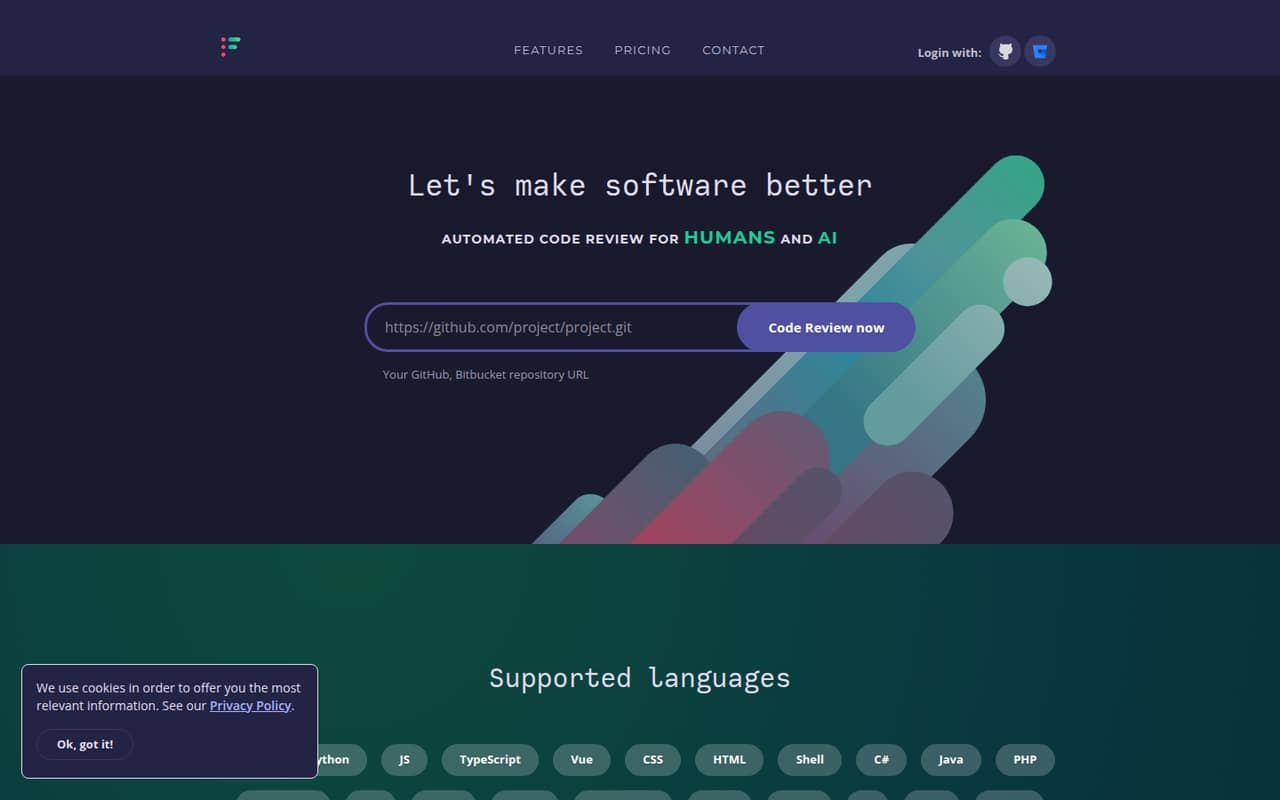
CodeFactor is a hosted code-review and quality-analysis service for GitHub and Bitbucket repositories. Its homepage lists many languages and analysis tools, and displays grades for public open-source projects. The workflow shown is repository-based, not a documented API or command-line integration.
The Community plan is free for unlimited public repositories and users, but excludes private repositories. Pro and Pro Max list additional repository and branch limits, while their prices and private-repository limits are unpublished. Confirm those terms, along with automation and data-handling requirements, before using it in a production workflow.
Good fit if
- Teams reviewing public repositories
- GitHub and Bitbucket users
- Projects seeking broad language coverage
Skip it if
- Teams requiring known private-repository costs
- Developers needing documented API automation
- Organizations requiring self-hosting
ScoresHow it rates
What works
- Free Community plan includes unlimited public repositories
- Unlimited users on the listed plans
- Supports a broad set of programming languages
- Names familiar tools such as ESLint and Pylint
- Shows grades for public open-source repositories
What doesn't
- Pro and Pro Max prices are unpublished
- Private-repository limits are unpublished
- No API, SDK or CLI workflow is listed
- Self-hosting and data-export terms are unpublished
- Pro limits repositories to two branches and 2GB
01What CodeFactor is, technically
CodeFactor is a hosted code-review and code-quality service for repositories on GitHub and Bitbucket. It sits alongside a source-control workflow: the homepage offers sign-in with either platform and a field for a repository URL, then presents automated review and code-quality ratings. It is not presented as a library, CLI or self-hosted server.
The service aims to surface code-quality issues across supported languages using named linters and analyzers, with grades that summarize repository quality. The homepage lists languages including Python, JavaScript, Java, Go and Ruby, plus tools such as ESLint, Pylint and ShellCheck. It also displays grades for public open-source repositories, so teams can inspect the kind of output CodeFactor presents.
For a codebase, the practical fit is a hosted analysis step associated with GitHub or Bitbucket. Confirm how repository access, review triggers and results fit your existing pull-request and CI workflows before relying on it as a required check.
02CodeFactor API, SDKs and docs
The integration surface CodeFactor names is GitHub and Bitbucket: users can sign in with either and submit a repository URL. The homepage frames the product as automated review for humans and AI, but does not present an API workflow. It also names no SDK, supported programming language for client libraries, CLI, webhook or plugin. Treat it as a repository-connected web service unless the vendor confirms additional integration options.
The listed analysis languages are repository languages, not SDK languages. CodeFactor lists Python, JavaScript, TypeScript, Java, Go, Ruby, Rust, C#, PHP, Swift, Kotlin and others. Its analysis-tool list includes ESLint, Pylint, ShellCheck, Yamllint, Trivy and many more. That breadth may help teams with mixed-language repositories, but the homepage does not establish which tool versions or configurations users can control.
Before automating setup or making CodeFactor a CI gate, confirm API and SDK support, review triggers, configuration options and documentation with the vendor. Check whether results can be consumed by your existing checks rather than only viewed in its interface.
03CodeFactor pricing for developers
The Community plan costs $0 per month and includes unlimited users and unlimited public repositories, with zero private repositories. It suits open-source projects and teams that only analyze public code; it does not cover private codebases.
Pro is for teams needing private repositories. The plan lists unlimited users, unlimited public repositories, two branches per repository and a 2GB maximum repository size. Pro Max lists unlimited users, unlimited public repositories, unlimited branches and unlimited repository size subject to a Fair Use Policy. Both paid plans leave the private-repository limit unpublished, and neither has a published monthly or annual price. The pricing page says annual billing can save up to 20%, but does not show annual prices.
The listed plans do not provide enough information to estimate a paid bill or identify usage-based charges, seat fees, overages or add-ons. Those terms are not published on the vendor's site. Ask CodeFactor for a quote that covers the number of private repositories, repository sizes, branch needs and any usage or billing limits. The free tier has a clear price; production budgeting for private repositories does not.
04CodeFactor: open source, self-hosting and lock-in
CodeFactor analyzes open-source repositories, but that does not establish that CodeFactor's own software is open source. The vendor does not publish a source-code licence or self-hosting option in the product details available here. The service is presented as hosted, with GitHub and Bitbucket as its named repository integrations.
The vendor also does not publish data-export or migration terms. Before connecting repositories, ask what repository data and analysis results CodeFactor stores, whether results can be exported in a reusable format, and what happens to stored data when an account is closed. Those answers affect how much work it would take to replace CodeFactor with another hosted analyzer or an internal tool.
The basic analysis is based on code already held in GitHub or Bitbucket, but grades, configuration and historical results could be service-specific. Confirm portability rather than assuming those records transfer with your repository.
05CodeFactor in production
The published plan limits matter if CodeFactor is part of a production review workflow. Pro lists two branches per repository and a 2GB maximum repository size; Pro Max removes those listed caps, but subjects unlimited repository size to a Fair Use Policy. The private-repository count is unpublished for both paid plans, so get that limit in writing before onboarding a large organization.
The vendor does not publish rate limits, service-level commitments, availability figures or documented behavior for failed or delayed analysis in the details available here. Confirm how reviews are triggered, what happens when the service is unavailable, and whether a result can block a merge. Avoid making an external service a required gate until you understand its failure behavior.
For security review, ask how repository access is authorized and revoked, what code or metadata is retained, and what security and compliance documentation is available. Also confirm data deletion and export terms. The homepage's language and analyzer lists establish breadth, but not version pinning or control over analyzer configuration.
Questions people ask
Is CodeFactor free?
CodeFactor's Community plan is listed at $0 per month. It includes unlimited users and unlimited public repositories, but zero private repositories. Pro and Pro Max are the listed options for teams that need private repositories; their prices and private-repository limits are unpublished.
Does CodeFactor support GitHub and Bitbucket?
Yes. CodeFactor's homepage offers sign-in with GitHub and Bitbucket and a field for a repository URL from either service. Confirm with the vendor how reviews are triggered and whether the integration fits your pull-request or CI workflow.
Which programming languages does CodeFactor analyze?
The homepage lists languages including Python, JavaScript, TypeScript, Vue, CSS, HTML, Shell, C#, Java, PHP, Go, Ruby, Swift, Rust, Kotlin and R. It also names analyzers such as ESLint, Pylint and ShellCheck. Confirm supported versions and configuration options with the vendor.
Does CodeFactor have a public API, SDK or CLI?
The homepage names GitHub and Bitbucket sign-in and repository URL submission as integration paths, but does not present an API, SDK or CLI workflow. Ask CodeFactor whether it supports the automation and result access your CI or developer tooling requires.
Can CodeFactor be self-hosted?
The product is presented as a hosted service, and the vendor does not publish a self-hosting option in the product details available here. If your deployment or data-residency requirements rule out hosted analysis, ask CodeFactor directly about deployment choices and data handling.