We may earn a commission if you buy through links on this page. It never changes a score or a ranking. How we make money
The bottom line
Useful CI coverage and PR feedback, with reliability and security concerns to weigh.
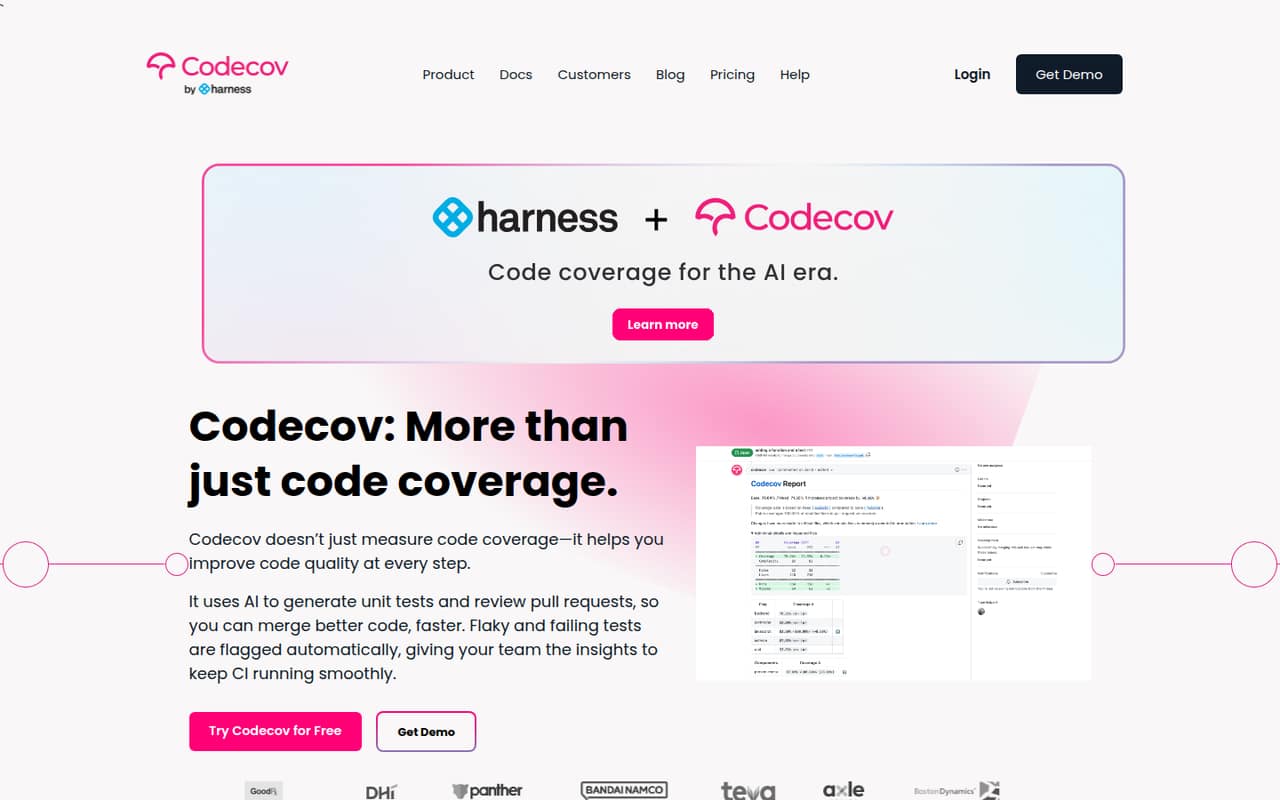
Codecov is a hosted code-coverage service that consumes CI coverage reports and adds analysis to pull requests. It also offers flaky-test insights, test-performance tracking, JavaScript bundle tracking, and AI-generated unit tests.
Its broad language and CI support make it easy to consider, and the free Developer plan covers unlimited public uploads. But teams should validate report reliability, protect CI credentials, and confirm current self-hosting and licensing terms before making it a required merge check.
Good fit if
- Teams adding coverage to pull requests
- Open-source projects with public uploads
- JavaScript teams tracking bundle size
Skip it if
- Teams requiring guaranteed coverage accuracy
- Organizations needing clear self-hosting terms
- Projects unwilling to secure CI credentials
ScoresHow it rates
What works
- Supports many languages, CI systems, and code hosts
- Coverage analysis appears in pull requests
- Free plan includes unlimited public uploads
- Tracks flaky tests and test-suite performance
- Tracks JavaScript bundle changes and size limits
What doesn't
- Developers report missed or inconsistent coverage
- A historical uploader compromise exposed CI supply-chain risk
- Private uploads are capped on Developer and Team
- API and SDK support needs verification in vendor docs
- Self-hosting license terms need careful review
01What Codecov is, technically
Codecov is a hosted code-coverage service that sits alongside your CI pipeline and code host. Your test suite produces coverage data; Codecov ingests it and presents coverage changes and risk insights in pull requests. The homepage also describes AI-generated unit tests, flaky-test reporting, test-suite performance tracking, and JavaScript bundle-size checks.
That makes Codecov an analysis and feedback layer, not a replacement for your test runner or coverage instrumentation. Its place in the stack is after tests run and before or during code review: CI uploads coverage, then reviewers use PR feedback to decide what needs attention. The service works with many languages, CI platforms, and code hosts, including GitHub Actions, GitLab CI, Jenkins, GitHub, GitLab, and Bitbucket. The homepage also advertises an official GitHub Action in the context of login and onboarding. Teams should decide whether coverage is an advisory signal or a merge gate; a percentage alone does not establish test quality.
02Codecov API, SDKs and docs
The main integration surface is the CI pipeline: run tests with your existing tools, upload coverage, and review Codecov's analysis in a pull request. The homepage names integrations with GitHub Actions, GitLab CI, Travis CI, CircleCI, Jenkins, Azure Pipelines, Bitrise, and other CI systems. Supported code hosts include GitHub, GitLab, Bitbucket, GitHub Enterprise, GitLab CE / EE, and Bitbucket Server.
Codecov lists language support for Python, JavaScript, Ruby, Go, Rust, JavaScript's TypeScript, C, C++, C#, PHP, Swift, and many others. It describes coverage for any language, CI tool, test suite, and code host. Its homepage does not name a public API style or language-specific SDKs; confirm API and SDK support in the vendor's docs before planning a custom integration. The product also advertises PR comments, status checks for bundle-size limits, and copy-and-pasteable test names and stack traces for rerunning flaky tests. Check the docs for the specific uploader, configuration, and CI permissions your workflow requires.
03Codecov pricing for developers
Codecov's Developer plan costs $0 per month. It includes one user for private repositories, 250 private uploads per month, unlimited public uploads, and unlimited repositories. That can suit open-source projects, but a private project can hit the monthly upload cap or need more than one private-repo user.
Team is $5 per user per month, or $4 per user per month on the annual-price listing. It allows up to 10 users and includes 2,500 private uploads per month, unlimited private and public repositories, and unlimited public uploads. Pro is $12 per user per month, with unlimited users and private and public uploads, plus flags, carryforward flags, components, and project coverage. Enterprise has custom pricing, a custom user limit, unlimited uploads, dedicated IP allowlisting, and faster processing.
The pricing page lists a 14-day free trial. It lists no add-ons. No overage rates are stated, so ask what happens when a plan reaches its upload cap and how any upgrade is billed. Team's annual rate is listed; an annual Pro rate is not.
04Codecov: open source, self-hosting and lock-in
Codecov has published self-hosted code, but its licensing status needs scrutiny. In a Reddit discussion about the release, commenters corrected the claim that Codecov was open source, pointing to a Business Source License and a delayed transition to an open-source license. Check the current repository license and permitted use with Codecov before treating self-hosting as an option for production.
The hosted product is integrated into CI and code-host workflows, so migration means replacing report ingestion and pull-request feedback as well as preserving coverage checks. Keep test instrumentation and coverage files in your own build process, and retain the relevant CI configuration in version control. The vendor's pages here do not describe a data-export path; ask how to export historical reports and settings before committing to a long-term deployment. If you cannot run the self-hosted code under its current terms, plan for the hosted service or another coverage provider rather than assuming source availability removes lock-in.
05Codecov in production
The key production limits are plan-based upload caps and the reliability of the full CI-to-report path. Developer includes 250 private uploads per month; Team includes 2,500. The pricing page does not state an overage rate, so confirm behavior at the cap before making uploads part of a required workflow. The vendor also advertises faster processing and dedicated IP allowlisting on Enterprise.
Developers on Reddit report missed or inconsistent coverage, upload failures with EPIPE connectivity errors, and teams disabling some or all coverage checks. Those are user reports, not a published service-level guarantee. Coverage can also fall when covered code is removed, which may be correct while still making a simple percentage a poor merge gate.
Security deserves a separate review: Reddit discussions of a historical Bash uploader compromise describe concern about CI secrets and the official GitHub Action. Treat any CI uploader as code running in a privileged environment. Pin and verify third-party actions according to your policy, limit token scope, and ask Codecov about current security controls, incident response, and compliance evidence.
From the threadsWhat users say
Codecov's broad integrations and pull-request feedback attract teams looking to make coverage visible in review. Reddit sentiment is mixed to negative, with reports of coverage inconsistencies and concern about a historical uploader compromise.
It was unreliable enough that we had to shut it off on the big open source project I was involved with
Coverage is indeed largely useless. I read something recently that said "Delete all of your checks/asserts from your tests and check your coverage again. It's going to be the same. How do you feel about your tests now even though coverage is unchanged?
It's kind of crazy how many secrets and keys they might have gotten access to
The pigs remain grounded. Business Source License is not open source, as explicitly stated in the license text
Questions people ask
How does Codecov work?
Your test suite generates coverage data, which CI uploads to Codecov. Codecov analyzes the report and provides coverage and risk feedback in pull requests. It also offers flaky-test insights, test-performance tracking, and JavaScript bundle-size tracking. Your existing test runner and coverage instrumentation remain part of the workflow.
Which languages and CI systems does Codecov support?
Codecov lists support for languages including Python, JavaScript, Ruby, Go, Rust, C#, C++, PHP, Swift, and TypeScript. Its listed CI integrations include GitHub Actions, GitLab CI, Travis CI, CircleCI, Jenkins, and Azure Pipelines. Confirm the current integration instructions for your specific version and workflow in Codecov's docs.
Can Codecov block a pull request?
Codecov provides pull-request coverage analysis and status checks for JavaScript bundle-size limits. Whether coverage blocks a merge depends on how you configure your repository and branch protections. Decide whether coverage changes should be advisory or required, and avoid treating a coverage percentage as a substitute for reviewing test assertions.
Does Codecov generate unit tests?
Codecov advertises AI-generated unit tests intended to help improve pull-request coverage. The homepage does not detail model options, usage limits, or supported languages for generation. Check the product documentation and plan terms to confirm whether the feature fits your codebase and review process.
Can Codecov track flaky tests?
Codecov says it flags flaky and failing tests, identifies which lines failed which tests, and provides test names and stack traces to help rerun them. It also tracks test-suite performance over time. Confirm which CI and test-runner integrations support the specific flaky-test workflow you want to use.
Sources
- Codecov homepage
- Codecov pricing page
- Reddit: Twilio's private GitHub repositories cloned by Codecov attacker, cloud comms platform confirms
- Reddit: Codecov's Bash Uploader for Coverage Reports Compromised
- Reddit: Is anyone having a hell of a time with CodeCov recently? (past 2-3 years)
- Reddit: Codecov is now Open Source