
We may earn a commission if you buy through links on this page. It never changes a score or a ranking. How we make money
The bottom line
A hybrid platform for governed data and AI, with usage-based rates and few public integration details.
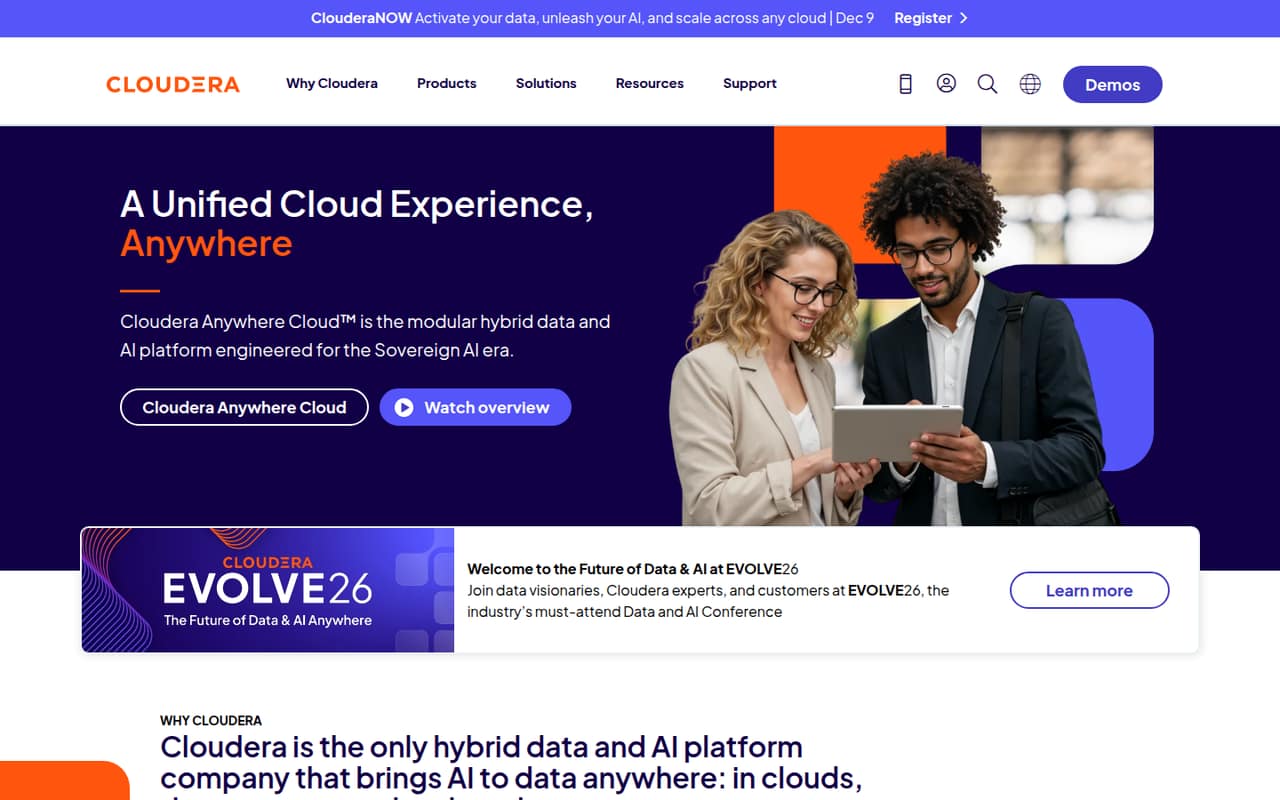
Cloudera Data Platform is a modular hybrid data and AI platform for running workloads across public clouds, data centers and the edge. Its stated capabilities cover data management, analytics, AI, governance, real-time data movement and an Apache Iceberg-based lakehouse.
The fit depends on how much of that platform you need and where your data lives. Cloud components have published hourly or invocation rates, but monthly totals and many usage limits are not published. Confirm integrations, deployment requirements and a workload estimate with Cloudera before committing.
Good fit if
- Teams operating across cloud and data centers
- Enterprises with governed data estates
- Data teams adopting Apache Iceberg
Skip it if
- Small projects needing a free tier
- Teams seeking a documented SDK-first API
- Buyers requiring fixed monthly pricing
ScoresHow it rates
What works
- Targets public cloud, data centers and edge
- Uses Apache Iceberg for its open lakehouse
- Combines data, analytics and AI capabilities
- Lists hourly rates for multiple cloud services
- Offers on-premises product options
What doesn't
- No free plan or trial is listed
- Monthly totals are not published for cloud rates
- Seat and usage limits are not published
- Homepage does not name SDKs or programming languages
- Platform licence and migration details need confirmation
01What Cloudera Data Platform is, technically
Cloudera Data Platform is a modular hybrid data and AI platform, not a single-purpose hosted API, SDK or command-line tool. It is designed to run data and AI workloads across public clouds, enterprise data centers and the edge. In a stack, it sits across data storage and processing, analytics, governance and AI deployment, with services intended to operate close to governed data.
The platform addresses a common enterprise setup: data and workloads spread across different environments, with a need to manage access and move or analyze data across them. Cloudera describes an open data lakehouse powered by Apache Iceberg, unified security and governance, real-time data movement, and private AI deployment where data lives. The product is modular, so teams should identify which services they need rather than assume every capability comes as one fixed package. The homepage does not establish a single deployment architecture or explain how each service connects to an existing stack; confirm those details for your environment.
02Cloudera Data Platform API, SDKs and docs
Cloudera presents a platform for data workloads, not a developer API with a named request protocol. Its homepage identifies Apache Iceberg as the lakehouse foundation and describes processing data from sources to destinations across hybrid environments. It does not name programming languages, SDKs, a CLI, REST endpoints, webhooks or plugins. Confirm supported SDKs and service-specific integration methods in Cloudera’s documentation before designing an application around them.
The integration work is likely to depend on the components selected: data engineering, data flow, data warehouse, operational database, AI workbench or inference, among others. The homepage does not explain their API contracts, authentication methods, compatibility matrices or versioning. Ask Cloudera for the relevant service documentation and examples, then check how each component connects to your storage, identity and deployment systems. Treat Apache Iceberg as a stated data format choice, not evidence that every part of the platform uses the same interface.
03Cloudera Data Platform pricing for developers
The pricing page lists no free plan or free trial. Cloud services are priced mainly per CCU per hour: AI Workbench (Machine Learning) is $0.20, AI Inference $0.25, Data Hub $0.04, Data Warehouse $0.07, Operational Database $0.08, Observability Premium (Cloud) $0.009, and Flow Management on Data Hub $0.15. Data Engineering lists Core at $0.07 and All-Purpose at $0.20 per CCU per hour. Data Flow Deployments and Test Sessions are $0.30 per CCU per hour; Functions start at $0.10 per billable invocation.
Private Link Network is $0.50 per VPC per hour, plus $5 per authorization. Lakehouse Optimizer compute is $0.05 per CCU, with its billing interval not published. On-premises rates include Observability at $80 per CCU per year, Data Visualization at $2,000 per user per year and GPU Acceleration at $7,500 per CGU per year. Cloud monthly totals and many usage limits are not published, so estimate from expected active hours, invocations and deployment size.
04Cloudera Data Platform: open source, self-hosting and lock-in
Cloudera describes deployment across public clouds, data centers and the edge, and its pricing includes on-premises products. That indicates options beyond a cloud-only service, but teams should confirm the deployment model and infrastructure requirements for each component. The platform uses Apache Iceberg for its lakehouse; that does not establish that Cloudera Data Platform itself is open source or that all its components share one licence. Ask Cloudera for the applicable licence terms.
The vendor’s homepage does not explain data export formats, migration tooling or how to move workloads off the platform. Iceberg may be relevant to lakehouse portability, but it does not by itself settle dependencies in governance, processing, AI services or operations. Before adopting the platform, identify which data and metadata can be exported, which interfaces are standard, and what would need rebuilding elsewhere. Include those answers in procurement and exit planning.
05Cloudera Data Platform in production
Cloudera’s hybrid design is intended to put data and AI workloads in cloud, data-center and edge environments, with centralized governance across the estate. That range can help teams keep workloads near governed data, but it also makes deployment topology, identity integration and consistent policy enforcement important design checks. Validate those controls against the security and compliance requirements for each environment.
The listed cloud rates are hourly or per invocation, so costs depend on active compute and function volume. The pricing page does not publish monthly totals or seat and usage limits for most services. Ask about service-specific quotas, rate limits, availability commitments, backup and recovery, support terms, and how usage is metered before production. Also request a workload estimate that includes private connectivity and any on-premises components. The homepage describes real-time processing and scaling AI models, but does not provide performance or reliability guarantees; obtain the contractual service levels and operational documentation for the components you plan to run.
Questions people ask
What is Cloudera Data Platform?
Cloudera Data Platform is a modular hybrid data and AI platform for workloads across public clouds, data centers and the edge. Its stated capabilities include data management, analytics, AI, governance, real-time data movement and an Apache Iceberg-based lakehouse.
Does Cloudera Data Platform run on AWS?
Cloudera describes its platform as running across public clouds, data centers and the edge, but the homepage does not name AWS or list supported cloud services. Ask Cloudera for the current cloud-provider and regional support matrix for the components you plan to use.
Does Cloudera Data Platform have a free plan?
The pricing information lists no free plan or free trial. Cloud services have hourly or invocation-based rates, while some on-premises products have annual prices. Ask Cloudera whether a separate evaluation arrangement is available for your intended services.
Is Cloudera Data Platform open source?
Cloudera says its lakehouse is powered by Apache Iceberg, but that does not make the full platform open source. Confirm the licence terms for each Cloudera component and any open-source dependencies with the vendor.
Can Cloudera Data Platform be self-hosted?
Cloudera describes workloads across data centers and the edge, and lists on-premises products. Confirm which services can run in your environment, what infrastructure they require, and whether the deployment includes the capabilities you need.