
We may earn a commission if you buy through links on this page. It never changes a score or a ranking. How we make money
The bottom line
A flexible open-source agent with a $0 entry point and usage costs that can scale quickly.
Cline is an open-source coding agent runtime for editors, terminals and apps built with its SDK. It can plan and execute multi-file work, run terminal commands, and connect to hosted or local models you choose.
The main trade-off is cost control: the runtime can be free, but AI inference is pay-as-you-go unless you use ClinePass. Reddit users report both high API bills and satisfaction with supervised planning and coding workflows.
Good fit if
- Developers who want model choice
- Teams that review agent diffs
- Apps embedding coding agents
Skip it if
- Teams needing published SLAs
- Projects with fixed inference budgets
- Buyers requiring documented compliance
ScoresHow it rates
What works
- Open-source runtime for editor, terminal and product use
- Supports Claude, GPT, Gemini and local models
- Plan mode, approvals, diffs and one-click undo
- Runs terminal commands and reacts to output
- MCP servers and SDK hooks extend the workflow
What doesn't
- Inference costs are separate from the free runtime
- Licence terms are not published on the homepage
- No published production quota or reliability target
- Security and compliance details need vendor confirmation
- Reddit users report high API bills and workflow interruptions
01What Cline is, technically
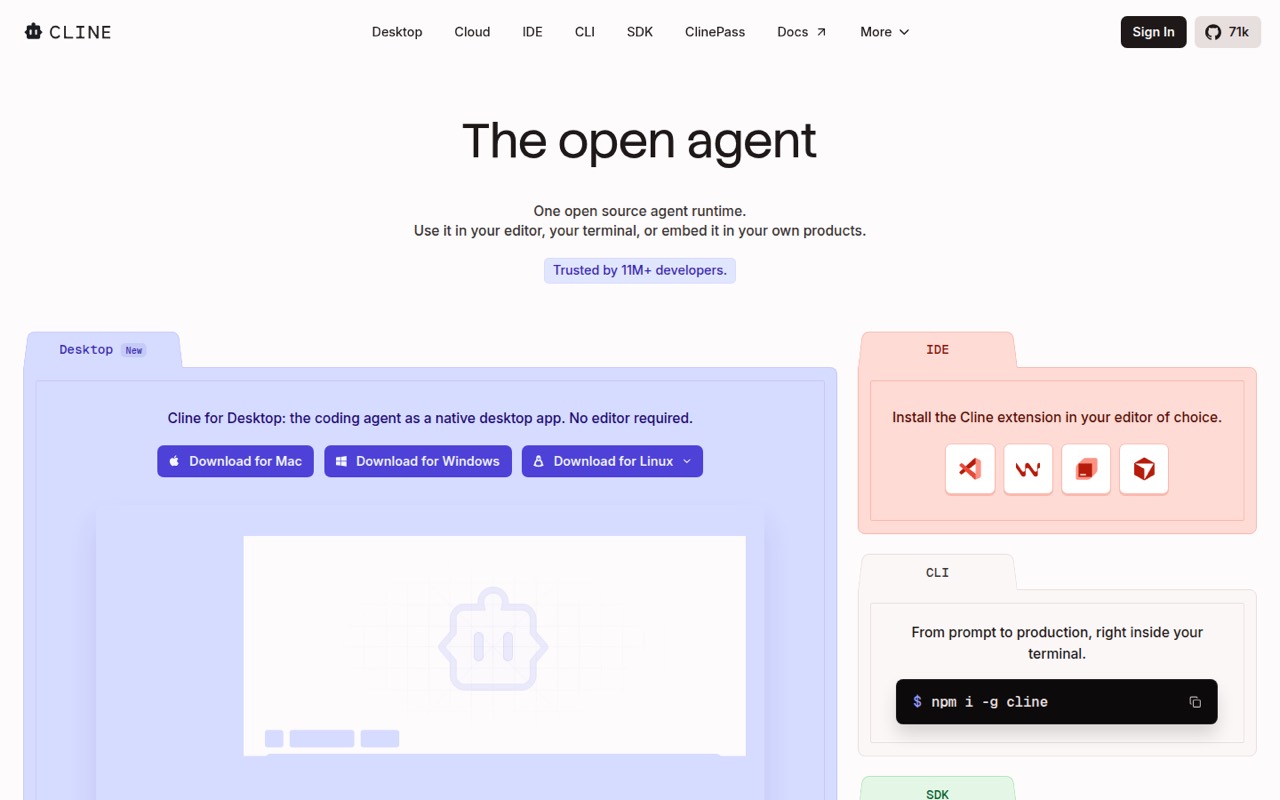
Cline is an open-source agent runtime that sits between a developer’s codebase and the model or infrastructure they choose. It is available as an editor extension, a terminal CLI and an SDK for embedding the runtime in other products. The homepage also offers a native desktop app.
The agent plans and executes coding tasks across files, runs terminal commands, and responds to their output. Developers can review proposed steps, approve them individually or enable auto-approval. Diffs, checkpoints and one-click undo provide control over changes.
Cline is not just a hosted coding service: the homepage says you can bring your own API key, endpoint or model weights, including local models through Ollama or LM Studio. That gives teams options for where inference runs, though it does not by itself establish that every part of the agent runtime can be self-hosted. Cline fits into an existing development stack as an agent interface and execution layer, rather than replacing the editor, terminal, model provider or CI system.
02Cline API, SDKs and docs
Cline’s documented integration surfaces are an editor extension, an npm CLI package and an npm SDK: npm i -g cline installs the CLI, and npm install @cline/sdk installs the package for embedding the agent runtime. The homepage names Visual Studio Code, Windsurf, JetBrains and Cursor as editor options. It describes SDK registration for custom tools and lifecycle hooks, plus connections to MCP servers for databases, APIs and infrastructure.
The homepage also describes chat access through Slack, Discord, Telegram and Linear, and headless use in GitHub Actions, GitLab or other pipelines. It does not name a public REST API or SDK programming languages. Check Cline’s docs to confirm language, runtime and API support before designing an integration around the SDK.
The docs cover .clinerules for repository-specific coding standards, architecture and deployment conventions. Those rules let teams put agent guidance alongside code. Cline also describes multi-agent delegation and cron schedules, but teams should check the docs for implementation details and operational requirements.
03Cline pricing for developers
The Open Source plan is listed at $0 per month, with no seat fees. It does not include free inference: developers bring an API key or use the Cline provider and pay for AI usage. That means the agent can be free to install while model calls still generate a variable bill.
Teams is listed at $20 per user per month, with the first 10 seats permanently free. It supports bring-your-own inference or provider-cost pass-through with zero markup. Enterprise pricing is custom. Annual-billing prices are not published.
ClinePass costs $9.99 per month and offers curated open-weight coding models with 2–5x standard API rate limits. Additional processing fees may apply. Optional pay-as-you-go inference credits are listed at provider cost with no markup; overage costs are not published. Cline does not publish a fixed request allowance or a general inference price, so estimate spend from the selected provider and workload rather than the $0 runtime price. The pricing page lists monthly prices; confirm current terms before budgeting a team rollout.
04Cline: open source, self-hosting and lock-in
Cline describes its agent runtime as open source, but its homepage does not publish the software licence. Check the repository and licence terms before redistributing or embedding it in a commercial product.
The product supports local Ollama and LM Studio models, custom OpenAI-compatible endpoints, and users’ own model weights or API keys. That provides flexibility over inference infrastructure. It does not confirm that every hosted service or component can be self-hosted; ask Cline which parts of the runtime, if any, require its services.
Cline does not publish a data-export or migration format on the homepage. Provider choice can reduce model-provider lock-in, while .clinerules are repository files that keep some agent guidance with your code. Custom tools, MCP connections and workflows may still need adaptation if you move to another agent. Confirm data handling and export options before connecting private repositories or production systems.
05Cline in production
Cline can run tests, dev servers and deploy commands in a terminal, and the homepage describes headless use in CI pipelines. That makes it possible to place the agent inside development and automation workflows, but it also means teams need approval policies and review steps for commands and code changes. Cline supports step-by-step approval, auto-approval, diffs and undo.
Cline does not publish general request quotas, a reliability SLA, or security and compliance commitments on its homepage. ClinePass is listed with 2–5x standard API rate limits; ask which limits apply to your provider and deployment. Confirm data retention, access controls, auditability and incident support with the vendor before using it on sensitive code.
Costs can be a production issue. One Reddit post reports about $1,000 per month in Anthropic API calls; another developer says Cline was costing about $20 per day. Other commenters praise supervised planning or cheaper model choices. These are individual reports, not a typical spend estimate.
From the threadsWhat users say
Reddit sentiment is mixed. Developers value Cline’s planning and supervised editing, while some report steep inference bills or interruptions that pushed them to switch tools.
lots of upfront interaction to plan and nail down requirements followed by tightly supervised coding
My work volume is BIG! I pay around 1000$ per month in api calls to anthropic
I use Cline with DeepSeek and its much much cheaper
I’ve abandoned Cline, because I’m sick of the constant attempts to funnel the user towards their cloud offerings;
Questions people ask
What is Cline used for?
Cline is a coding agent for an editor, terminal or product built with its SDK. It can inspect a codebase, plan a task, edit multiple files, run terminal commands and respond to their output. Developers can review and approve steps or enable auto-approval.
Is Cline free to use?
The Open Source plan is listed at $0 per month with no seat fees. AI inference is separate: you bring an API key or use Cline provider options and pay for usage. Teams lists its first 10 seats as permanently free; ClinePass is an optional paid subscription.
What are Cline rules?
Cline rules are repository guidance stored in .clinerules. Teams can use them to give the agent coding standards, architecture guidance and deployment conventions. Keeping those rules in the repo makes them available alongside the code, but check the docs for supported formats and rule-loading behavior.
Which models can Cline use?
The homepage lists Claude, GPT and Gemini, along with local Ollama or LM Studio models and OpenAI-compatible endpoints. Cline also says developers can bring their own API key, endpoint or weights. Check the docs for current provider setup and model-specific requirements.
Can Cline run in CI?
Cline describes headless use inside GitHub Actions, GitLab or another pipeline. It can also run terminal commands and react to their output. Before enabling it in CI, define which commands it may run, how approvals work and how credentials are handled; Cline’s homepage does not publish a general CI quota or SLA.
Sources
- Cline homepage
- Cline pricing, compiled via web search from cline.bot, agentsai.fyi, emergent.sh, promptquorum.com, rfp.wiki, checkthat.ai
- Reddit: Need a cheaper alternative to Cline ( Claude sonnet )
- Reddit: Is there anything else like Cline ?
- Reddit: In your opinion, what is the best CLI-based (or other) coding tool for regular software engineering (NOT VIBE CODING)?