
We may earn a commission if you buy through links on this page. It never changes a score or a ranking. How we make money
The bottom line
A broad hosted user layer with fast framework integration, but check usage costs and deployment constraints first.
Clerk is a hosted authentication and user-management service for web and mobile apps. Its SDKs and UI components cover sign-in, sessions, multifactor authentication and organization management, while a CLI and MCP server let developers and agents configure apps.
The 50,000-MRU-per-app Hobby tier is useful for starting out, but production costs can include MRU overages, paid SSO and Directory Sync connections, and feature add-ons. Teams that need self-hosting or control over the auth implementation should assess migration and data-export options before adopting it.
Good fit if
- Apps using supported frameworks
- B2B SaaS with organizations
- Teams outsourcing auth operations
Skip it if
- Teams requiring self-hosted auth
- Consumer apps with unpredictable growth
- Projects needing full data control
ScoresHow it rates
What works
- Authentication, sessions and user management in one service
- SDKs and UI components for named web and mobile frameworks
- Organization invitations, roles, permissions and auto-join
- MFA, passkeys and fraud-prevention features
- CLI and MCP server for agent configuration
What doesn't
- Usage overages can raise bills beyond the base plan
- No published self-hosting option or open-source license
- Vendor does not publish an export procedure
- Additional SSO and Directory Sync connections cost extra
- Rate limits and API protocol details need confirmation
01What Clerk is, technically
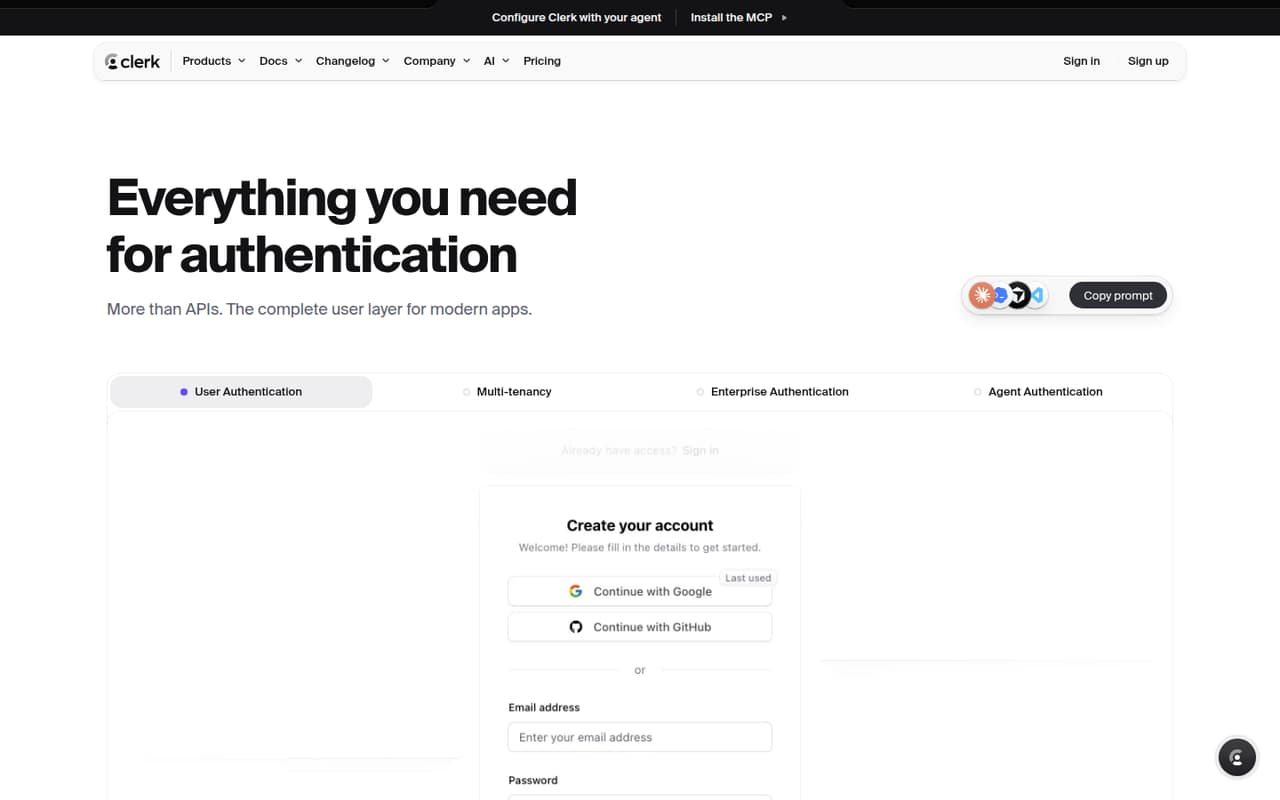
Clerk is a hosted authentication and user-management service, not a self-hosted identity server or a library you run as your auth backend. It sits between an app and its users: the app uses Clerk’s framework SDKs and UI components for sign-in, session handling and user or organization features, while Clerk manages the user layer. Its feature set includes passwords, magic links, one-time passcodes and social sign-on, along with multifactor authentication, active-device monitoring and session revocation.
For B2B apps, Clerk adds organization UI components, invitations, auto-join, roles and permissions. It also offers API keys and tools to configure apps through a CLI and MCP server. The architectural tradeoff is that an app delegates core identity flows and session lifecycle to a hosted provider. That can reduce the auth code an application team maintains, but it also makes the app dependent on Clerk’s service, SDKs and data model.
02Clerk API, SDKs and docs
The homepage lists SDKs for Next.js, React, Expo, React Router, TanStack React Start and Astro, and describes SDK support for modern web and mobile frameworks. It also lists integrations with Supabase, Convex and Vercel. Clerk’s ready-made UI components cover sign-in, user profiles and organization management, while the CLI can initialize an app with npx clerk@latest init. Other shown commands include clerk doctor, clerk webhooks listen, clerk config pull and clerk env pull.
Agents can use Clerk’s MCP server to configure app settings, users and domains; the homepage names Claude Code, Codex and Cursor as compatible agents. The homepage does not name an API protocol or provide a language-by-language SDK package list, so confirm exact SDK support and API details in Clerk’s docs before choosing a framework. Check how the SDK’s session and organization abstractions map to your app, and verify what the listed integrations require in your own stack.
03Clerk pricing for developers
Hobby costs $0 per month and includes 50,000 monthly retained users (MRUs) per app, up to three dashboard seats, five impersonations, seven-day fixed sessions and one-day application log retention. Pro costs $25 monthly or $20 per month billed annually; it includes 50,000 MRUs per app, one SSO and one Directory Sync connection per app, MFA and passkeys. Business is $300 monthly or $250 billed annually, with 10 dashboard seats and 30-day application and admin log retention. Enterprise is billed annually, with pricing not published.
Extra MRUs cost $0.02 each from 50,001 to 100,000, with lower per-MRU rates at higher tiers. Additional SSO and Directory Sync connections start at $75 per month each; satellite domains cost $10 monthly. SMS costs $0.01 per message in the US and Canada, with international rates varying. Enhanced Administration and Enhanced B2B Authentication are separate add-ons, and Clerk Billing adds 0.7% of billing volume on top of Stripe’s transaction charges. Model expected user growth and paid features before committing.
04Clerk: open source, self-hosting and lock-in
Clerk is offered as a hosted service. The vendor does not publish an open-source license, self-hosting option or data-export procedure. Teams that require control of the auth server, database or deployment should ask Clerk about export formats, deletion procedures and migration support before moving production users onto the service.
Migration work is likely to involve more than swapping a login form. Applications can depend on Clerk’s SDKs and components for sessions, user profiles and organization roles, so replacing it may mean mapping those records and rebuilding integrations in the app. The practical lock-in is in the identity and organization model, plus the auth flows wired into application code. Keep your app’s authorization checks and business data model explicit, and document the steps needed to replace Clerk if portability is a requirement.
05Clerk in production
Clerk advertises SOC 2 Type 2 and CCPA compliance, with regular third-party audits and penetration tests. The Business plan includes a SOC 2 report and 30-day application and admin log retention. Enterprise includes a 99.99% uptime SLA and custom log retention; HIPAA compliance is available with a BAA. Confirm which plan and contractual terms cover the requirements your security review actually checks. The vendor does not publish request-rate limits in the pricing information, so ask about limits, quota behavior and failure handling before relying on the service at scale.
The main production risks to model are service dependency, usage-based billing and migration effort. MRUs accrue per app, and add-ons can apply to connections, SMS and other features. A Reddit thread about Clerk pricing shows users disputing how quickly costs rise; some figures in that discussion do not match the current plan prices, so use current pricing when forecasting. Reddit commenters also describe the tradeoff: outsourcing auth can save engineering time, while self-hosting advocates value control over data and implementation.
From the threadsWhat users say
Reddit comments reflect both the appeal of outsourcing authentication work and concerns about pricing and control. Sentiment is mixed, with some commenters favoring the time saved and others questioning fit for consumer apps or preferring self-hosting.
Using a service saves time, that’s exactly why services like Clerk exist, they handle the messy parts for you
I believe in a self hosting solution, so I have all the control over data and modify any function if I want
It is good for enterprise apps where you can charge for seats. Not great for consumer apps
My company doesn't want to manage user data, so we use a third party for user data and authentication instead
Questions people ask
What does Clerk do?
Clerk provides hosted authentication and user-management features for apps. It handles sign-in flows, sessions, multifactor authentication and user profiles, and adds organization tools such as invitations, roles, permissions and auto-join for multi-tenant apps.
Does Clerk support Next.js and React?
Yes. Clerk lists SDKs for Next.js and React, along with Expo, React Router, TanStack React Start and Astro. Check Clerk’s docs for the package and setup details that match your framework version and application architecture.
Does Clerk support organizations and roles?
Yes. Clerk provides organization UI components, invitations, auto-join, custom roles and permissions. These features are aimed at apps that need to manage organization membership and authorization, particularly B2B SaaS products.
Can I self-host Clerk?
Clerk is presented as a hosted service, and the vendor does not publish a self-hosting option. If your deployment or data-control requirements rule out a hosted auth provider, ask Clerk about its deployment and data-export options before adopting it.
What does Clerk cost for a production app?
Pro costs $25 per month or $20 per month billed annually, and Business costs $300 monthly or $250 billed annually. Both include 50,000 MRUs per app, but paid connections, extra MRUs and feature add-ons can increase the bill.