
We may earn a commission if you buy through links on this page. It never changes a score or a ranking. How we make money
The bottom line
Chooch automates hospital inventory with camera AI, but its API surface and production costs need vendor confirmation.
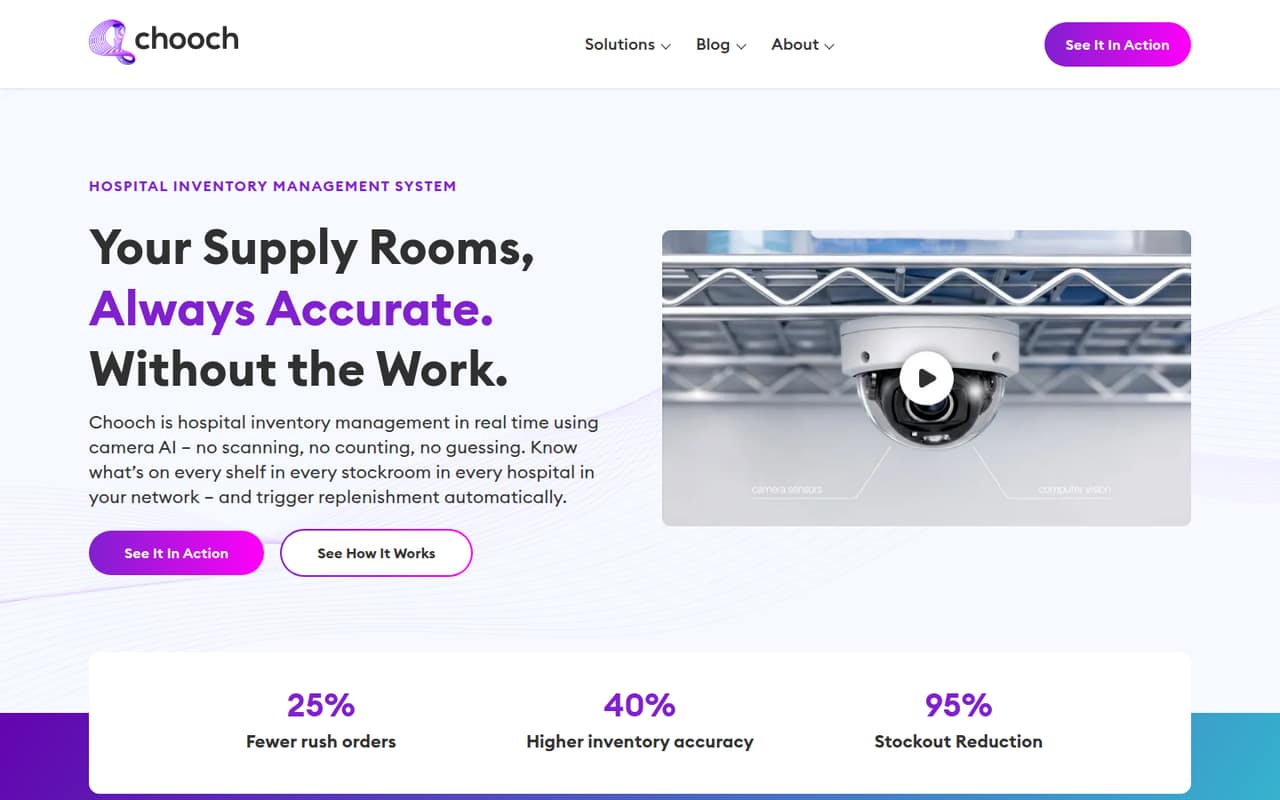
Chooch AI is a camera-based hospital inventory platform: it tracks supplies on shelves, forecasts demand and can trigger replenishment through ERP integration. Its workflow targets supply-chain teams rather than developers building general-purpose computer vision applications.
The pricing page lists a free account at $0 per month, but usage limits are unpublished; enterprise pricing is custom. The public product pages describe cameras, dashboards and ERP integration, not a developer API, SDKs or self-hosting options. Get integration, security and cost details from Chooch before committing.
Good fit if
- Hospital supply-chain operations
- Teams replacing manual stock counts
- Hospitals with ERP procurement workflows
Skip it if
- Developers seeking a public vision API
- Teams requiring self-hosted software
- Buyers needing published usage pricing
ScoresHow it rates
What works
- Tracks shelf inventory without barcodes or RFID
- Forecasts demand from consumption patterns
- Can trigger replenishment through ERP integration
- Flags slow-moving and expiry-risk stock
- Camera-offline alerts support device monitoring
What doesn't
- Public API, SDK and language support are not described
- Free-account usage limits are unpublished
- Enterprise pricing requires a custom quote
- Self-hosting and data export details are unpublished
- Security controls and service commitments need confirmation
01What Chooch AI is, technically
Chooch AI is a vendor-operated hospital inventory platform built around cameras, computer vision and inventory dashboards. Cameras monitor shelves and bins; the platform interprets visual data, updates on-hand counts and surfaces demand signals. It is not presented as a general-purpose vision library, command-line tool or developer API.
In a hospital stack, Chooch sits between physical supply rooms and materials management or ERP software. Its stated workflow moves from camera monitoring to stock-level updates, threshold alerts and a purchase order sent to the connected system. Supply-chain teams use dashboards for live status, usage trends and replenishment history across locations. The platform also aims to adjust PAR and safety-stock levels from observed consumption and flag excess, slow-moving or expiration-risk stock.
The vendor describes cameras placed on racks and a structured deployment involving site assessment, installation, configuration, testing, training and go-live support. The public product pages do not establish whether the service runs on-premises or in a vendor cloud. Confirm deployment topology, network requirements and ownership of camera hardware before treating it as a fit for your hospital architecture.
02Chooch AI API, SDKs and docs
The public integration surface Chooch describes is camera monitoring plus ERP or materials-management integration. Its workflow can send purchase orders when inventory reaches defined thresholds, while dashboards expose current status, usage trends and replenishment history. The homepage does not describe a REST API, webhooks, CLI, plugins, SDKs or supported programming languages. Confirm the integration method and SDK support in the vendor’s technical documentation before estimating implementation work.
For an ERP connection, ask which systems are supported, whether Chooch writes purchase orders directly or sends a signal for approval, and how it handles failed or duplicate transactions. The public site says the platform is designed to work alongside existing procurement workflows, but it does not detail authentication, field mapping, event delivery or sandbox access. Also clarify whether inventory records and alerts can be exported or queried programmatically.
The described deployment includes configuration, testing and training, so integration appears to be a vendor-supported project rather than a self-serve developer install. Ask for interface specifications, sample payloads and a test environment before committing engineering capacity.
03Chooch AI pricing for developers
The pricing page lists a Free Account / Free App at $0 per month. It includes account registration, but the page does not publish usage limits. That makes the free option difficult to size for a production evaluation: confirm whether camera count, locations, tracked items, users or data retention are capped, and what happens when a limit is reached.
The Enterprise plan is custom-priced, with a quote and demo available on request. The pricing page does not publish monthly or annual enterprise rates, an entry price or a billing formula. It also does not list add-ons. Ask for a quote based on deployment scope, including camera hardware, installation, ERP integration, support and ongoing software fees; the public pricing details do not establish which are included.
There is no published usage-based rate to model against requests, seats or compute, and no published overage schedule. Before a pilot, get written pricing for expansion across rooms and hospitals, plus any charges for integration changes or support. Treat the free account as an evaluation starting point, not evidence that a full camera deployment is free.
04Chooch AI: open source, self-hosting and lock-in
Chooch is presented as a commercial hospital inventory platform. The vendor does not publish an open-source licence or a self-hosting option on its public product pages, so do not plan on modifying or deploying the software independently without written confirmation. The pages also do not describe data-export formats or a migration process.
The practical lock-in risk is tied to the workflow: cameras monitor supply locations, computer vision maps images to inventory, and ERP integration carries replenishment actions. Replacing Chooch could require a new camera and inventory-recognition setup, remapping room and item data, and rebuilding procurement connections. The degree of portability depends on what records, images, event history and configuration you can retrieve.
Before deployment, ask who owns camera hardware and derived inventory data, what exports are available, and whether records can be returned in a usable format at contract end. Confirm data deletion terms and whether the ERP connection can be disabled without interrupting existing procurement processes.
05Chooch AI in production
Production use depends on camera coverage, network connectivity and the accuracy of item recognition in each supply room. Chooch says it monitors camera health and connectivity, generates alerts when a camera goes offline, and resumes inventory monitoring when connectivity returns. Confirm how quickly alerts arrive, who receives them and whether inventory counts reconcile after an outage.
The vendor says the hospital inventory solution is designed not to capture patient data. That statement does not replace a review of camera placement, image handling, retention, access controls and your hospital’s privacy and security requirements. Ask for security documentation, deployment architecture, service commitments, incident procedures and details on how data is protected in transit and at rest.
The vendor does not publish usage limits or enterprise rates, so model scale and cost with a written quote for the intended rooms and locations. Test the ERP workflow in a controlled rollout: confirm threshold behavior, approval steps, duplicate-order handling and recovery from failed integrations. The site describes deployment support, but production support response targets are not stated.
Questions people ask
How does Chooch AI track hospital inventory without barcodes?
Chooch uses cameras positioned on racks in hospital inventory rooms. Its computer-vision system analyzes images of shelves and bins to identify items and update inventory levels. The vendor says this removes the need for barcode or RFID scanning and manual counts; confirm camera placement and item coverage for your specific rooms.
Can Chooch AI automatically reorder supplies?
Chooch describes an ERP or materials-management integration that can trigger purchase orders when inventory reaches defined thresholds. The vendor also says the platform can flag a shortfall and prepare a reorder signal. Ask which procurement systems are supported and whether an order is sent automatically or requires approval.
How much does Chooch AI cost?
The pricing page lists a free account at $0 per month, but its usage limits are unpublished. The Enterprise plan requires a custom quote, and the page does not publish monthly or annual rates. Request a quote that covers deployment scope, cameras, ERP integration and ongoing support.
Does Chooch AI capture patient data?
The vendor says its hospital inventory solution is designed for inventory management and does not capture patient data. Hospitals should still review camera placement, image handling, access controls and retention policies with Chooch, then assess the system against their own privacy and security requirements.
What happens if a Chooch AI camera goes offline?
Chooch says it monitors device health and connectivity and generates automated alerts if a camera goes offline. Inventory monitoring is stated to resume when connectivity returns. Before relying on that recovery process, ask about alert timing, escalation, offline data handling and how counts are reconciled after an outage.