
We may earn a commission if you buy through links on this page. It never changes a score or a ranking. How we make money
The bottom line
Useful payout coverage and marketplace controls, with a high published entry price and transaction rates to confirm.
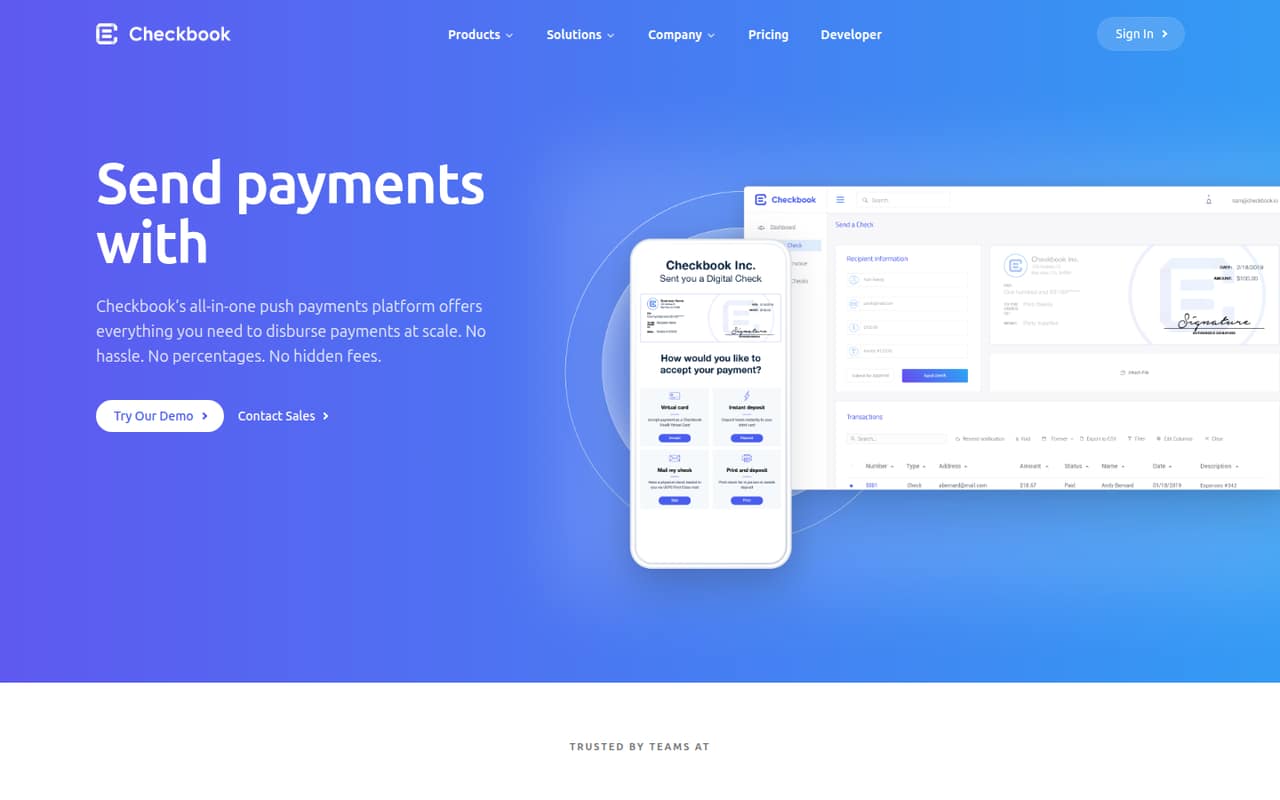
Checkbook is a hosted disbursements platform: teams can send payments through a RESTful API or dashboard, while recipients choose among digital and physical deposit options. Marketplace teams can customize the payment experience with white-label tools.
The main trade-off is price transparency. Business is listed at $2,000 per month, and per-transaction charges apply at rates the vendor does not publish. Checkbook may fit businesses with substantial payout needs; get a transaction quote and confirm production limits before committing.
Good fit if
- Businesses sending frequent disbursements
- Marketplaces needing branded payment flows
- Teams supporting several payout methods
Skip it if
- Side projects seeking a free tier
- Teams requiring published transaction rates
- Developers needing self-hosted payment software
ScoresHow it rates
What works
- Supports ACH, real-time payments, cards and paper checks
- Recipients can choose deposit options without signing up
- RESTful API supports payments, batches and customer onboarding
- White-label controls cover colors, emails, content and flows
- Dashboard and integrations offer alternatives to custom API work
What doesn't
- Business costs $2,000 per month
- Per-transaction rates are not published
- SDK languages and rate limits are not published
- No free plan or trial is listed
- Self-hosting and data export details need confirmation
01What Checkbook is, technically
Checkbook is a hosted payments service with a RESTful API and an online dashboard. It is not presented as a library, CLI or self-hosted server. A business can use the API to send payments, track them, send check batches and onboard customers; staff can also manage payment features through the dashboard.
The service sits between a business or marketplace application and the payout methods it offers. Those include ACH, real-time payments, printed and mailed checks, push to card and virtual cards. Recipients can select a deposit option through Checkbook’s digital-check flow without signing up. For marketplaces, white-label tools let teams customize colors, emails, content and payment flows, using direct API calls or OAuth-provided flows and modals.
That breadth can consolidate payout workflows, but it also makes Checkbook part of a critical financial path. Before adopting it, scope which payment methods your recipients can actually use, how exceptions are handled and how Checkbook fits your reconciliation process.
02Checkbook API, SDKs and docs
The documented integration surface is a RESTful API. Checkbook says it can track payments, send check batches and onboard customers from a business’s own site or platform. Marketplace builders can make direct API calls or use OAuth for Checkbook-provided flows and modals. The company also offers a full-featured online dashboard, which it says contains the API’s features and functionality.
The vendor lists pre-built integrations for QuickBooks Online and Accounting Seed on its homepage, and also names Sage Intacct among its integrations. It links to an API reference and says teams can get started quickly, but SDK languages, package names, webhook support and CLI tools are not named there. Confirm SDK support, authentication details and event-delivery options in the vendor’s developer docs before estimating implementation work.
For a fast integration, test the full payment lifecycle in your design: creating a payment, recipient choice, status tracking, failures and reconciliation. Checkbook supports multiple payout methods, so confirm which methods are available to your account and target recipients.
03Checkbook pricing for developers
Checkbook has no free plan, and no free trial is listed. Business costs $2,000 per month. The plan includes payments, invoices, multi-party checks, CSV upload, API access, check approvals, authorized users, white-label and marketplace features, live support and a dedicated customer success manager. The pricing page describes monthly billing and publishes no annual rate.
Enterprise is for custom payment solutions and has custom pricing. It includes full feature availability, payments, invoices, multi-party checks, API access, third-party integrations, live support and a dedicated customer success manager. Checkbook also charges per transaction, but the rates are not published.
That means the monthly plan price is not a complete production estimate. Your bill can include both the plan and transaction charges; the sources do not give a rate card or volume bands to model usage. Ask for a written quote covering each payout method, projected transaction volume, failed or returned payments and any additional services. There is no published usage limit or overage schedule to use in a cost forecast.
04Checkbook: open source, self-hosting and lock-in
Checkbook is sold as a hosted API and dashboard, not as a self-hosted server. The vendor does not publish an open-source licence or describe a self-hosting option, so teams should treat it as a proprietary service unless Checkbook confirms otherwise.
The homepage describes tokenized handling of financial data and points to security and compliance information, but does not explain data export or migration procedures. Ask Checkbook what payment, recipient and reconciliation records you can export, in which formats, and for how long they remain available after termination.
Migration effort will depend on how much of your application relies on Checkbook’s recipient flows, payment statuses and marketplace features. Keep an internal record of payment identifiers and reconciliation data, and isolate Checkbook-specific API calls behind an adapter where practical. That will not remove the work of replacing payment rails, but it can reduce coupling in your application.
05Checkbook in production
Checkbook supports a range of payout methods, but the vendor does not publish API rate limits or transaction-volume ceilings on its homepage. Ask for account-specific throughput limits, retry guidance, idempotency behavior and expected handling for returns or rejected payments before designing production queues.
The homepage says real-time payments can reach a bank account in less than 60 seconds. Treat that as a product claim, not a published service-level agreement; confirm availability, eligibility and any delivery commitments for your use case. The vendor describes its platform as tokenized and links to security and compliance resources, but confirm the controls, certifications and responsibilities that apply to your account.
Plan for reconciliation and support escalation as carefully as the initial API call. Business includes live support and a dedicated CSM; Enterprise lists the same. Get the per-transaction rate card, service commitments, maintenance process and incident contact path in writing. Without published limits and transaction rates, capacity and cost planning depend on answers from the vendor.
Questions people ask
What payment methods does Checkbook support?
Checkbook lists ACH, real-time payments, printed checks, mailed checks, push to card and virtual cards. Its homepage also names FedNow payments. Which methods are available can depend on the account and recipient; confirm eligibility and coverage with Checkbook before building around a specific payout route.
Does Checkbook require recipients to create an account?
Checkbook says recipients can use its digital-check flow without signing up. They enter the necessary information when depositing the payment and can choose from flexible deposit options. Confirm the information required for each method and any differences between recipient flows before launch.
Can I integrate Checkbook into my own platform?
Yes. Checkbook offers a RESTful API for sending and tracking payments, sending batches and onboarding customers. Marketplace teams can use direct API calls or OAuth flows and modals provided by Checkbook. The service also has an online dashboard and pre-built integrations.
How much does Checkbook cost?
Business is listed at $2,000 per month. Enterprise pricing is custom, and Checkbook charges additional per-transaction fees whose rates are not published. There is no free plan listed. Ask for a written quote based on your payment methods and expected transaction volume.
Can marketplaces customize Checkbook’s payment experience?
Yes. Checkbook’s white-label marketplace tools let teams customize colors, emails, content and payment flows. The vendor says marketplace customers can create users, add bank accounts and facilitate payments between them. Confirm the scope of customization and any account-specific requirements with Checkbook.