
We may earn a commission if you buy through links on this page. It never changes a score or a ranking. How we make money
The bottom line
Catchpoint targets Internet performance issues; confirm API support and product-specific pricing before adopting it.
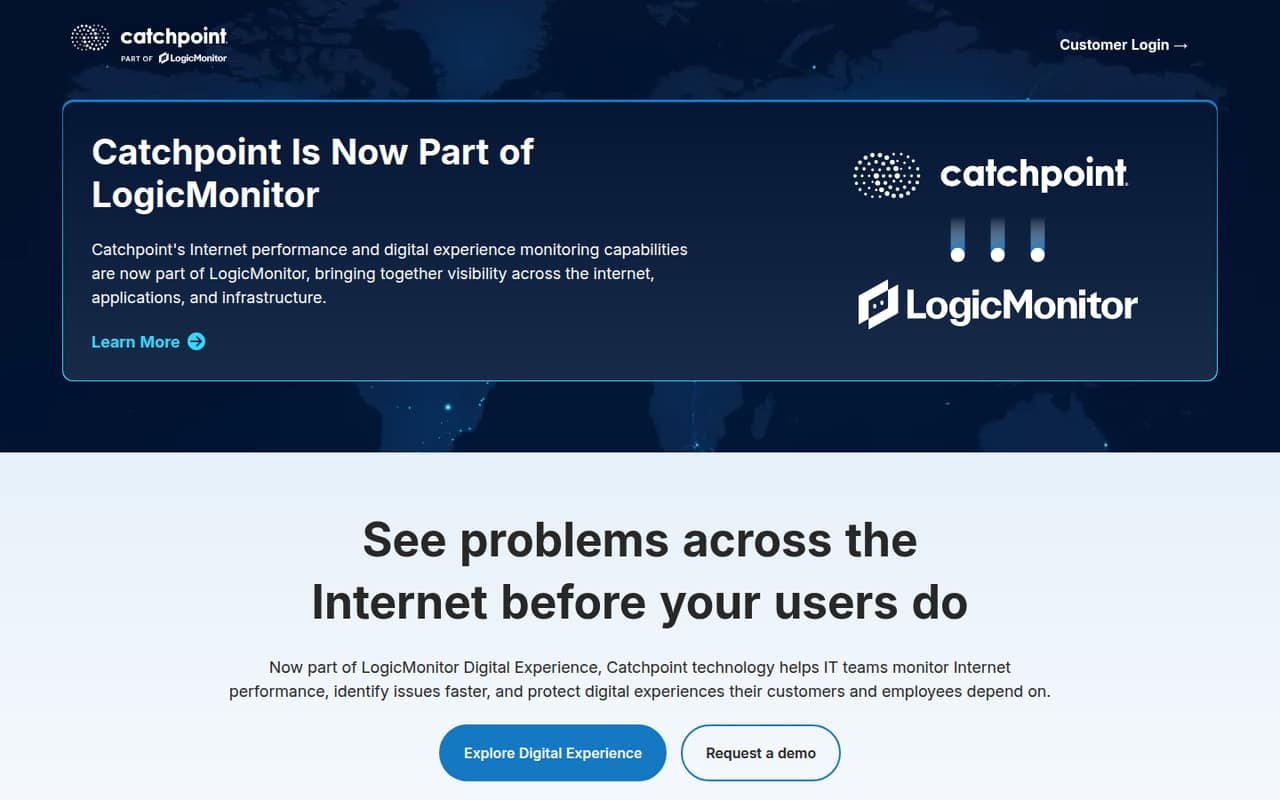
Catchpoint is Internet performance monitoring technology that is now part of LogicMonitor Digital Experience. Its stated job is to help IT teams spot problems across the Internet and identify issues before they affect customers or employees.
Good fit if
- Teams monitoring Internet performance
- Organizations protecting digital experiences
- LogicMonitor buyers evaluating synthetics
Skip it if
- Teams requiring a documented SDK
- Buyers needing published Catchpoint pricing
- Teams requiring self-hosted monitoring
ScoresHow it rates
What works
- Focused on Internet performance monitoring
- Designed to help identify issues faster
- Synthetics and Internet Sonar appear in LogicMonitor pricing text
- Reddit users discuss API calls and webhooks
- LogicMonitor packages list a 14-day trial
What doesn't
- Catchpoint-specific pricing is not listed
- Homepage names no SDKs or programming languages
- API limits and rate limits are not published
- Open-source status and self-hosting need confirmation
- Reddit discussion shows integration setup can be confusing
01What Catchpoint is, technically
Catchpoint is Internet performance monitoring technology, now part of LogicMonitor Digital Experience. It is a vendor-operated monitoring service, not a library, CLI or self-hosted server. It sits alongside an application stack and watches Internet performance so IT teams can identify issues affecting customer and employee experiences.
The homepage positions the product around monitoring Internet performance, finding issues faster and protecting digital experiences. LogicMonitor pricing text also lists Synthetics and Internet Sonar among former Catchpoint capabilities, alongside real user monitoring with session replay and endpoint monitoring. That suggests a monitoring suite broader than a single network probe, but the capabilities and packaging buyers can purchase now need confirmation with LogicMonitor. Treat Catchpoint as an observability service to evaluate alongside your existing monitoring stack, not as an established replacement for application telemetry or infrastructure monitoring.
02Catchpoint API, SDKs and docs
Catchpoint's developer-facing integration surface is not described on its homepage. A Reddit discussion refers to an API URL, token and key; commenters discuss OAuth, POST requests, and webhooks when Catchpoint runs tests. One commenter suggests Ansible's uri module, while the original poster is trying to trigger a test from an Ansible workflow. This is evidence of an HTTP API and webhook workflow being discussed by users, not a complete integration guide.
The homepage names no programming languages, SDKs, CLI or plugin system. Confirm supported SDKs, API versioning, authentication flow, request schemas and webhook behavior in LogicMonitor's documentation before building against the service. The Reddit discussion also shows why a working cURL call is not the whole integration: authentication and the execution environment can affect setup. Confirm whether your required API endpoints remain available under the current LogicMonitor Digital Experience offering.
03Catchpoint pricing for developers
The listed prices are for LogicMonitor packages, not a separate Catchpoint plan, so treat them as starting points to verify with the vendor. The pricing page lists Essentials at $19, Advanced at $37 and Signature at $50 per Hybrid Unit per month. Essentials includes 100 synthetic points per Hybrid Unit; Advanced includes 250; Signature includes 500. Each plan also lists AI Credits, a sandbox up to 10% of paid capacity and 3,000+ integrations. Annual billing details are not published, and the listed plans have no free tier; a 14-day trial is listed.
The unit-based model means cost grows with the number of Hybrid Units you need. Additional capability capacity is available to purchase, but its price is not listed. Real User Monitoring with Session Replay, Endpoint Monitoring, Data Publisher and ServiceNow CMDB Integration are listed as add-ons without prices. Ask LogicMonitor for a Catchpoint-specific quote, the current mapping of former Catchpoint features to plans, and how synthetic-point capacity is billed at your expected scale.
04Catchpoint: open source, self-hosting and lock-in
Catchpoint is presented as commercial monitoring technology within LogicMonitor Digital Experience. The vendor does not publish an open-source licence or a self-hosting option on its homepage, so buyers should treat it as a hosted service unless LogicMonitor confirms otherwise. Ask for the service's data-export formats, retention rules, and whether test definitions, alert settings and historical results can be exported.
Migration effort will depend on how much your monitoring setup relies on Catchpoint-specific tests, alerting and dashboards. The stated monitoring purpose makes those definitions and historical data important to preserve when moving to another provider. Before committing, confirm API access to the data you need and whether exported data remains usable outside LogicMonitor. Also ask how former Catchpoint capabilities are supported in the current LogicMonitor product and what happens to access if you end the subscription.
05Catchpoint in production
Before relying on Catchpoint for production alerting, confirm the operational limits that affect your monitoring design: API rate limits, synthetic-point capacity, data retention, alert delivery guarantees, regional coverage and service-level commitments. The pricing page lists synthetic points per Hybrid Unit, but does not give a Catchpoint-specific capacity model. Ask LogicMonitor about authentication controls, role permissions, audit logs, data residency and compliance requirements for your deployment.
A Reddit thread about calling the API from Ansible shows users working through token or OAuth authentication and POST requests. One commenter points to webhooks when tests run; another suggests Ansible's uri module. The same thread includes a Windows/WinRM execution error, which appears to concern the Ansible environment rather than Catchpoint itself. This is useful integration context, not evidence of Catchpoint reliability or failure rates. Validate the exact API workflow and failure handling in your own deployment before making it a release or incident-response dependency.
From the threadsWhat users say
The small Reddit sample is mixed: commenters offer practical pointers on API calls and webhooks, while the original poster is still working through authentication and Ansible execution issues. It provides little evidence about product reliability, support quality or broader user satisfaction.
Catchpoint can easily do webhooks when it tests
Use the uri module. Should be some examples of POSTing or whatever it is you need in the docs
Our first task is to connect to CatchPoint from Ansible and none of us have experience in doing that
What hosts are you trying to run this against? Just your localhost? What OS?
Questions people ask
What does Catchpoint monitor?
Catchpoint's stated focus is Internet performance: helping IT teams monitor Internet performance, identify issues faster and protect digital experiences for customers and employees. LogicMonitor pricing text also lists Synthetics and Internet Sonar among former Catchpoint capabilities. Confirm which capabilities are currently included in the product you are evaluating.
Does Catchpoint have an API?
A Reddit discussion refers to a Catchpoint API URL and token, and users discuss OAuth, POST requests and webhooks. That points to API-based integration, but does not establish endpoint coverage or current authentication requirements. Check LogicMonitor's current API documentation for supported operations, authentication, rate limits and versioning before implementation.
How much does Catchpoint cost?
The listed prices are for LogicMonitor packages, not separate Catchpoint pricing: Essentials starts at $19, Advanced at $37 and Signature at $50 per Hybrid Unit per month. Catchpoint-specific pricing is not listed. Ask LogicMonitor for a quote that identifies the current plan and capacity required for your monitoring workload.
Is there a free Catchpoint plan or trial?
The listed LogicMonitor packages have no free plan and include a 14-day trial. Those terms are for LogicMonitor packages, not a separate Catchpoint offer. Confirm with LogicMonitor whether the trial includes the specific Catchpoint capabilities, synthetic capacity and integrations your team needs to evaluate.
Can we self-host Catchpoint or export its data?
Catchpoint is presented as part of LogicMonitor Digital Experience, but the homepage does not establish a self-hosted deployment or data-export options. Ask LogicMonitor about hosting choices, export formats, retention and access to test definitions and historical results. Confirm those details before making the service part of incident response.