
We may earn a commission if you buy through links on this page. It never changes a score or a ranking. How we make money
The bottom line
A cloud-native spatial platform with broad analysis tools, but unclear pricing and developer integration details.
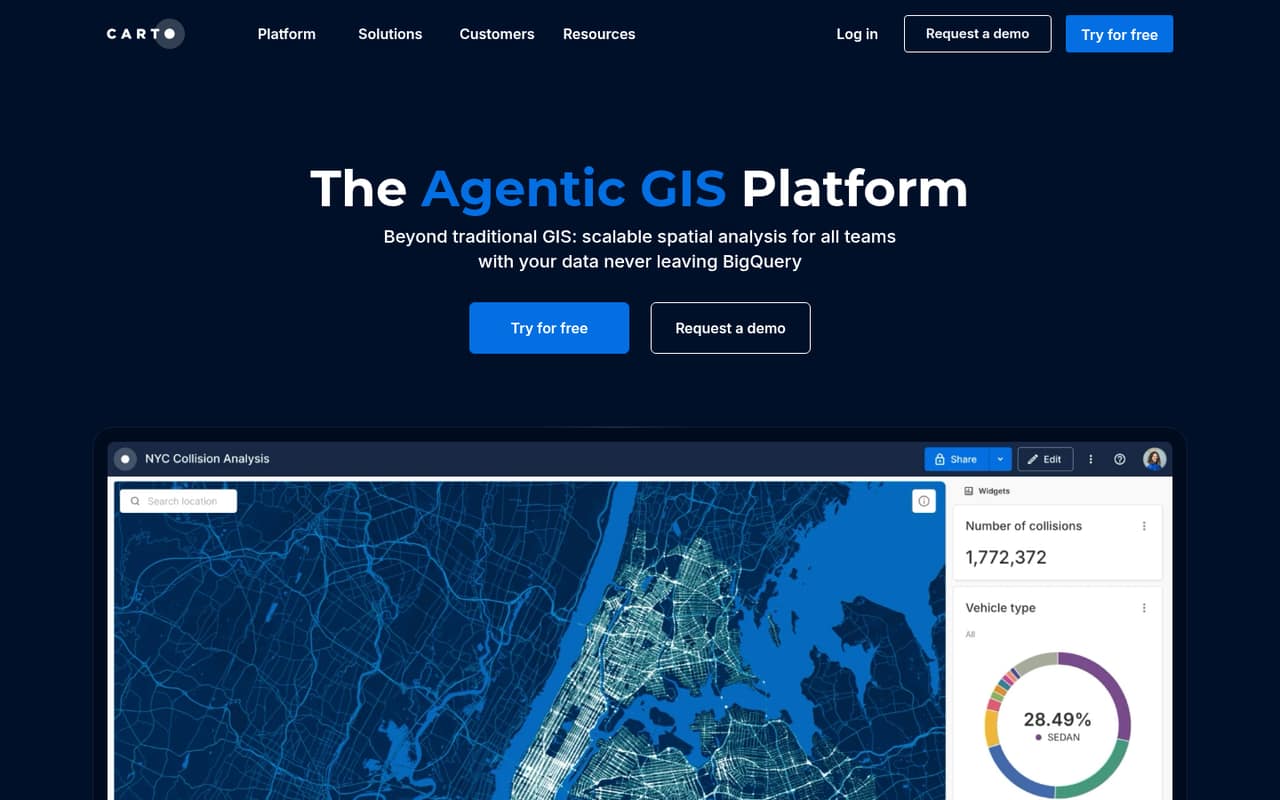
CARTO is a cloud-native GIS platform for spatial analysis, visualization, AI agents, and app development in cloud data ecosystems such as BigQuery. It combines low-code workflows with tools for building applications that run in a data lakehouse.
The fit looks strongest for organizations already working with cloud data platforms. The vendor lists a 30-day trial and several usage or commitment tiers, but does not publish prices on the pricing information available to us. Confirm API protocols, SDK support, and costs before building a production dependency.
Good fit if
- Teams using BigQuery
- Analysts building spatial workflows
- Enterprises developing location apps
Skip it if
- Buyers needing published prices
- Teams requiring self-hosting
- Developers seeking named SDKs
ScoresHow it rates
What works
- Works within cloud data ecosystems, including BigQuery
- Offers 100+ drag-and-drop analysis components
- Supports app development in a data lakehouse
- Uses deck.gl, WebGL, and GPU visualization
- Includes a 30-day free trial
What doesn't
- Plan prices are not published
- No free plan is listed
- API protocol and SDK support need confirmation
- License and self-hosting options are unclear
- Pay-as-you-go API access is limited
01What CARTO is, technically
CARTO is a cloud-native GIS platform, not a standalone mapping library or command-line tool. It sits alongside a cloud data ecosystem such as BigQuery, providing spatial analysis, visualization, AI-agent features, and app development around organizational data. The vendor says the platform is designed to keep data in BigQuery, rather than moving it through separate GIS silos or ETL pipelines.
For analysts, CARTO offers low-code, drag-and-drop workflows with more than 100 analysis components. For developers, its app-development tools are described as framework-agnostic, with apps running in a data lakehouse. Visualization uses deck.gl, WebGL, and GPU technology. That places CARTO between the data platform and the people or applications consuming spatial insights: it supplies spatial tooling and interfaces, while the underlying data remains in the cloud ecosystem. Teams should verify which parts of their chosen architecture run in CARTO and which run in their data platform.
02CARTO API, SDKs and docs
The vendor describes APIs for designing and deploying alongside the agents and APIs a team already uses. Its product also supports framework-agnostic app development, with visualization built on deck.gl, WebGL, and GPU technology. The homepage does not name a specific API protocol, SDK, programming language, CLI, or webhook surface, so confirm those details in CARTO’s developer documentation before choosing an integration pattern.
The clearest integration point on the vendor's site is the cloud data ecosystem: CARTO names BigQuery and says analysis can work with data that stays there. For teams building applications, verify how the platform connects to the data lakehouse, what authentication and permissions are required, and which framework and language combinations are supported. CARTO also refers to APIs and tokens in its plan structure, with limited access on Pay As You Go and unlimited API access and tokens on the Strategic committed tier. Ask the vendor for endpoint documentation, SDK availability, and applicable request limits for your workload.
03CARTO pricing for developers
The pricing information lists no free plan and no published monthly or annual prices. CARTO offers a 30-day free trial. The Pay As You Go (Flexible) tier has metered consumption, limited API access and tokens, and no upfront commitment. Its actual cost per request, compute unit, or other usage measure is not published, so estimate a production bill only after CARTO defines the billing units for your workload.
The committed options require upfront annual billing. Enterprise includes a basic annual quota for a team; Strategic includes an expanded annual quota and unlimited API access and tokens; Custom is described for high-volume quota. The published pricing information does not give prices, quota quantities, overage rates, seat costs, or add-on fees. That leaves the main cost drivers unclear for teams forecasting usage or deciding between tiers. Before implementation, ask for a quote with expected data volume, analysis frequency, API use, user count, and the cost of exceeding the included quota. Do not treat the trial as a free production tier.
04CARTO: open source, self-hosting and lock-in
The vendor describes CARTO as a cloud-native platform that works in cloud data ecosystems, including BigQuery, and says data can stay in BigQuery. The vendor's site does not establish whether the CARTO platform itself can be self-hosted or what license applies to its software. Ask CARTO directly about source availability, deployment options, and any limits on moving between hosted and customer-managed environments.
Keeping data in a cloud data platform may reduce the need to copy it into a separate GIS store, but it does not by itself settle migration effort. Before adopting CARTO-specific workflows, agents, or app components, check how to export maps, analysis definitions, and application code, and whether those artifacts can run without CARTO. The vendor does not publish enough information to assess data export or platform lock-in; include both in contract and architecture review.
05CARTO in production
CARTO's website emphasizes visualization at billions of data points and apps running in a data lakehouse, but those claims do not set a service-level target or a workload-specific capacity limit. The pricing tiers distinguish API access and annual quotas, yet published request rates, quota amounts, and overage behavior are not stated. Get those limits in writing for the plan you are considering.
The homepage presents keeping data in BigQuery as a way to avoid data silos and governance compromises. That is relevant to architecture, but teams still need to verify identity integration, access controls, auditability, data residency, and compliance terms against their own requirements. Ask about availability commitments, incident response, backup responsibilities, and behavior during data-platform or API outages. One Reddit thread raises affordability as a concern, asking whether CARTO is unaffordable without an extra $15,000 per year; it does not establish a representative price or resolve current plan costs. Treat it as a reason to request a workload-based quote, not as a current price.
From the threadsWhat users say
The available Reddit discussion is a single affordability-focused thread, not a broad review sample. It signals price concern but does not support a reliable overall consensus on CARTO.
Unaffordable if you don't have an extra 15k/year?
I'm a mid-level public policy professional
I caught the CARTO bug when I taught myself to use it
I first gained access to it when I had access to a student account
Questions people ask
What is CARTO used for?
CARTO is a cloud-native GIS platform for spatial analysis, visualization, AI-agent features, and app development. It combines low-code analysis workflows with mapping and app tools, and is designed to work with cloud data ecosystems such as BigQuery. The vendor says applications can run in a data lakehouse.
Does CARTO work with BigQuery?
Yes. CARTO names BigQuery as a cloud ecosystem integration and says its platform can bring geospatial work to BigQuery without moving data out of it. Confirm the specific connection, permissions, supported operations, and any plan requirements with CARTO before designing a production integration.
How much does CARTO cost?
CARTO does not publish plan prices in the pricing information available to us. Its listed options are Pay As You Go (Flexible), Enterprise, Strategic, and Custom. Pay As You Go is metered with limited API access and tokens; committed tiers require upfront annual billing. Request a quote based on your expected usage and quota.
Does CARTO have a free plan or trial?
The pricing information lists no free plan but does list a 30-day free trial. The trial’s usage limits and what happens when it ends are not stated there. Ask CARTO to confirm the trial’s included features, API access, data limits, and any conversion or billing terms before starting.
Can I self-host CARTO or use its SDKs?
The vendor describes CARTO as a cloud-native platform but does not publish self-hosting, licensing, or named SDK details in its homepage information. It does mention APIs and framework-agnostic app development. Confirm deployment choices, supported languages, SDKs, API protocols, and export options with CARTO before committing.