
We may earn a commission if you buy through links on this page. It never changes a score or a ranking. How we make money
The bottom line
A low-cost hosted CDN and edge platform, with protocol and integration details to verify before adoption.
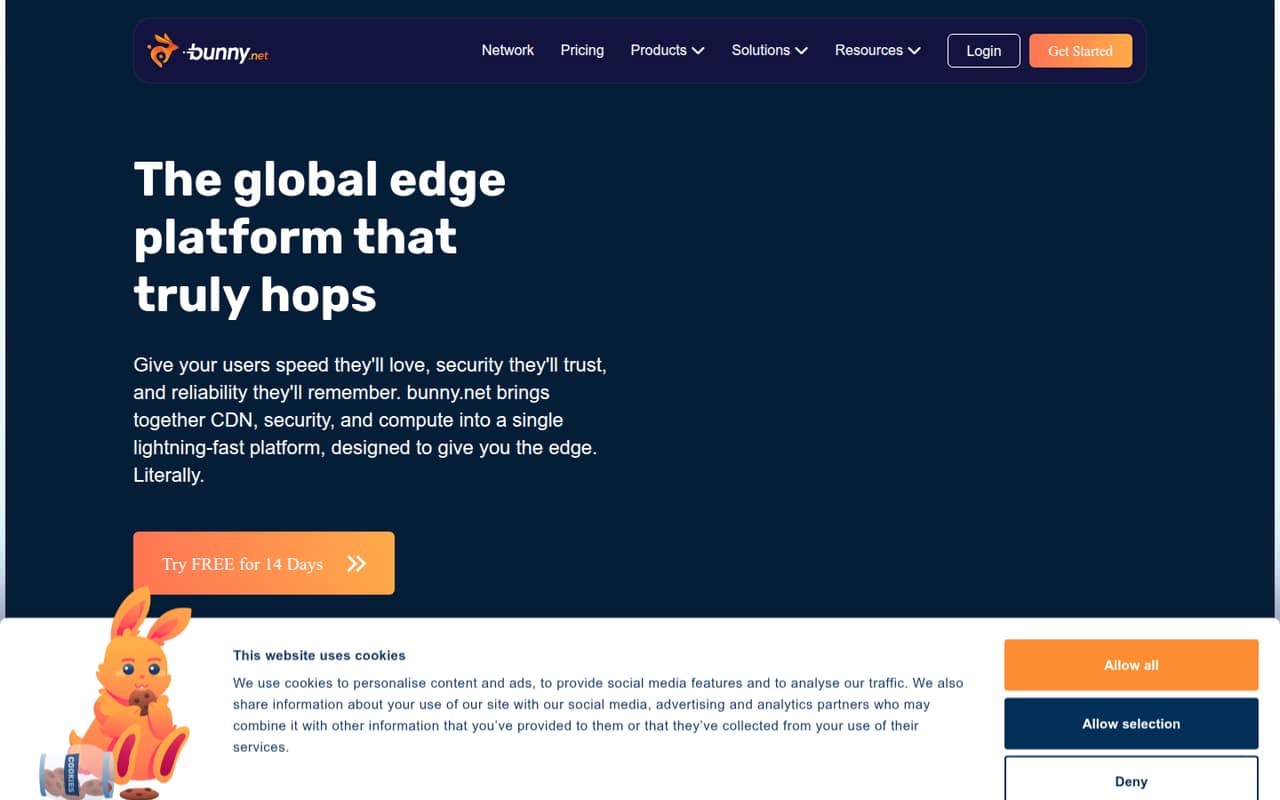
bunny.net is a vendor-operated edge platform for CDN, storage, video, security, DNS and compute. Its Standard network starts at $0.01/GB in Europe and North America, with a $1 monthly minimum and a 14-day free trial rather than a permanent free plan.
It brings several edge services under one provider, but developers should verify API, SDK and protocol requirements for their stack. Reddit feedback is mixed: some report good production experiences, while others flag IPv6, routing and HTTP/3 concerns.
Good fit if
- Projects serving global static assets
- Teams needing video and CDN
- Developers testing edge deployments
Skip it if
- Teams requiring a self-hosted CDN
- Stacks that depend on HTTP/3
- Buyers needing published SDK coverage
ScoresHow it rates
What works
- 119 edge locations listed on the homepage
- Standard CDN rates start at $0.01/GB in Europe and North America
- CDN, storage, video, DNS and compute in one platform
- 14-day trial; homepage says no credit card required
- Vendor advertises 24/7 support
What doesn't
- No permanent free plan listed
- A $1 monthly minimum applies
- API, SDK and language support need verification
- A Reddit commenter reports weaker IPv6 support
- A Reddit commenter says HTTP/3 is not supported
01What bunny.net is, technically
bunny.net is a vendor-operated global edge platform: a hosted set of services that sits between applications, origin servers and end users. Its CDN serves content from edge locations; Storage offers hot object storage replicated around the world; Stream handles video delivery; and Shield and DNS cover security and routing. For compute, Edge Scripting and Magic Containers are positioned for running applications at the edge. The homepage also lists SQLite-compatible databases and Optimizer for image processing.
That puts bunny.net alongside application infrastructure rather than inside an application as a library. A team can use it to deliver assets, video and images, route DNS, and run some workloads closer to users. The homepage lists 119+ edge locations, but that network footprint does not by itself establish performance for a particular route or workload. Treat it as a collection of hosted products: map each service to its role in your stack, then check its integration and operational details before moving production traffic.
02bunny.net API, SDKs and docs
The homepage presents hosted products rather than a language-specific library: CDN, Stream, Storage, Edge Scripting, Magic Containers, Database, Shield, Optimizer and DNS. It says Magic Containers can deploy apps globally and describes Database as SQLite-compatible, but gives no implementation details in that product overview. The deployment workflow for Edge Scripting and Magic Containers is therefore the relevant starting point for compute; CDN, storage and DNS need to fit your delivery and infrastructure configuration.
Before choosing bunny.net, confirm the vendor’s documentation for API protocol and endpoints, SDK availability by language, authentication, deployment workflow and any CLI or framework integrations your team needs. The homepage does not name a programming language or SDK, so do not assume your preferred stack has a maintained client. Also verify how configuration, logs and monitoring connect to your existing deployment pipeline. The vendor advertises real-time monitoring, but check which products and metrics it covers.
03bunny.net pricing for developers
The pricing details list no permanent free plan. The homepage offers a 14-day free trial and says no credit card is required. After that, CDN use is pay-as-you-go, with a $1 monthly minimum. The Standard network has 119 PoPs and charges $0.01/GB in Europe and North America, $0.045/GB in South America, $0.03/GB in Asia and Oceania, and $0.06/GB in the Middle East and Africa.
The Volume network has 10 PoPs: $0.005/GB for the first 500 TB, $0.004/GB from 500 TB to 1 PB, and $0.002/GB from 1 PB to 2 PB. From 2 PB, the listed instruction is to contact sales. These are network-specific CDN rates; confirm which network and regions match your traffic before estimating a bill. Annual billing is not listed. Prices for Stream, Storage, compute, Shield and other products are not published in these CDN rates, and add-on prices are not listed. Ask for the full service-level cost of your workload.
04bunny.net: open source, self-hosting and lock-in
bunny.net is presented as a hosted platform, not software to install on your own servers. A self-hosting route and an open-source licence are not published; teams that require either should ask the vendor before committing. The same applies to data export: confirm what can be exported, in what format, and what happens to stored objects, configuration and logs when an account closes.
Migration effort depends on which products you adopt. CDN delivery can generally be moved by changing delivery and DNS configuration, but dependencies on Bunny-specific storage, video, edge scripts or Magic Containers may require replacements and application changes. Keep origin storage and deployment artifacts accessible outside the platform where practical, and document DNS, cache and security configuration. The platform combines several services, but that convenience can increase the amount of configuration and workload you need to move later.
05bunny.net in production
The homepage lists 119+ edge locations, 1 million+ requests per second and 250 Tbps+ network capacity. These are vendor-published network figures, not a guarantee for a particular region, route or application. Validate cache behavior, origin failover, traffic patterns and security settings with your own workload. The homepage advertises DDoS protection, free SSL certificates and real-time monitoring; confirm the scope and configuration of each for the products you plan to use.
Reddit feedback is mixed. One commenter reports running Bunny in production but says its IPv6 support is weaker and that it does not seem to support QUIC/HTTP/3. Another commenter agrees on IPv6 and HTTP/3 concerns, while framing them as trade-offs rather than blockers. A commenter in a separate hosting thread says Magic Containers need better billing and reporting and are still in beta. Treat these as individual reports, not universal findings. Check current protocol support, product status, regional behavior, limits and billing details with the vendor before routing critical workloads.
From the threadsWhat users say
Reddit sentiment is mixed: some users report positive production experience, while others raise concerns about routing, IPv6 and HTTP/3. One commenter also flags Magic Containers' billing and reporting.
BunnyCDN is not a viable alternative. I have tried to move away from Cloudflare, but BunnyCDN is terrible. Its IPv6 support is far worse, its routing is 3 to 4 times slower than Cloudflare's, and it doesn't seem to support QUIC/HTTP3
Running Bunny in production here
I’ve had good experience with bunny. Though I think their magic containers need much better billing and reporting. It is officially still in beta, though
they've recently released many edge related products like workers and streaming and security on the edge
Questions people ask
Is bunny.net reliable?
The homepage advertises a global network, 119+ edge locations, DDoS protection and real-time monitoring. Those claims do not guarantee performance for your specific routes or workload. Reddit comments include both a report of production use and concerns about IPv6, routing and HTTP/3. Validate service behavior and current protocol support before depending on it.
How much does bunny.net cost?
The listed CDN pricing has a $1 monthly minimum. Standard network rates range from $0.01/GB in Europe and North America to $0.06/GB in the Middle East and Africa. A 14-day trial is offered, but there is no permanent free plan listed. Other product prices are not published in these CDN rates.
Does bunny.net have a free plan?
The pricing details list no free plan. The homepage offers a 14-day free trial and says no credit card is required. After the trial, CDN usage is pay-as-you-go with a $1 monthly minimum. Check the vendor’s current terms for what the trial covers and whether it includes the products you need.
Is bunny.net a replacement for Cloudflare?
It may cover several similar infrastructure needs, including CDN, DNS and security, and it also offers storage, video and edge compute. It is not a guaranteed like-for-like replacement. Reddit users report concerns about IPv6, routing and HTTP/3, so compare current protocol support and product requirements before switching.
Can I self-host bunny.net?
bunny.net is presented as a hosted edge platform. A self-hosting option and an open-source licence are not published. If you need to run the service on your own infrastructure, ask the vendor directly; otherwise, plan for a hosted-service migration path and check data export options before storing critical workloads.
Sources
- bunny.net homepage
- bunny.net pricing page
- Reddit: Still haven't found a European Cloudflare replacement. What are you actually running?
- Reddit: While the Web Waits: Remaining online during the Cloudflare outage. Bunny.net CDN a European alternative.
- Reddit: Putting a Bunny.net CDN in Front of My Static Blog
- Reddit: Porkbun + bunny.net (vs Cloudflare)