
We may earn a commission if you buy through links on this page. It never changes a score or a ranking. How we make money
The bottom line
A flexible managed browser layer; watch unit use and confirm self-hosting terms before committing.
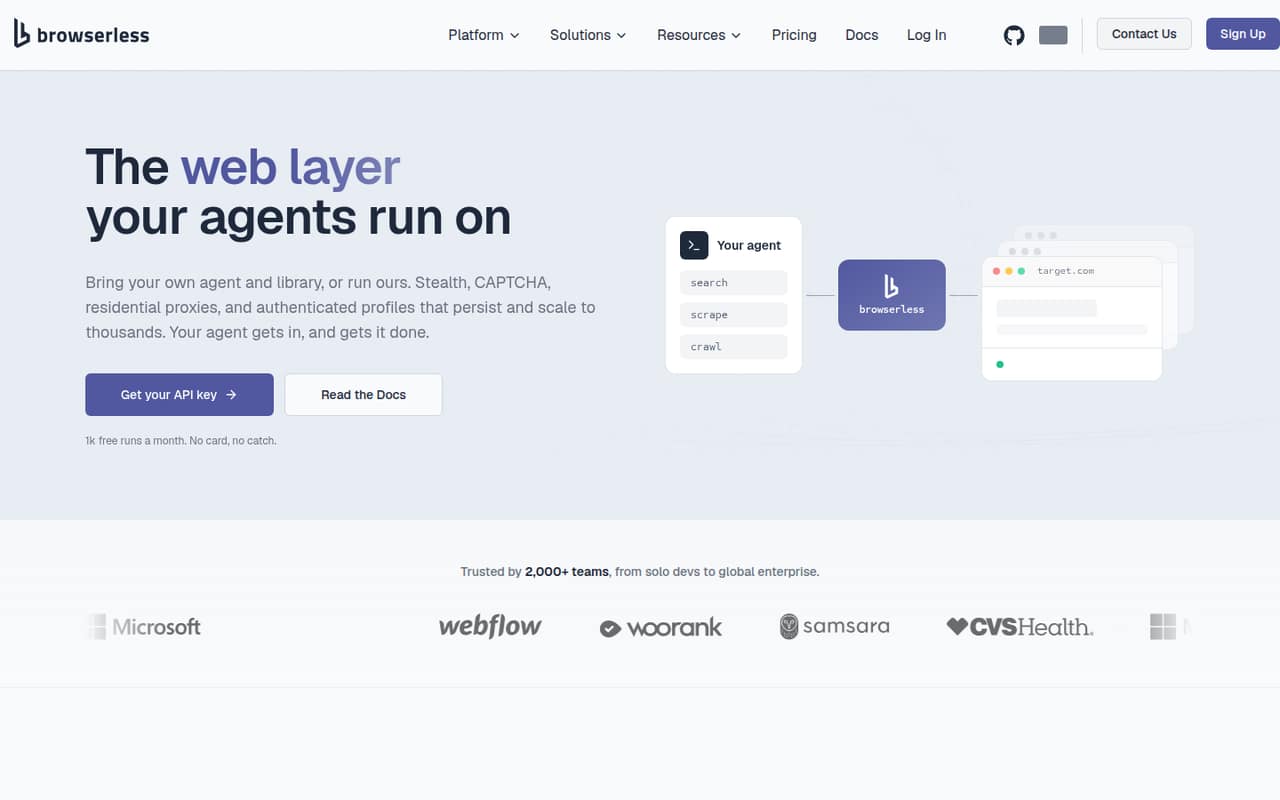
Browserless is managed browser infrastructure: connect Puppeteer or Playwright code, call browser APIs over HTTP, or give an MCP client search, scrape and crawl tools. It also offers self-hosted deployment, authenticated profiles, proxies and CAPTCHA solving.
The integration story is clear, but production economics depend on units, proxy traffic and CAPTCHA solves. Reddit reports include self-hosting maintenance and dropped sessions, while another self-hoster describes using it with changedetection.io. Confirm current licensing and deployment support before building around self-hosting.
Good fit if
- Puppeteer or Playwright teams
- MCP-based web agents
- Scraping with managed browsers
Skip it if
- Teams needing published rate limits
- Buyers requiring clear license terms
- Workloads with unpredictable unit spend
ScoresHow it rates
What works
- Connect existing Puppeteer and Playwright scripts
- Offers HTTP APIs and MCP tools
- Free tier includes 1k units monthly
- Self-hosted and cloud deployment options
- Includes proxies, CAPTCHA solving and persisted sessions
What doesn't
- Usage costs rise with units and add-ons
- Monthly prices are not published
- Self-hosting license terms need confirmation
- Reddit users report session and container issues
- Vendor does not publish a data export path
01What Browserless is, technically
Browserless is managed browser infrastructure, not a browser automation library or a desktop app. It runs browsers for your code and exposes them through hosted browser connections and HTTP APIs. You can connect existing Puppeteer or Playwright scripts to a managed browser, use APIs for scraping and browser tasks, or connect an MCP client to its search, scrape and crawl tools.
In a typical stack, Browserless sits between your application or agent and the target website. It handles browser execution and offers features such as proxies, CAPTCHA solving, session persistence, screenshots and PDFs. The vendor also offers self-hosting on customer infrastructure, with the same API across deployments. That gives teams a path to move browser workloads out of application containers without replacing their automation logic. The main trade-off is operational and financial: hosted usage is billed in units, while self-hosting leaves your team responsible for browser infrastructure.
02Browserless API, SDKs and docs
The main integration surfaces are a WebSocket browser endpoint, HTTP APIs and an MCP server. The homepage shows a Puppeteer connection using puppeteer.connect() and a wss://chrome.browserless.io endpoint with an API token. For scraping, it shows a POST /unblock request. The vendor also documents connecting Playwright and Chromium over CDP, and says MCP tools work with Claude, Cursor or any MCP client.
The example is TypeScript with puppeteer-core; the homepage also names Puppeteer and Playwright as supported automation libraries. It does not establish a separate SDK for every language, so confirm language and SDK support in the vendor docs before choosing a stack. The homepage links to API, MCP and self-hosting documentation. It also describes screenshots and PDF generation through APIs. Browserless says swapping launch() for connect() can leave existing automation code in place, though teams should verify their browser options and session behavior against their own workflows.
03Browserless pricing for developers
The Free plan costs $0 and includes 1k units per month, two concurrent browsers, a two-minute maximum session, one day of persisted sessions and replays, and an eight-hour log search window. Prototyping is $25 per month when billed annually and includes 20k units; Starter is $140 for 180k units; Scale is $350 for 500k units. The pricing page lists yearly billing as saving 30%; monthly prices are not published.
Overages are $0.0020 per unit on Prototyping, $0.0017 on Starter and $0.0015 on Scale. Residential proxies cost six units per MB, datacenter proxies two units per MB, and each successful CAPTCHA solve costs 10 units. Those add-ons can make a scraping workload cost more than its base plan suggests. Enterprise has custom pricing, millions of units consumed, and options for private deployment or licensed self-hosting. Model unit consumption and proxy traffic before choosing a tier.
04Browserless: open source, self-hosting and lock-in
Browserless offers self-hosted deployment on customer infrastructure and says the same API works across cloud, managed and self-hosted deployments. Enterprise pricing includes private deployment or licensed self-hosting. That makes self-hosting a deployment option, but it does not by itself establish that every current release can be used commercially without a license.
A Reddit discussion about Browserless's licensing refers to GPL and a commercial-license requirement, with commenters disputing how those terms apply. Treat that as a reason to verify the license for the exact version and use case with Browserless, not as current legal guidance. The vendor does not publish a data export path. Migration may be easier if your application stays on standard Puppeteer or Playwright APIs, but browser sessions, profiles and service-specific APIs can create work when moving away. Ask what can be exported and how long persisted data remains available.
05Browserless in production
Browserless lists plan-specific limits for monthly units, concurrent browsers, maximum session time and persisted-session retention. Check those against job duration and peak concurrency, and ask the vendor for rate limits and queue behavior before relying on it for bursty workloads. The homepage claims 99.9% uptime and says the service auto-scales; those are vendor claims, so confirm the applicable SLA and support terms for your plan. Its Trust Center is the place to review security and compliance details.
Reddit reports are mixed. One self-hosting team said containers silently died and long-running authenticated sessions had dropped connections and timeouts; a commenter said their team spent six hours a week maintaining browser infrastructure. In another thread, a self-hoster described using Browserless with changedetection.io. These are individual reports, not a reliability measure, but they point to the areas to test: long authenticated flows, reconnect behavior, browser upgrades and recovery after crashes. Set unit alerts and keep application-level retries and session recovery.
From the threadsWhat users say
Reddit sentiment is mixed: self-hosters value flexibility but describe operational overhead and session instability. Some users see the hosted service as a way to avoid maintaining browser infrastructure.
In practice I became a part-time DevOps engineer babysitting containers that would silently die mid-session
Sessions were fine for quick scrapes but anything long-running with auth would randomly crap out
We were spending like 6 hours a week just keeping the browser infra alive instead of building the actual agents
You can also program it to do things in steps, so you can have browserless log into a website for you and check things that are normally behind a login screen
Questions people ask
Can I use Browserless with Puppeteer or Playwright?
Yes. Browserless shows a Puppeteer connection using puppeteer.connect() and says existing Puppeteer and Playwright scripts can connect to managed browsers. It also names Chromium CDP connections. Check the docs for compatibility with your browser options, session setup and required library versions.
Does Browserless have an MCP server?
Yes. Browserless offers MCP tools for search, scrape and crawl. Its homepage says they can be used with Claude, Cursor or any MCP client. Confirm the current tool interfaces and authentication steps in the MCP documentation before wiring them into an agent.
Can I self-host Browserless?
Yes. Browserless offers self-hosted deployment on customer infrastructure and says the same API works across deployments. Enterprise pricing includes private deployment or licensed self-hosting. Confirm the current license for your version and commercial use case before deploying.
What does Browserless bill as a unit?
The published pricing gives unit allowances and overage rates, plus unit charges for proxy traffic and successful CAPTCHA solves. The pricing details here do not define every action's unit consumption. Ask Browserless how your specific browser sessions, API calls and enabled features translate into units.
Does Browserless retain authenticated sessions?
Browserless offers authenticated profiles and persisted sessions. The homepage says profiles can be reused across runs, while plan limits set persisted-session and replay retention from one to 90 days for the listed tiers. Review the docs and your plan terms for profile handling and retention details.
Sources
- Browserless homepage
- Browserless pricing page
- Reddit: Updated my setup so changedetection.io works with browserless v2
- Reddit: Browserbase vs Browserless.. which one actually held up for production agents?
- Reddit: Open-source web automation & scraping tool - Browserless 🤖
- Reddit: Any alternatives to Browserless.io