
We may earn a commission if you buy through links on this page. It never changes a score or a ranking. How we make money
The bottom line
A flexible browser-agent stack with transparent usage prices, but validate task reliability before production.
Browser Use combines hosted web agents that return JSON, cloud stealth browsers, and Browser Harness, a free, open-source tool for Claude Code and Codex. Pay-as-you-go use has no subscription, while enterprise adds custom deployment and terms.
The pricing is easy to inspect, but model-driven browser actions can fail on changing pages. Reddit feedback ranges from reports of useful real-world tasks to complaints about hallucinated clicks; test your own workflows before making the agent a critical path.
Good fit if
- Agents that need browser access
- Teams automating login-gated workflows
- Claude Code or Codex users
Skip it if
- Strictly deterministic browser workflows
- Teams needing published rate limits
- Buyers requiring a named open-source licence
ScoresHow it rates
What works
- Web agents return task results as JSON
- Pay-as-you-go has no monthly subscription
- Credits never expire
- Enterprise offers on-prem deployment
- Browser Harness is free and open source
What doesn't
- Model-driven clicks can fail on changing pages
- SDK and language support need confirmation
- Rate limits are not published
- Browser Harness licence is not named
- Self-serve support terms are not published
01What Browser Use is, technically
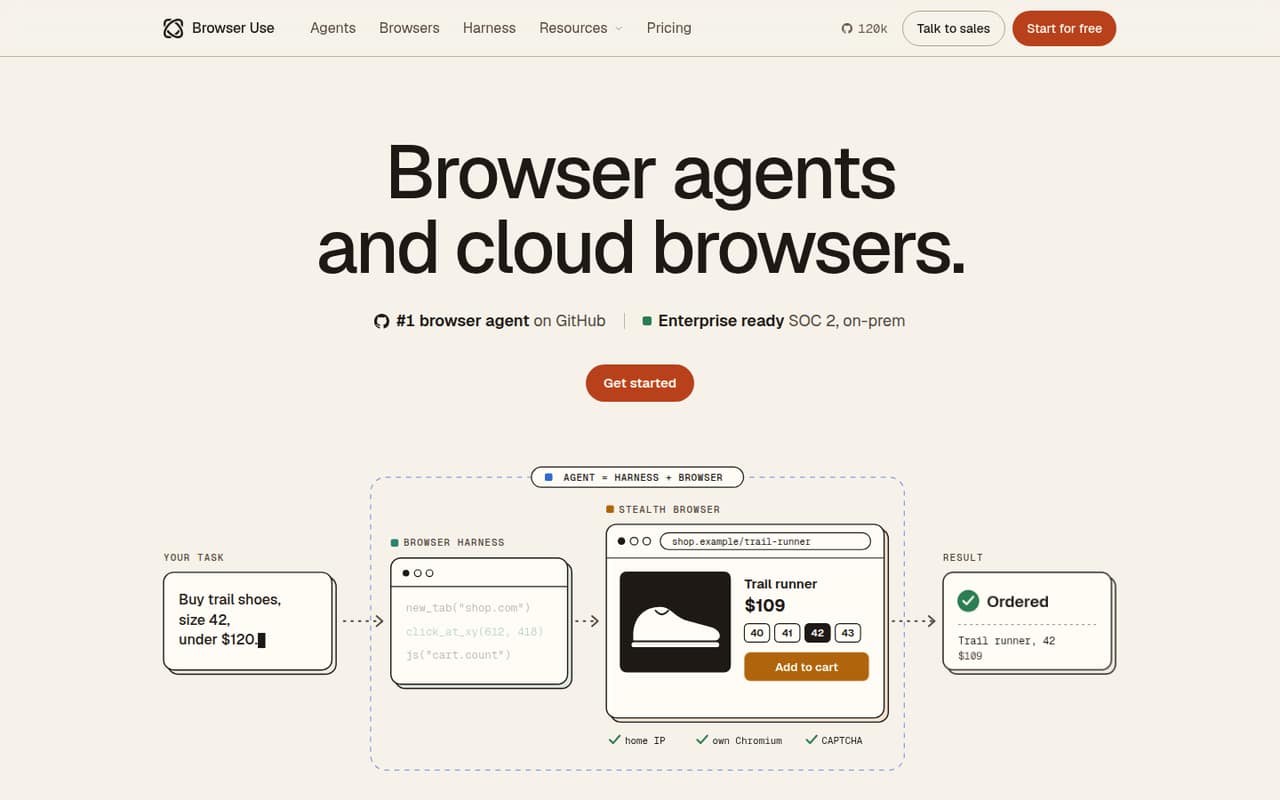
Browser Use is a hosted browser-agent and cloud-browser service, alongside Browser Harness, a free, open-source browser tool for Claude Code and Codex. The hosted agents accept a task and return JSON; the cloud browsers provide a browser environment designed to get past bot checks. Browser Harness is a separate integration surface for coding agents.
In a stack, Browser Use sits between an agent or application and the websites it needs to operate. The agent supplies the goal, Browser Use provides browser control, and the result can feed back into application logic. That differs from a fixed automation script: the agent decides how to carry out a task, so page changes and model decisions can affect outcomes. The vendor lists US or EU cloud, with EU runs in Frankfurt, and on-prem deployment for enterprise. It also lists SOC 2 Type II and HIPAA on enterprise plans.
02Browser Use API, SDKs and docs
The homepage describes a task-based web-agent interface: send a task and receive JSON. It also advertises stealth browsers and shows Browser Harness operations such as new_tab, click_at_xy and js. Browser Harness is positioned for Claude Code and Codex, and the homepage says it is used as the browser tool in Hermes Agent.
The homepage does not name a programming language, SDK, API protocol, CLI or webhook. Treat the task-to-JSON agent and Browser Harness as the published integration surfaces, and confirm SDK support, authentication, request and response schemas, and documentation details in the vendor’s docs before choosing a language or designing an adapter. The vendor advertises a $0.006-per-task web-agent price, but buyers should confirm which model and execution costs that task rate covers. For a production integration, also ask about retries, timeouts, idempotency, logs and how task results are retrieved.
03Browser Use pricing for developers
Pay as you go costs $0 per month, with a $1 one-time signup credit. The plan includes up to 1,000 browsers at once, credits that never expire, SOC 2 Type II and a signed DPA. There is no subscription or annual billing. Browser Harness is free and open source, but it is a separate tool rather than a stated allowance of hosted browser usage.
Hosted usage adds up by resource: browser time costs $0.02 per hour, billed by the minute with a one-minute minimum; home-IP traffic is $5/GB, while direct or your own proxy is $0.20/GB. BU Ultrafast is $0.006 per task. Agent models are billed at varying per-token rates, or a bring-your-own key costs the provider rate plus 0.2x. The vendor lists paid concurrency thresholds: $100 total paid for 50 browsers, $1,000 for 250, $5,000 for 500 and $25,000 for 1,000. Enterprise has custom pricing, annual credit pools and custom concurrency above 1,000.
04Browser Use: open source, self-hosting and lock-in
Browser Harness is described as free and open source, but the homepage does not name its licence. Check the repository’s licence before redistributing or embedding it in a product. The hosted web agents and cloud browsers are a separate service; the homepage lists on-prem deployment as an enterprise option, not as a self-serve installation path.
The vendor does not publish data-export or migration details on the homepage. Ask whether task inputs, JSON results, browser recordings and logs can be exported, how long they are retained, and whether an on-prem deployment changes those terms. Browser Harness may offer a more portable integration point than depending on hosted browser sessions, but the agent, model billing and browser infrastructure can still create service-specific dependencies. Confirm the supported export formats and what happens to stored data when an account closes.
05Browser Use in production
The vendor lists up to 1,000 concurrent browsers on Pay as you go, with higher custom concurrency on Enterprise. It does not publish request-rate limits or detailed retry and availability targets on the homepage; ask for those, plus the applicable SLA, before placing time-sensitive work on the service. Costs can include browser minutes, IP traffic and model tokens, not just the task rate.
Browser Use lists SOC 2 Type II and a signed DPA on Pay as you go, with HIPAA available on enterprise plans. Confirm the data-handling terms for your workload, and whether your deployment region and retention requirements are supported. Reddit feedback is mixed: one commenter praised varied tasks and CAPTCHA handling in the Web UI, while a separate thread describes hallucinated clicks and sessions that fail. Treat those as user reports, not service guarantees. Test retries, page changes, authentication and failure recovery against your own sites.
From the threadsWhat users say
Reddit sentiment is mixed. Some users describe successful real-world tasks, while others report unreliable clicks and question whether browser agents are ready for production.
easy to install and legitimately works as advertised
spent like two weeks watching browser-use hallucinate clicks on elements that didn't exist
start with browser-use just to get something running fast, the Python API is easier to get into
Because for me all I see is a video of the browser at the end in the recordings tab?
Questions people ask
What is Browser Use?
Browser Use offers hosted web agents that take a task and return JSON, cloud stealth browsers designed to get past bot checks, and Browser Harness, a free, open-source browser tool for Claude Code and Codex. Enterprise options include on-prem deployment and HIPAA availability.
Does Browser Use have an API or SDK?
The homepage describes web agents that accept a task and return JSON, and shows Browser Harness operations such as opening tabs and clicking at coordinates. It does not name a language, SDK or API protocol. Check the vendor’s docs for supported SDKs, authentication and request schemas before implementation.
Can I run Browser Use on-prem?
The vendor lists on-prem deployment as an Enterprise option. Pay as you go is described as self-serve browser and agent use, while Enterprise supports custom deployment and terms. Ask the vendor about installation requirements, supported infrastructure, upgrades and data handling for an on-prem deployment.
Is Browser Use suitable for production automation?
It can fit workflows that need an agent to operate a browser, but model-driven actions may fail as pages change. Reddit users report both successful tasks and hallucinated clicks. Validate your sites, authentication paths, retries, recovery behavior and cost under realistic workloads before relying on it.
Does Browser Use support HIPAA?
The vendor says HIPAA is available on Enterprise plans. The Pay as you go plan lists SOC 2 Type II and a signed DPA. Ask the vendor for the applicable contractual terms, deployment options and data-handling details for your workload.
Sources
- Browser Use homepage
- Browser Use pricing page
- Reddit: Tested 6 browser use agents for real-world tasks — here's an honest breakdown + looking for recommendations
- Reddit: Ok I admit it, Browser Use is insane (using gemini 2.0 flash-exp default) [https://github.com/browser-use/browser-use]
- Reddit: Stagehand vs Browser Use.. which one actually works for production agents?
- Reddit: Browser Use vs Playwright in 2026: When Should You Use an AI Browser Agent?