
We may earn a commission if you buy through links on this page. It never changes a score or a ranking. How we make money
The bottom line
A capable hosted search API for agents, with usage pricing and production details to verify.
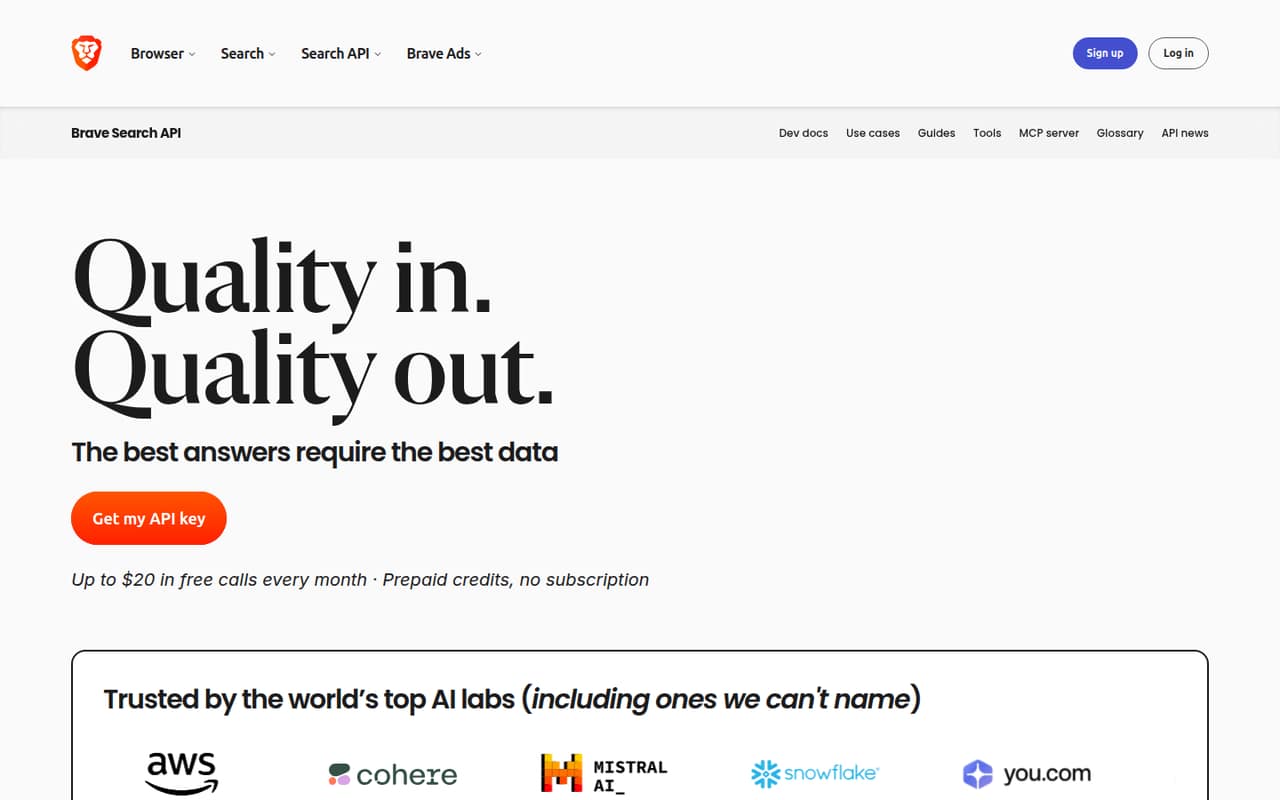
Brave Search API is a hosted HTTP API for web search and LLM context, backed by Brave’s own search index. Its LLM Context endpoint returns ranked passages with source URLs and timestamps, while other endpoints handle answers, images, video, news and web search.
The $5 monthly credit lowers the cost of getting started, and configurable context, Goggles and structured results offer useful retrieval controls. Before relying on it in production, verify how credits behave when depleted, how monthly ceilings work, and whether the API’s query and content limits fit your workload.
Good fit if
- AI agents needing ranked context
- Teams avoiding Google or Bing dependence
- Apps with variable search usage
Skip it if
- Teams requiring self-hosted search
- Workloads needing published monthly ceilings
- Apps that depend on guaranteed support terms
ScoresHow it rates
What works
- Own search index, with no Google or Bing dependency
- LLM Context returns ranked passages and source metadata
- Context size adjustable from 1k to about 33k tokens
- Goggles can re-rank results and define domain sets
- $5 monthly credit offsets eligible usage
What doesn't
- Monthly request and query ceilings are not published
- Answers has a lower rate limit than Search
- Source code and licence details are not published
- Self-hosting and data-export options are not published
- A production user reports query-length and reliability friction
01What Brave Search API is, technically
Brave Search API is a hosted HTTP API, not a search library or a self-hosted server. It sits in an application’s retrieval layer: your service sends a query to Brave, then uses the returned results or passages in an app, agent or model pipeline. Brave says its API is backed by its independent search index, which it crawls, ranks and serves itself rather than passing queries to Google or Bing.
The LLM Context endpoint is aimed at machine consumption. It returns ranked, extracted passages with source URLs and timestamps, so an application can provide a model with context without first processing a standard results page. Other endpoints cover answers, images, video, news and web search. The context endpoint lets developers set a size from 1k to about 33k tokens and choose a relevance threshold. That puts Brave between a search index and the application’s model: it supplies retrieval data, while the application still controls prompting, model choice and answer handling.
02Brave Search API API, SDKs and docs
Integration uses an HTTP API. Brave’s sample request calls https://api.search.brave.com/res/v1/llm/context with a q query parameter and an X-Subscription-Token header. The homepage lists Python, cURL, JavaScript and Go examples; confirm SDK support and language-specific setup in the vendor’s docs. The Python sample uses requests to make a GET request.
The API surface is broader than LLM Context: the homepage lists answers, image, video, news and web search. For retrieval tuning, developers can set context from 1k to about 33k tokens, select a strict, balanced or lenient relevance threshold, and use Goggles to re-rank results or define custom domain sets. Results can include extra snippets and schema-enriched data. Sources carry URLs and timestamps, with an option to filter to the last 24 hours. These controls are useful in an agent stack, but teams should check the docs for endpoint-specific parameters, error behavior, authentication handling and SDK support before choosing an integration pattern.
03Brave Search API pricing for developers
The pricing page lists a recurring $5 monthly credit for Search, Answers, Spellcheck and Autosuggest. At the Search rate of $5 per 1,000 requests, that credit covers 1,000 requests if used only for Search. The pricing notes describe prepaid, pay-as-you-go credits rather than a monthly or annual subscription. Reddit users say existing customers on the former free plan keep their 2,000 monthly requests; new customers should not assume that legacy allowance applies.
Search costs $5 per 1,000 requests, with a 50 requests-per-second limit. Answers costs $4 per 1,000 queries plus $5 per million input tokens and $5 per million output tokens, with a 2 requests-per-second limit. Spellcheck and Autosuggest each cost $5 per 10,000 requests and allow 100 requests per second. Monthly ceilings are not published for these plans. Enterprise pricing is custom. The pricing notes say usage draws down prepaid credits at the listed rate, but the overage behavior after credits run out is not published; confirm it before budgeting production traffic.
04Brave Search API: open source, self-hosting and lock-in
Brave presents this as a hosted API backed by its own search index. It does not publish a self-hosting option for the API or index, and the API’s source availability and open-source licence are not published. Treat the service as hosted-only unless Brave confirms otherwise. The index itself is described as Brave’s own crawled, ranked and served infrastructure.
The API returns results and source metadata to the calling application, but a separate data-export or bulk-export feature is not published. Applications can store returned data themselves, subject to their own policies and applicable terms; confirm usage and retention rights with Brave. Migrating away means replacing the retrieval calls and adapting result handling to another provider or an internal index. Query formats, passage structure and Brave-specific controls such as Goggles can create integration work, so isolate provider-specific code behind an application interface if portability matters.
05Brave Search API in production
Rate limits vary by plan: Search allows 50 requests per second, Answers 2, and Spellcheck and Autosuggest 100 each. Monthly request or query ceilings are not published. Teams should verify how throttling, retries, credit depletion and service availability work before setting production SLOs. The homepage describes source URLs and timestamps, metadata for last fetch, and a filter for the last 24 hours; confirm freshness expectations for the specific endpoint and workload.
One Reddit post describing three months of production use reports that a 400-character query limit became a problem and says the experience went badly. Treat that as one developer’s report, not a published limit or general reliability finding; confirm current query limits and test representative inputs. Another thread discusses uncertainty around the new pricing and credits. Brave’s index independence may reduce dependence on other search providers, but it does not remove the need to check security, privacy, data handling, support terms and incident procedures with the vendor.
From the threadsWhat users say
Reddit sentiment is mixed. Users welcome the context endpoint and the option to avoid dependence on Google or Bing, while pricing changes and at least one production account raise concerns.
The new LLM Context API goes beyond standard search results
Anyone who already subscribed to the Free Plan with 2,000 requests free per month will continue to have access to the plan
Spoiler it went pretty bad
I host my own SearXNG, and it has an API. Not sure if it's quite as good though
Questions people ask
Does Brave Search API have a free tier?
The pricing notes describe $5 in credits applied automatically each month to Search, Answers, Spellcheck and Autosuggest. At Search’s listed rate, that covers 1,000 requests if spent only on Search. Reddit users say existing subscribers to the former 2,000-request free plan keep access; new customers should verify their account’s terms.
What does Brave Search API cost?
Search costs $5 per 1,000 requests. Answers costs $4 per 1,000 queries, plus $5 per million input tokens and $5 per million output tokens. Spellcheck and Autosuggest each cost $5 per 10,000 requests. Enterprise pricing is custom, and the pricing notes describe prepaid credits rather than subscriptions.
What rate limits apply to Brave Search API?
The pricing page lists 50 requests per second for Search, 2 requests per second for Answers, and 100 requests per second each for Spellcheck and Autosuggest. Monthly request or query ceilings are not published. Check current endpoint-specific limits with Brave before estimating production capacity.
Does Brave Search API include LLM context?
Yes. Brave’s LLM Context endpoint returns ranked, extracted passages with source URLs and timestamps. Developers can configure the context from 1k to about 33k tokens and choose a relevance threshold. The pricing notes list Search at $5 per 1,000 requests.
Can I self-host Brave Search API?
Brave describes a hosted API backed by its own index. A self-hosting option, source availability and an open-source licence are not published. If your architecture requires on-premises search or control of the index, confirm those requirements with Brave before integrating.
Sources
- Brave Search API homepage
- Brave Search API pricing, compiled via web search from brave.com, twitterapi.io, cloro.dev, katteb.com, finks.ai
- Reddit: PSA: Brave Search API no longer free, other changes and features added
- Reddit: Brave Search API no longer free but chargers $5/1k searches, but...
- Reddit: What’s the best alternative to Brave Search API in 2026?
- Reddit: Honest Brave Search API review after 3 months of using it in production