
We may earn a commission if you buy through links on this page. It never changes a score or a ranking. How we make money
The bottom line
A broad communications API and carrier platform; confirm integration details and full production costs before committing.
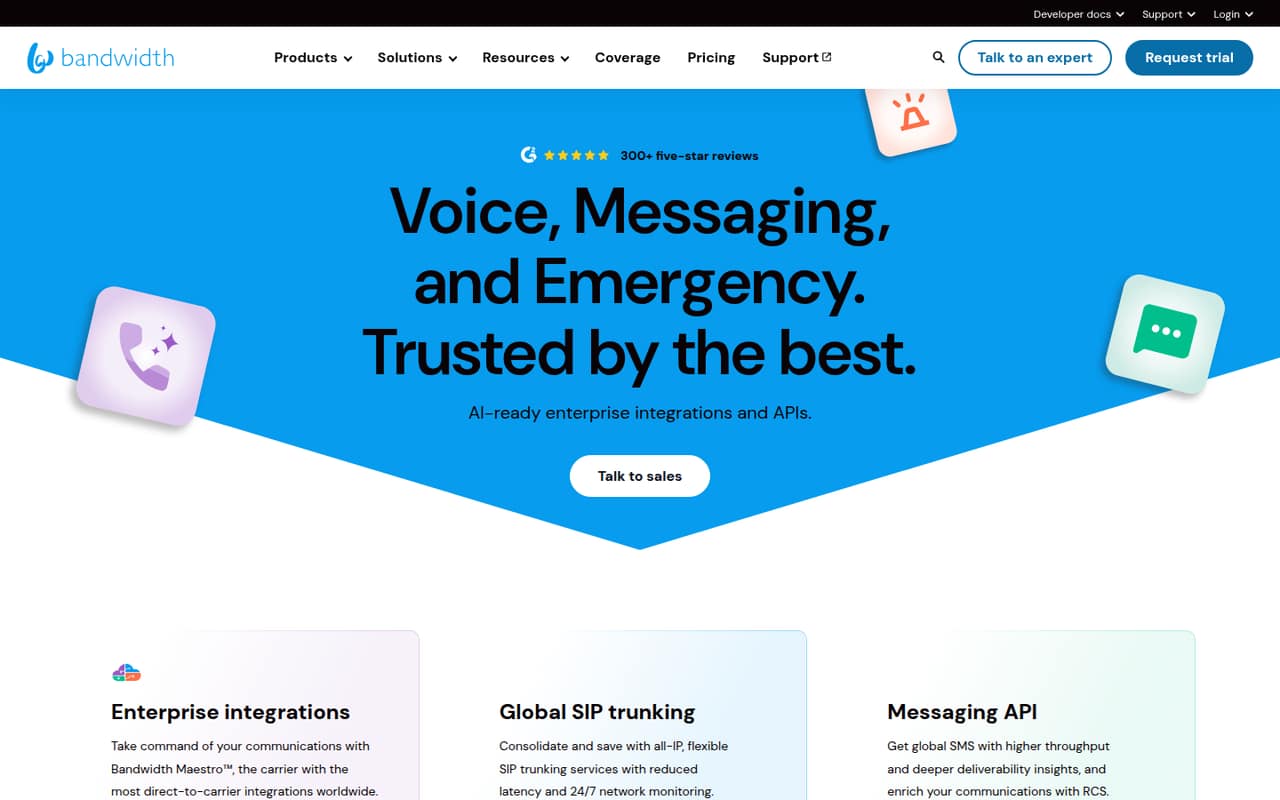
Bandwidth provides enterprise APIs for programmable voice, messaging and emergency communications, backed by its carrier network. Its homepage also lists global SIP trunking, RCS and integrations with contact center and business communications services.
Pricing is usage-based, with published per-message and per-minute rates for several products. There is no free plan listed. Teams should confirm API integration requirements, service limits and any additional charges with Bandwidth before sizing a production deployment.
Good fit if
- Enterprise communications platforms
- Teams needing carrier connectivity
- Voice and messaging application builders
Skip it if
- Developers needing a free tier
- Teams requiring self-hosted infrastructure
- Projects needing published SDK details
ScoresHow it rates
What works
- Voice, messaging and emergency communications from one provider
- Published per-unit rates for several API products
- PSTN connectivity in about 70 countries
- Messaging API includes global SMS and RCS
- Enterprise integrations include Salesforce, Webex and Microsoft Teams
What doesn't
- No free plan or free trial is listed
- SIP Trunking requires a custom quote
- API protocols, SDKs and languages need confirmation
- API-specific limits and rate limits are not published
- Self-hosting and open-source licensing are not listed
01What Bandwidth Communications APIs is, technically
Bandwidth is a communications API provider backed by its own carrier network and services. Application teams can use its APIs for programmable voice, messaging and emergency communications, while Bandwidth supplies connectivity into the public telephone network and other communications infrastructure. That puts it between an application or communications platform and the carrier services needed to reach users by voice or message.
The product is not presented as a library, CLI or self-hosted server. Bandwidth’s homepage describes enterprise APIs and services, global SIP trunking, and integrations with contact center and business communications tools. Its PSTN connectivity reaches about 70 countries, according to the homepage. That combination can suit teams building communications into a product or connecting existing enterprise systems. It is a broader commitment than adding a standalone SDK: the application depends on Bandwidth for API access and, where used, network connectivity.
02Bandwidth Communications APIs API, SDKs and docs
The integration surface is Bandwidth’s communications APIs, including programmable voice and Messaging APIs. The homepage also names Authentication and SIP Trunking as priced products, plus integrations for Salesforce Contact Center, Webex Calling, Google, Genesys, Five9 and Microsoft Teams. Microsoft Teams options include Direct Routing and Operator Connect. These integrations may reduce the work of connecting an existing communications stack, but they are distinct from an application SDK.
Bandwidth does not name API protocols, programming languages, SDKs, a CLI or webhook support on its homepage. Confirm the supported API style, SDK languages, authentication flow, versioning and documentation with the vendor before estimating integration effort. Also check which integrations are available for your specific products and account. The homepage promotes a request-trial path and sales contact, so teams should confirm whether access requires a sales-led setup and what credentials or provisioning steps are needed.
03Bandwidth Communications APIs pricing for developers
Bandwidth lists usage-based pricing and no free plan. Messaging APIs cost $0.004 per U.S. 10DLC SMS and $0.015 per MMS; U.S. short-code rates are $0.008 per SMS and $0.020 per MMS, while toll-free rates are $0.007 per SMS and $0.020 per MMS. These are message charges, so total spend rises with sending volume and the messaging route used.
For Voice API, listed rates include $0.0100 per minute for local outbound calling and $0.0055 per minute for inbound. Standard transcription is $0.0450 per minute, real-time transcription is $0.0451, recording is $0.0020 per minute, conferencing is $0.0015 per minute, and Answering Machine Detection is $0.0060 per call. In-app calling is $0.0025 per minute. Authentication is $0.0500 per two-factor authentication and $0.1500 per Call Verification. SIP Trunking is usage-based but requires a quote. Monthly and annual rates are not published; ask Bandwidth how applicable fees and billing are calculated for your traffic.
04Bandwidth Communications APIs: open source, self-hosting and lock-in
Bandwidth presents these products as commercial communications APIs and network services, not as an open-source package. The vendor does not publish an open-source licence or describe a self-hosting option on its homepage. Treat the APIs and carrier connectivity as hosted services, and confirm contract terms and service dependencies with Bandwidth before adopting them.
Your application can own its business logic, but communications behavior will depend on the API calls and Bandwidth services it uses. The homepage does not describe data export or migration tools. Before production, ask how to retrieve message and call records, what formats are available, how long records remain accessible, and how to port numbers or move traffic to another provider. Migration effort will depend on how tightly your code relies on Bandwidth-specific APIs and integrations; keep a provider boundary in your application if portability matters.
05Bandwidth Communications APIs in production
Bandwidth reports 99.999% core network uptime and 24/7 network monitoring for its global SIP trunking service. Those statements concern network infrastructure; confirm whether your specific API products have separate service-level commitments and what incident remedies apply. The homepage also reports PSTN connectivity in about 70 countries and coverage of 93% of the global economy. Check availability for the destinations and traffic types your application needs.
The vendor does not publish API rate limits, throughput caps or service-specific scaling limits on its homepage. Ask for limits before load planning, especially for high-volume messaging, concurrent calls and authentication traffic. The pricing page lists per-message, per-minute and per-call charges, so usage patterns and optional voice features affect the bill. Confirm security controls, data handling, retention, compliance responsibilities and emergency-calling behavior for your deployment. For SIP Trunking, request a quote and verify what the quoted usage charges include.
Questions people ask
What can developers build with Bandwidth Communications APIs?
Bandwidth lists APIs and services for programmable voice, messaging and emergency communications. Its Messaging API supports global SMS and RCS, while its homepage also features global SIP trunking and integrations with contact center and business communications tools. Confirm product availability and technical requirements with Bandwidth for your use case.
Does Bandwidth Communications APIs have a free tier?
No free plan or free trial is listed in the pricing information. The products are priced by usage, with rates published for several messaging, voice and authentication actions. Ask Bandwidth whether it offers trial access for your account and what setup or usage conditions apply.
Which programming languages and SDKs does Bandwidth support?
Bandwidth’s homepage does not name SDKs or programming languages. It identifies communications APIs and enterprise integrations, but developers should confirm supported languages, API protocols, SDK maintenance and documentation with the vendor before choosing an implementation.
How much does Bandwidth Voice API cost?
Listed Voice API rates include $0.0100 per minute for local outbound calls, $0.0055 per minute for inbound calls, and $0.0025 per minute for in-app calling. Transcription, recording, conferencing and Answering Machine Detection have separate rates, so the total depends on which features your application uses.
Does Bandwidth support international PSTN connectivity?
Bandwidth’s homepage says it provides PSTN connectivity in about 70 countries and coverage of 93% of the global economy. Confirm country-specific availability, supported call types and applicable rates with the vendor before relying on that coverage for a deployment.