
We may earn a commission if you buy through links on this page. It never changes a score or a ranking. How we make money
The bottom line
A hosted Azure route to generative AI, but budget for token usage and check quotas before launch.
Azure OpenAI Service is Microsoft’s hosted Azure offering for using OpenAI models in applications. It appears within Foundry Models, which supports model discovery from exploration through deployment; Microsoft Foundry also covers building and evaluating generative AI solutions and custom agents.
The fit is strongest for teams already building on Azure. Standard billing is usage-based, quotas include tokens per minute and requests per minute, and excess requests are throttled. Provisioned throughput and discounted batch processing offer alternatives, but published prices for these plans are not available in the pricing details reviewed.
Good fit if
- Teams already building on Azure
- Applications using generative AI
- Non-urgent batch workloads
Skip it if
- Teams requiring self-hosted models
- Projects needing fixed public prices
- Latency-critical workloads without quota checks
ScoresHow it rates
What works
- Listed within Foundry Models for model discovery
- Foundry covers model exploration through deployment
- Microsoft Foundry supports building and evaluating generative AI
- Standard billing follows input and output token usage
- Batch API lists a 50% discount on Global Standard pricing
What doesn't
- No Azure OpenAI-specific model details on the homepage
- Standard requests can be throttled when quotas are exceeded
- Provisioned throughput prices are not published
- No Azure OpenAI-specific free plan is listed
- A Reddit user reports poor speed
01What Azure OpenAI Service is, technically
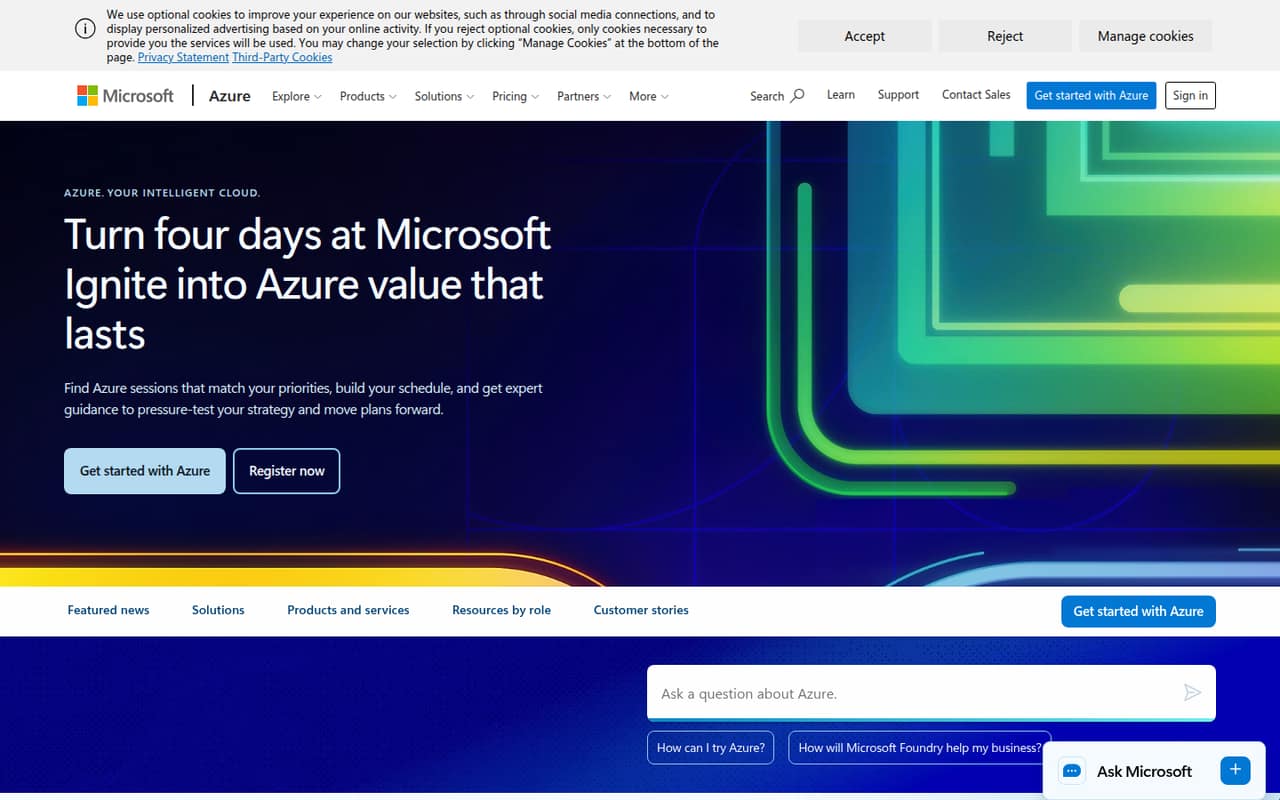
Azure OpenAI Service is Microsoft’s hosted Azure offering for using OpenAI models in applications. It is a cloud service, not a library, CLI or self-hosted server. The homepage lists Azure OpenAI within Foundry Models, alongside Foundry Agent Service, Foundry Tools and other Azure products.
In a typical stack, the service supplies the model capability while your application and surrounding Azure services handle product logic and workflows. Microsoft describes Foundry as a place to build, evaluate and deploy generative AI solutions. Foundry Models supports model selection from exploration through deployment, but the homepage does not give Azure OpenAI-specific model details. Azure also promotes building intelligent apps at enterprise scale and building custom agents through Microsoft Foundry. That makes the service relevant to teams adding generative AI to an existing Azure application, rather than teams looking for a complete standalone chatbot product.
02Azure OpenAI Service API, SDKs and docs
The homepage positions Azure OpenAI as a hosted service within Foundry Models, but it does not name an API protocol, SDK, programming language or CLI for this service. Microsoft directs developers to Azure documentation, developer resources and the Azure portal. Confirm the supported API surface, SDK versions, authentication method and language coverage in the service documentation before choosing a client or committing to an integration.
Foundry Models is presented as covering model selection from exploration through deployment. The broader Microsoft Foundry offer supports building and evaluating generative AI solutions and custom agents. Those are platform-level capabilities; the homepage does not map them to specific Azure OpenAI endpoints or SDK calls. For teams already using Azure, the service sits within Microsoft’s cloud product catalogue, and Azure’s AI apps and agents portfolio provides a broader application context. Plan to verify how your chosen model deployment connects to your app, logging and existing identity controls in Azure documentation.
03Azure OpenAI Service pricing for developers
There is no Azure OpenAI-specific free plan in the pricing details reviewed. A separate general Azure Free Account offer lists 30 days and $200 in Azure credit; it is not an ongoing free allowance, and the service’s own pricing details do not state how far that credit will go. Standard (On-Demand) bills input and output tokens, with quotas measured in tokens per minute and requests per minute. The vendor does not publish a starting price in the published pricing details.
For reserved capacity, Provisioned (PTUs) is billed per PTU-hour, with monthly and annual reservations available; those prices are not published. Throughput depends on allocated PTU units, and excess traffic may be throttled or spill over to Standard billing. Batch API is billed per token and lists a 50% discount on Global Standard pricing, with completions returned within 24 hours and separate batch quota limits. Standard and batch prices are not published on the vendor's site, so estimate costs with current rates before setting a production budget.
04Azure OpenAI Service: open source, self-hosting and lock-in
Azure OpenAI Service is a hosted Azure service, not an open-source package or a self-hosted server. The vendor does not publish an open-source licence for the service in the reviewed Azure homepage material. Model hosting is therefore tied to Azure rather than something you install on your own infrastructure.
The homepage does not describe data export or a migration path. Treat those as architecture questions to resolve before production: establish what application data, prompts, outputs and logs you can retrieve, and whether your integration depends on Azure-specific deployment or identity features. Keeping model calls behind an internal interface can reduce application-level coupling, but moving workloads still requires checking model availability, request compatibility, data handling and pricing at the destination. Ask Microsoft about applicable data-retention and export terms for your deployment.
05Azure OpenAI Service in production
The documented operational limit to plan around is quota: Standard uses tokens per minute and requests per minute, and excess requests are throttled. Batch API has its own quota limits and returns completions within 24 hours. Provisioned throughput depends on allocated PTU units; excess traffic can be throttled or spill over to Standard billing. Model deployment capacity, latency expectations and fallback behavior should be verified for the region and workload you intend to run.
The homepage does not state service-specific reliability, security or compliance commitments. Check the applicable Azure documentation and contract for those controls, along with monitoring, data handling and support terms. Reddit reports are mixed and anecdotal: one Azure user describes a simple Azure Function integration as easy to set up, while a commenter comparing service speed calls Azure OpenAI slow. Neither report establishes expected performance. Load-test your own application and set limits, retries and budget alerts around the quotas and billing mode you choose.
From the threadsWhat users say
Reddit comments describe practical application use, including invoice automation and internal support workflows, and one commenter found setup easy. Sentiment on speed is negative in a separate thread, but the comments are anecdotal and do not establish typical performance.
It's actually very easy to use and setup
We’ve used it alongside azure OCR to reach a pretty cool level of invoice automation
we use python SDK for Azure Open AI as it gets features faster than the .NET SDK
Azure OpenAI is slow AF
Questions people ask
What is Azure OpenAI Service?
Azure OpenAI Service is Microsoft’s hosted Azure offering for using OpenAI models in applications. The Azure homepage lists it within Foundry Models, which Microsoft describes as supporting model discovery from exploration through deployment. Microsoft Foundry also supports building and evaluating generative AI solutions.
Does Azure OpenAI Service have a free tier?
The pricing details reviewed do not list an Azure OpenAI-specific free tier. A general Azure Free Account offer lists 30 days and $200 in credit. That is a temporary Azure offer, not a continuing free allowance for Azure OpenAI usage.
How is Azure OpenAI Service billed?
Standard (On-Demand) and Batch API use per-token billing. Provisioned (PTUs) is billed per PTU-hour, with monthly and annual reservations available. Published prices were not available in the pricing details reviewed, so check current rates before estimating spend.
What happens when I exceed my Azure OpenAI quota?
Standard quotas use tokens per minute and requests per minute; excess requests are throttled. Batch API has separate quota limits. With Provisioned throughput, excess traffic may be throttled or spill over to Standard pay-as-you-go billing.
Can I self-host Azure OpenAI Service?
Azure OpenAI Service is a hosted Azure service, not a self-hosted server or an open-source package. If self-hosting or portability is a requirement, check what data you can export and assess how much your application depends on Azure-specific deployments and integrations.