
We may earn a commission if you buy through links on this page. It never changes a score or a ranking. How we make money
The bottom line
A managed Azure ML service with a $0 base charge and separately billed underlying resources.
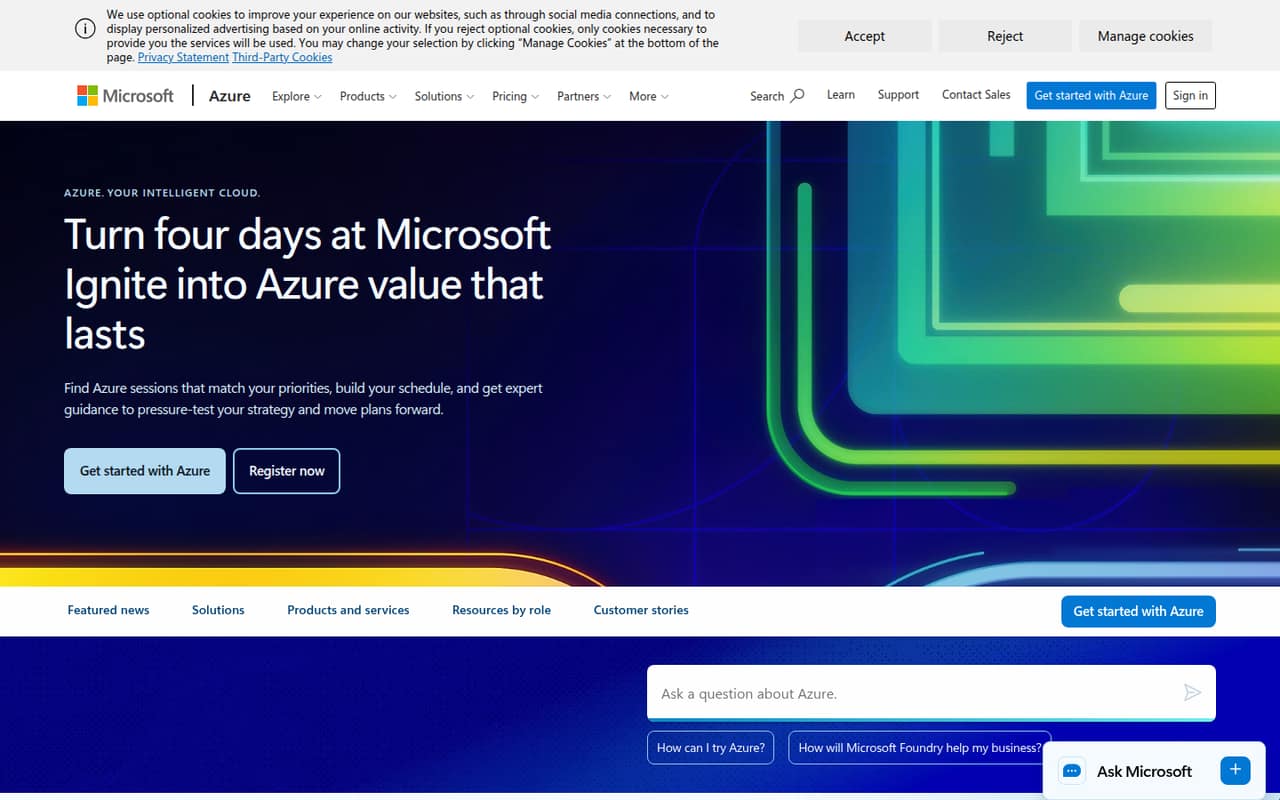
Azure Machine Learning is an Azure service for the end-to-end machine learning lifecycle, with MLOps in Azure’s solution set. The homepage positions it for enterprise use, but does not give developers enough integration detail to assess SDK or CLI fit without checking the product documentation.
The $0 base charge is not the cost of running a workload: compute and supporting Azure services are billed separately. Reddit users discuss API deployment and one reports a workspace-creation problem, so verify subscription access and deployment requirements before committing.
Good fit if
- Teams already building on Azure
- ML lifecycle and MLOps workloads
- Teams budgeting for variable compute
Skip it if
- Teams requiring self-hosting
- Projects needing published fixed pricing
- Developers needing confirmed SDK coverage
ScoresHow it rates
What works
- Covers the end-to-end machine learning lifecycle
- Azure lists MLOps among its solutions
- No base monthly or annual service charge
- Azure Free Account includes $200 credit for 30 days
- Underlying compute can use reservations or a savings plan
What doesn't
- Compute and supporting Azure resources cost extra
- Underlying resource rates are not published here
- Homepage does not identify SDKs or a CLI
- One Reddit user reports being unable to create a workspace
- Source availability and self-hosting options need confirmation
01What Azure Machine Learning is, technically
Azure Machine Learning is an Azure service for managing the end-to-end machine learning lifecycle. Architecturally, treat it as a managed cloud service in your Azure stack, not as a standalone library or a self-hosted server. Azure positions it alongside AI and machine learning products, and lists machine learning operations (MLOps) among its solutions.
That makes it relevant when a team wants ML work to sit within its Azure environment. Azure’s homepage also places deep learning within its AI infrastructure context, describing compute for even compute-intensive workloads. That is context for the broader Azure stack, not a published promise about a particular Azure Machine Learning compute tier.
The service’s stated scope is broad, but the homepage does not lay out its component architecture, deployment topology, or supported model workflows. Before choosing it, map where your code, data, model artifacts, and production endpoints will live, then confirm those details in Azure’s product documentation.
02Azure Machine Learning API, SDKs and docs
Azure’s homepage identifies Azure Machine Learning as a service and lists MLOps as a solution area, but does not name SDKs, languages, a CLI, or an API protocol. A Reddit user reports deploying a model from Studio as an API using its “setup web service” feature and receiving an API key; commenters discuss REST calls. Another commenter says the documentation they saw had Python and C# examples. Treat those as user reports, not a complete or current integration guide.
For a web application, that report suggests an HTTP integration may be possible, but confirm the supported endpoint, authentication flow, SDKs, and current deployment options in Azure’s docs before designing the client. One commenter notes that REST callers need to understand methods and authentication, and mentions API Management as an option. The homepage does not establish whether a CLI or particular language SDK is available, so verify SDK support in the vendor’s documentation. Avoid putting credentials in browser-side code; check the service’s documented security pattern for your application.
03Azure Machine Learning pricing for developers
Azure Machine Learning has a $0 base service charge per month; the pricing information lists no fixed annual price. The Azure Free Account offers $200 in credit for 30 days and 12 months of popular Azure free services. That credit is an account offer, not a stated promise that every Azure Machine Learning workload is free for 30 days or that the service itself has a permanent free tier.
The bill grows with the Azure resources your workload consumes. Compute, Blob Storage, Key Vault, Container Registry, and Application Insights are billed separately. The stated pricing information does not give fixed rates for those resources, so estimate them for your chosen configuration with Azure’s pricing tools before deployment. It also lists 1-year or 3-year reservations and a savings plan as ways to cover underlying compute, without fixed prices.
There is no published per-request or per-seat charge in the pricing facts. For production, model the compute and supporting services separately, and check how reservations or a savings plan fit expected usage. Don’t treat the $0 service charge as a workload budget.
04Azure Machine Learning: open source, self-hosting and lock-in
Azure presents Azure Machine Learning as an Azure service. The homepage does not publish its source licence, a self-hosted edition, or a data-export path; confirm those points with Microsoft before making them part of an architecture decision. Do not assume that the service can be deployed outside Azure or that its management layer is open source.
Plan for some Azure coupling if you build around the service: Azure bills compute and supporting resources such as Blob Storage, Key Vault, Container Registry, and Application Insights separately. Moving away would mean identifying replacements for those resources and for the ML lifecycle functions you use. Keep datasets, training code, model artifacts, and deployment definitions in formats your team can retain independently where the product supports it, and verify export options in the docs. Ask Microsoft which artifacts can be exported and which deployment or orchestration steps need to be rebuilt.
05Azure Machine Learning in production
The homepage frames Azure Machine Learning as enterprise-grade and covers the end-to-end ML lifecycle, but that positioning is not a substitute for checking service limits, regional availability, reliability commitments, security controls, and compliance terms for your workload. The pricing facts also do not give fixed underlying resource rates, so estimate compute and supporting Azure services before setting a production budget. Confirm how the service handles scaling and what limits apply to your selected deployment path.
A user in one r/AZURE thread says their subscription would not let them create a new workspace while trying to follow a learning exercise. That is a single report, not evidence of a general outage, but it makes subscription eligibility and permissions worth checking early. In another Reddit thread, a user reports deploying a model as an API and receiving an API key through Studio’s setup flow. Verify the current endpoint and authentication guidance in Azure’s docs before exposing it to an application.
From the threadsWhat users say
The small set of Reddit comments is mixed: users discuss API-based deployment, while one learner reports being blocked from creating a workspace. The comments do not establish broader reliability or support quality.
I do have one but I can’t use the machine learning service. It literally won’t let me create a new workspace
I have trained a model using Azure Machine Learning Studio and deploy it as an API
For REST API you don’t need a sample for every language or framework. You need to know methods and auth
But their documentation, there are only sample code examples for python, c#
Questions people ask
What is Azure Machine Learning?
Azure Machine Learning is an Azure service for the end-to-end machine learning lifecycle. Azure places it among its AI and machine learning products and lists MLOps among its solution areas. The homepage describes it as enterprise-grade but does not lay out a full technical architecture.
Does Azure Machine Learning have a free tier?
The service has a $0 base charge. The Azure Free Account offers $200 in credit for 30 days and 12 months of popular Azure free services. Compute and supporting Azure resources are billed separately, so check whether your particular workload fits within account credits and any applicable free-service limits.
How does Azure Machine Learning pricing work?
There is no base monthly or annual service fee in the stated pricing. You pay separately for underlying compute, Blob Storage, Key Vault, Container Registry, and Application Insights. Their costs depend on the resources used; the pricing facts do not give fixed rates. Azure lists reservations and a savings plan for compute.
Can I call an Azure Machine Learning model from my application?
A Reddit user reports deploying a model as an API from Studio and receiving an API key. Commenters discuss REST calls, and one mentions Python and C# examples in the documentation they saw. Confirm the current endpoint, authentication method, and supported SDKs in Azure’s docs before integrating.
Can I self-host Azure Machine Learning?
Azure presents Azure Machine Learning as an Azure service. The homepage does not publish a self-hosted edition or the service’s source licence, so do not assume either is available. If self-hosting or portability is a requirement, ask Microsoft about deployment options, licensing, and export of data and model artifacts.