
We may earn a commission if you buy through links on this page. It never changes a score or a ranking. How we make money
The bottom line
A capable agent observability platform, with a free tier and a self-hostable open-source option.
Arize AX is a hosted platform for tracing, evaluating and debugging AI agents; Phoenix is its open-source, local-first alternative. OpenInference and OpenTelemetry support can reduce dependence on a proprietary trace format, and AX Free offers a route to evaluate the workflow before paying.
The main production checks are usage ceilings, retention, deployment requirements and operational commitments. AX Free and Pro cap issues, spans, ingestion and retention; Enterprise has custom pricing and deployment options. The Reddit threads we read is mixed, with commenters noting that agent traces alone may not expose infrastructure failures.
Good fit if
- Teams tracing AI agents in production
- Engineers building evaluation workflows
- Teams wanting local-first observability
Skip it if
- Teams needing published rate limits
- Projects requiring fixed enterprise pricing
- Teams avoiding observability platform dependencies
ScoresHow it rates
What works
- Traces include token, latency and cost data
- Supports span, trace and session evaluations
- Phoenix can run locally or self-hosted
- OpenInference and OpenTelemetry support interoperability
- AX plans include unlimited users and evaluations
What doesn't
- AX Free caps spans, ingestion, issues and retention
- AX Pro limits usage and retention
- Enterprise pricing is custom
- SDK languages and API style need confirmation
- Rate limits and service commitments need verification
01What Arize AI is, technically
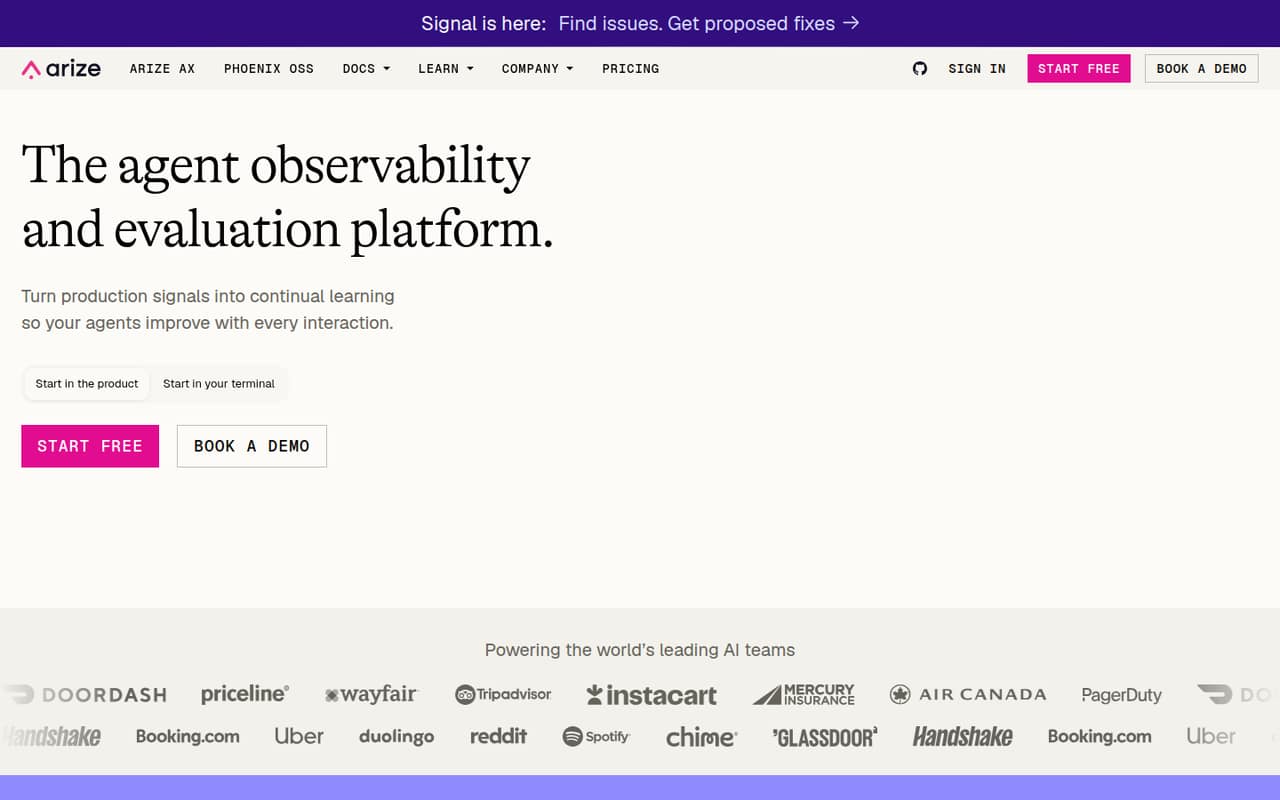
Arize AX is a managed SaaS platform for observing, evaluating and improving AI applications, including agents. Instrument an application, send traces, then use the hosted product to inspect agent activity, run evaluations and investigate production issues. Traces include token, latency and cost data; evaluations can run at span, trace and session levels. Signal surfaces issues and proposes fixes, while Alyx is an AI engineering agent for running evaluations and debugging.
Phoenix is Arize’s open-source, local-first observability and evaluation option. The vendor says it can run locally or be self-hosted, letting teams trace LLM calls, evaluate behavior and investigate failures. Both products use OpenInference and OpenTelemetry conventions. AX adds managed infrastructure, online evaluations and workflows for production improvement; its Enterprise plan lists SaaS or self-hosted deployment. In a stack, Arize sits alongside the application and its model or agent framework, collecting traces for development and production analysis.
02Arize AI API, SDKs and docs
The documented integration path is to connect an agent or application and send its first trace. Arize names OpenInference, built on OpenTelemetry, as its semantic convention and tracing foundation; the stated aim is instrumentation without a proprietary trace format. The homepage offers a terminal setup through npx and links to a setup guide, docs and cookbooks. It does not name programming languages or describe an API style, so confirm SDK and API support in Arize’s docs before choosing an instrumentation path.
The vendor lists integrations with more than 40 models, frameworks and AI tools, including OpenAI, Anthropic, Google, Amazon Bedrock, LangGraph, LangChain, LlamaIndex, CrewAI, OpenAI Agents SDK and DSPy. It also names Cursor, Claude Code and OpenCode for agent-native workflows. Open standards support work across Google Cloud, AWS, Azure and self-hosted environments. ADB stores traces in open formats and connects through DataFabric to BigQuery, Databricks and Snowflake. Check the docs for the exact integration steps and compatibility for your stack.
03Arize AI pricing for developers
AX Free costs $0 per month and includes 10 issues, 25,000 spans, 1 GB of ingestion and 15-day retention per month. It includes unlimited users and evaluations, but its issue, span, ingestion and retention ceilings make it a trial-sized production allowance rather than an unlimited free service. Phoenix is the open-source local-first option; the published pricing does not list a Phoenix fee.
AX Pro costs $50 per month and raises the listed allowances to 25 issues, 50,000 spans, 10 GB ingestion and 30-day retention, with unlimited users and evaluations. The plan price is monthly; annual pricing is not published. AX Enterprise has custom pricing, unlimited Signal issues and custom spans, ingestion and retention, plus SaaS or self-hosted deployment. The pricing page does not list overage rates, add-ons or a free trial. Before production, ask how additional usage is handled, whether limits can be raised mid-cycle and what Enterprise deployment costs. User counts and evaluation counts are unlimited on the listed AX plans, so the published thresholds center on usage and retention.
04Arize AI: open source, self-hosting and lock-in
Phoenix is described by Arize as open source and can run locally or be self-hosted. The vendor does not name Phoenix’s licence on the vendor's site, so check the repository licence and obligations before distributing or modifying it. AX Enterprise lists SaaS or self-hosted deployment; AX Free and Pro are listed as monthly plans without a self-hosted option.
Arize says OpenInference uses OpenTelemetry and avoids a proprietary trace format. Its ADB datastore stores traces in open formats and connects through DataFabric to BigQuery, Databricks and Snowflake. Those choices can make instrumentation and downstream access more portable, but they do not by themselves establish complete export coverage or a migration path for evaluations, dashboards and workflow configuration. Confirm which data and configuration can be exported, in what formats, and whether export carries a fee. Phoenix offers a route to run without AX’s managed service, but expect to operate the infrastructure yourself.
05Arize AI in production
AX Free and Pro impose explicit monthly ceilings for issues, spans and ingestion, with retention of 15 and 30 days respectively. Enterprise allows custom spans, ingestion and retention. The vendor does not publish rate limits or SLA terms on its homepage, so ask about ingestion behavior at peak load, alert delivery, incident response and service commitments before making AX a production dependency.
Arize lists SOC 2 Type II, ISO 27001, PCI DSS, HIPAA and GDPR among its security and compliance credentials. Verify the specific deployment’s scope, data handling terms and requirements with the Trust Center. One Reddit thread argues that tracing prompts and completions may not reveal infrastructure causes such as Kubernetes OOMs; a commenter points out that infrastructure monitoring can cover those failures. That is a useful boundary to plan for: agent traces explain application behavior, while cluster, network and database monitoring may still be needed to diagnose the full request path.
From the threadsWhat users say
The Reddit threads we read is mixed and small in scope. Commenters see value in connecting AI evaluation to production monitoring, while raising the point that agent traces do not replace infrastructure observability.
when an AI app's output degrades, the cause can sit anywhere from the prompt to the model to the infrastructure underneath it
It is true, but it’s not unsolved, as Datadog has been doing it for a while
We would therefore alert you in case a misconfigured pod leads to OOMs and therefore impacts your agentic workloads
Production monitoring and pre-deployment testing shouldn't be siloed
Questions people ask
What is the difference between Arize AX and Phoenix?
AX is Arize’s managed AI engineering platform, with managed infrastructure, agent observability, online evaluations and continual-improvement workflows. Phoenix is the open-source, local-first observability and evaluation option. The vendor says Phoenix can run locally or be self-hosted; AX Enterprise lists both SaaS and self-hosted deployment.
What can Arize trace and evaluate?
Arize traces agent activity, including token, latency and cost data. The platform supports span, trace and session evaluations. Its stated use cases include understanding application behavior, measuring quality, monitoring production performance and improving prompts, models and workflows.
Which frameworks and models does Arize integrate with?
Arize says it integrates with more than 40 models, frameworks and AI tools. Named examples include OpenAI, Anthropic, Google, Amazon Bedrock, LangGraph, LangChain, LlamaIndex, CrewAI, OpenAI Agents SDK and DSPy. Confirm exact support and setup instructions in the docs for your versions.
Can I self-host Arize?
Phoenix can run locally or be self-hosted. AX Enterprise lists SaaS or self-hosted deployment. AX Free and AX Pro are listed as monthly plans, without a self-hosted deployment option. Ask Arize about self-hosted requirements, support and pricing for your intended setup.
What security and compliance credentials does Arize list?
Arize lists SOC 2 Type II, ISO 27001, PCI DSS, HIPAA and GDPR. Its homepage directs buyers to the Trust Center for details. Confirm the scope of each certification, applicable deployment options and data-processing terms for your use case.