
We may earn a commission if you buy through links on this page. It never changes a score or a ranking. How we make money
The bottom line
A flexible, open-source backend platform; budget around resource limits and validate function behavior.
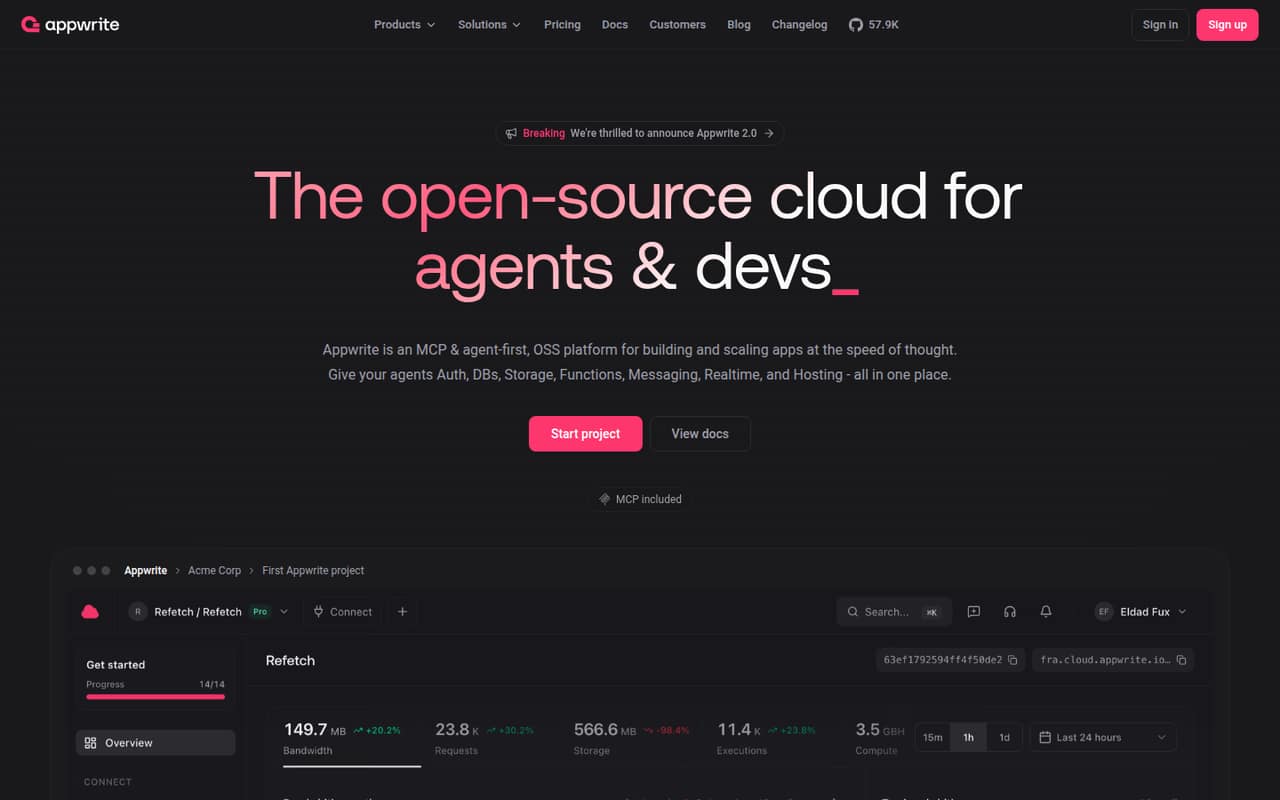
Appwrite combines authentication, databases, storage, functions, messaging, realtime and hosting in a Cloud or self-hosted backend platform. Its mix of managed PostgreSQL and MySQL and Appwrite databases gives teams options, but the right fit depends on your data model and deployment needs.
The Free plan includes all platform services but freezes projects at resource limits. Pro adds usage charges, while database compute and optional HA replicas or point-in-time recovery add separate costs. Reddit users report both stable self-hosted deployments and concerns about function timeouts and Cloud errors, so test your workload before committing.
Good fit if
- Teams wanting a broad backend stack
- Projects needing Cloud or self-hosting
- Agent workflows using MCP
Skip it if
- Teams requiring published SDK details
- Projects needing predictable usage costs
- Workloads that cannot tolerate function issues
ScoresHow it rates
What works
- Auth, databases, storage and functions in one platform
- Offers Cloud and self-hosted environments
- Supports managed PostgreSQL and MySQL
- Free plan includes all platform services
- Data migrations between Cloud and self-hosted
What doesn't
- Free projects freeze at resource limits
- Pro subscription price is not published
- Database read, write and storage rates are not shown
- Homepage does not name SDKs or languages
- Reddit users report function timeouts and Cloud errors
01What Appwrite is, technically
Appwrite is an open-source backend platform offered as a hosted Cloud service and a self-hosted environment. It sits behind an application’s frontend and provides backend services through Appwrite APIs: authentication, databases, file storage, serverless functions, messaging and realtime. The platform also includes Sites for deploying frontends from Git.
That makes Appwrite a backend-as-a-service rather than a standalone database, frontend framework or client library. You can use Appwrite databases or managed PostgreSQL and MySQL, then connect authentication, storage and functions around the app. The vendor describes Appwrite as agent-first and says MCP is included, positioning it for both developers and AI agents working with a live project.
Cloud removes the need to run the platform infrastructure yourself. Self-hosting gives teams another deployment path, but also means operating the backend. The choice is architectural: use Appwrite as a managed backend, or run its server in infrastructure you control.
02Appwrite API, SDKs and docs
The homepage identifies backend APIs and MCP as integration surfaces, and names Cursor, Claude Code and Codex among the agents it works with. Appwrite also exposes services such as event-driven Functions and Realtime subscriptions. The homepage does not name SDK languages, a CLI, or a specific API protocol, so confirm SDK and protocol support in the vendor’s docs before choosing it for a language-specific codebase.
The service model is modular: add authentication, databases, storage, messaging or functions as the app needs them. Sites deploy static, SSR and CSR frontends from Git with instant previews. The vendor’s homepage links to documentation and describes data migrations from third parties or between Cloud and self-hosted environments.
For an AI-assisted workflow, MCP is the named integration point. For conventional application code, check the official docs for the client libraries, authentication flows and API operations available for your chosen language. Also verify whether the integration supports the deployment mode you plan to use.
03Appwrite pricing for developers
Appwrite Cloud has a Free plan at $0 per month. It includes all platform services, but projects freeze when they reach resource limits; usage limits reset each billing cycle. The vendor does not publish the Pro subscription price in the published pricing details. Pro includes email alerts at 75% and 100% of resource limits, additional resource charges at limits, and an organization budget cap.
Database compute is a separate monthly cost. Listed tiers run from Starter at $10 to Scale Max at $4,099 per database per month. Appwrite includes $10 of database compute credits monthly. HA replicas cost the full price of the selected compute tier per replica; point-in-time recovery adds 20% of base compute price. Read/write overage and storage rates are not shown on the vendor’s site, so ask for those figures before estimating production spend. The pricing page lists database compute prices monthly but does not say whether Free or Pro subscriptions have annual billing.
04Appwrite: open source, self-hosting and lock-in
Appwrite describes itself as open-source and offers a self-hosted environment as well as Cloud. The exact open-source licence is not published in the available vendor material, so check the repository licence before incorporating the server into a product or modifying it.
The vendor says its data migration tools can move data from third parties or between Cloud and self-hosted environments. That gives teams a documented route between Appwrite deployment types, but it is not a guarantee that every data model or service configuration exports cleanly. The homepage does not describe a general data-export format or a full migration path to another backend.
Application code that depends on Appwrite’s auth, database and function APIs will need adapting if you leave. Confirm export formats and migration coverage for each service you use, and test a sample exit before relying on Cloud for production data.
05Appwrite in production
Appwrite lists encryption in transit and at rest, DDoS protection, abuse controls and a global CDN among its platform features. Its homepage says the infrastructure is designed for high security and privacy standards, and describes support for GDPR workflows and controls related to HIPAA and CCPA. Treat those as vendor claims to verify against your compliance requirements; the homepage does not establish that every deployment is certified or compliant by default.
Plan around resource limits: Free projects freeze at their limits, while Pro incurs additional resource charges. Check the unpublished read/write overage and storage rates, and establish alerts or budget caps before launch. For database-heavy workloads, include compute, replica and recovery costs in the forecast.
Reddit feedback is mixed. One user reports functions timing out, especially during cold starts; another says self-hosted Appwrite remained stable in production. Other commenters mention Cloud server errors. Test function behavior and operational recovery in your own deployment before depending on it.
From the threadsWhat users say
Reddit sentiment is mixed: some commenters describe stable self-hosted use and positive progress, while others report function timeouts and Cloud errors. Pricing opinions also vary, so validate the plan against your expected usage.
functions are super unreliable. They randomly time out
1.9.6 was a strong step in the right direction
The main reason isn't the $25 fee but the frequent "Server Error" errors on the console with no description
I think it's completely reasonable, so the company can stay healthy
Questions people ask
How much does Appwrite cost?
Appwrite Cloud has a Free plan at $0 per month. Its Pro subscription price is not published in the available pricing details. Pro can also incur resource charges at limits. Dedicated database compute is priced separately, starting at $10 per database per month for the Starter tier.
Can I self-host Appwrite?
Yes. Appwrite offers a self-hosted environment alongside Cloud. The vendor says data migrations can move between Cloud and self-hosted environments. Self-hosting means you operate the platform infrastructure; Appwrite does not publish an infrastructure cost estimate in the published details.
What services does Appwrite include?
Appwrite brings authentication, databases, storage, functions, Sites, messaging and realtime into one platform. It supports email, SMS, OAuth, anonymous sessions and magic URLs for auth; databases include Appwrite databases and managed PostgreSQL and MySQL.
Does Appwrite support SQL databases?
Appwrite offers managed PostgreSQL and MySQL as database options, alongside Appwrite databases. The choice affects how you model and query data, so check the vendor docs for the specific database features and APIs you need before deciding.
What happens when a Free project reaches its limits?
The Free plan says projects freeze at resource limits, and usage limits reset each billing cycle. The pricing details do not give the resource thresholds for each service. Check the current plan limits before launch, especially if a freeze would interrupt a production app.