
We may earn a commission if you buy through links on this page. It never changes a score or a ranking. How we make money
The bottom line
Appsmith fits teams building data-connected internal apps that need JavaScript control and self-hosting.
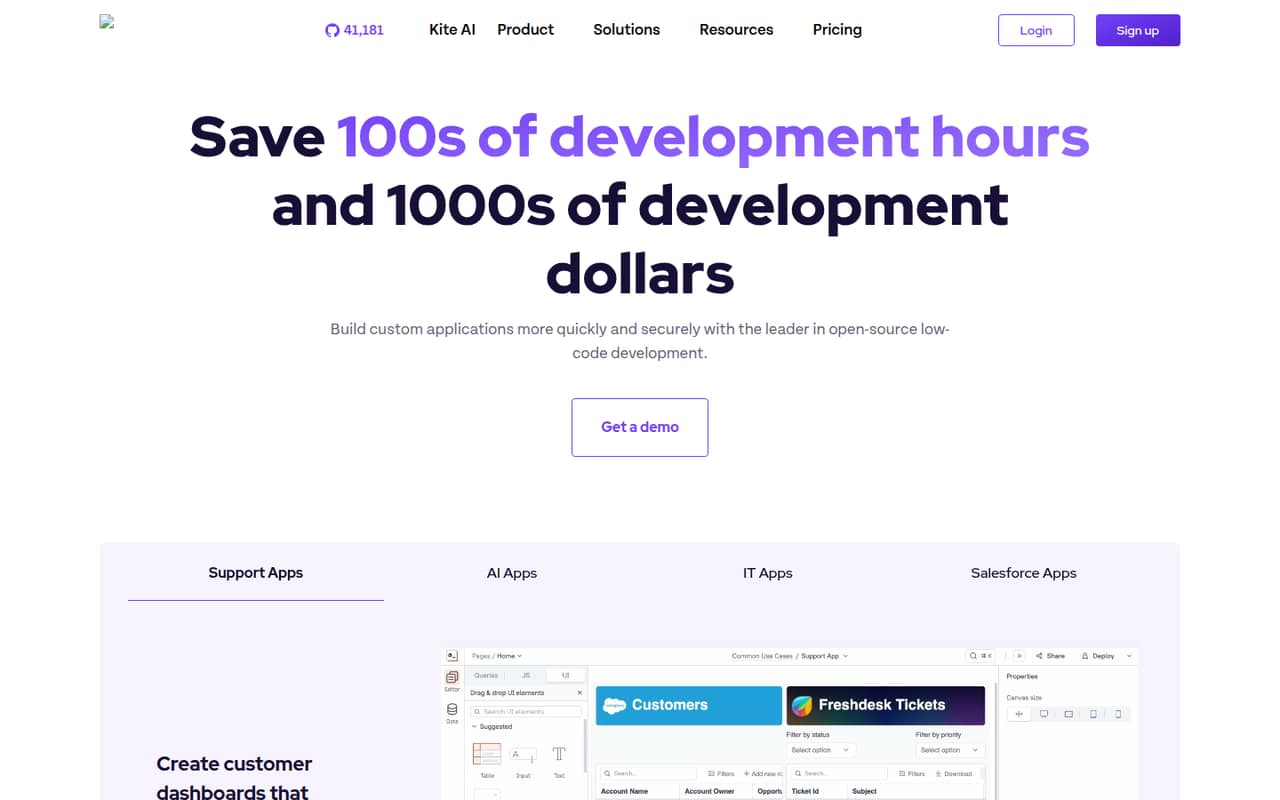
Appsmith is a low-code application platform, not a general-purpose API or UI library. Teams assemble interfaces with widgets, add logic in JavaScript, connect databases and REST or GraphQL APIs, and manage changes through Git. It can run in a vendor-hosted cloud or in your own infrastructure, including air-gapped deployments.
The main trade-off is between fast assembly and portability: apps use Appsmith’s platform and widget model, so moving them to another runtime is likely a rebuild. The free options and self-hosting make it easy to start, while Business charges per user and Enterprise starts at 100 users. Confirm plan fit, deployment requirements and current SDK support before committing.
Good fit if
- Internal tools connected to business data
- Teams that want Git-based deployment
- Organizations requiring self-hosting
Skip it if
- Teams seeking a portable UI library
- Apps that avoid platform-specific runtimes
- Projects requiring published rate limits
ScoresHow it rates
What works
- Connects to databases, SaaS tools, REST and GraphQL APIs
- Customize widgets and logic with JavaScript, HTML and CSS
- Git workflows support branches, reviews and deployment
- Apache 2.0 Community Edition is available
- Any edition can run in your infrastructure
What doesn't
- Business charges per user, with full-month billing
- Enterprise starts at 100 users
- Appsmith-specific widgets and workflows create migration work
- SDK and CLI support need confirmation in vendor docs
- Self-hosting means operating the platform yourself
01What Appsmith is, technically
Appsmith is a low-code platform for building custom business applications. It is not a database, a general-purpose API, or a UI library you drop into an existing frontend. Teams build inside Appsmith’s application environment, using drag-and-drop widgets for the interface and JavaScript for business logic, data transformations and customization.
The platform connects those apps to databases, SaaS tools, large language models, and REST or GraphQL APIs. That puts it between internal users and the systems that hold or process business data: it supplies the app UI and workflow layer, while connected services remain the data and service layer. Appsmith supports a managed cloud option and deployments in your own infrastructure, including air-gapped deployments. Git sync and designated environment branches fit the resulting app into a version-control and CI/CD workflow. It is aimed at custom internal applications such as dashboards and operational tools, rather than replacing a general web application framework.
02Appsmith API, SDKs and docs
Appsmith’s integration surface is data sources and APIs: the vendor says apps can connect to databases, SaaS tools, and REST or GraphQL APIs. The UI is assembled from widgets; customization uses JavaScript, HTML and CSS. Teams can also import external JavaScript libraries, write reusable code in a centralized IDE, and use natural-language prompts to generate customizable widget and workflow code.
For delivery, Appsmith supports Git repository sync, branches, commits, pull-request reviews and deployment from designated environment branches into CI/CD processes. That is a code-review workflow around Appsmith apps, not evidence of a standalone command-line deployment tool. The vendor’s homepage names JavaScript, HTML and CSS but does not name language-specific SDKs. Before standardizing on an SDK or CLI, confirm current support and integration guidance in Appsmith’s docs. The main fit is teams comfortable working with a visual builder plus JavaScript, rather than teams expecting a conventional framework package or generated client.
03Appsmith pricing for developers
The Free plan costs $0 per month and includes up to 5 cloud users, 5 workspaces, 3 Git repos, 3 standard access roles and Google SSO. Community is also free and provides the open-source platform. The Free plan has explicit workspace, repository and user limits; Community is the option to evaluate for a self-hosted open-source deployment.
Business costs $15 per user per month and supports up to 99 users, with unlimited workspaces, Git repos and environments, plus workflows, reusable packages, premium integrations, and email and chat support. Business users are billed for the full month if included at any point in the billing cycle; developer seats have no additional charge. Enterprise costs $2,500 per month for 100 users and starts at 100, with unlimited users and added security and support features. Enterprise is typically billed annually; no annual prices or discounts are listed. A 15-day free trial is available. The vendor does not publish request-based or compute-based rates, so confirm any usage-based charges and production limits before budgeting.
04Appsmith: open source, self-hosting and lock-in
Appsmith Community Edition is open source under the Apache 2.0 license, and the vendor says it is maintained and community supported. The vendor also says any edition can run in your own infrastructure, including air-gapped deployments. That gives teams control over where the platform runs, but self-hosting means your team owns its deployment and operations.
Git sync provides a route to version and review app changes, but it is not the same as exporting a finished app to a portable runtime. Appsmith apps use its widgets, editor and workflow model, so moving away will likely require rebuilding the UI and adapting logic to another platform. Connected data remains in the databases and APIs your app uses; plan a separate migration for app configuration and behavior. The vendor does not publish a general-purpose app export path, so ask how your app definitions can be retrieved before relying on them.
05Appsmith in production
Before depending on Appsmith, check deployment sizing, backup and recovery, upgrade procedures, and the limits that apply to your chosen plan. The vendor lists SAML and OIDC SSO, role-based access controls, SCIM provisioning, audit logging and SOC 2 Type II. Enterprise includes 24x7 support with response-time SLAs; Business includes email and chat support. Confirm the required controls and support terms against your deployment and contract.
The vendor does not publish rate limits or a scaling profile in the details cited here, so ask for the limits relevant to your data sources, concurrent users and production workload. Self-hosting also makes platform operations part of your team’s job. In one Reddit thread, a self-hoster objected to a shell-script installation and raised concerns about telemetry; an Appsmith representative said anonymous events covered installation success or failure, and another commenter pointed to Docker Compose setup instructions. Treat that as a deployment concern to verify against current setup docs, not a current limitation.
From the threadsWhat users say
Reddit comments show interest in Appsmith’s UI and flexibility, alongside practical concerns about integrations, deployment and trust. Some comparisons come from affiliated users, so treat them as individual views rather than independent evaluations.
I prefer Appsmith to Retool for its smooth UI
the ability to create pages from a MSSQL table isn't available
I actually don't trust this application anymore
Appsmith has a simpler UX(drag and drop) for building, JS editor(complex apps need code)
Questions people ask
Is Appsmith open source?
Yes. Appsmith Community Edition is available for free under the Apache 2.0 license. The vendor says it is maintained and community supported. Paid plans add features and support for teams using the cloud service or requiring business and enterprise capabilities.
Can I self-host Appsmith?
Yes. The vendor says any edition can run in your own infrastructure, including air-gapped deployments. Self-hosting gives you control over where the platform runs, but your team must operate it. Check current deployment instructions and operational requirements before selecting this route.
What languages can I use in Appsmith?
The vendor names JavaScript, HTML and CSS for customizing apps. Appsmith also supports importing external JavaScript libraries and using natural-language prompts to generate code that teams can customize. Confirm current SDK and CLI support in the vendor’s docs if those are requirements.
Can Appsmith apps use Git and CI/CD?
Yes. Appsmith supports syncing repositories, working with branches, committing changes, reviewing pull requests and deploying merged changes from designated environment branches. That lets teams incorporate app changes into Git-based review and CI/CD workflows.
What data sources can Appsmith connect to?
The vendor says Appsmith connects to databases, SaaS tools, large language models, and REST or GraphQL APIs. Confirm that your specific service and authentication requirements are supported before building around a connection, particularly for production integrations.
Sources
- Appsmith homepage
- Appsmith pricing page
- Reddit: Appsmith VS Retool VS Budibase or something else. What are your choices?
- Reddit: Appsmith (v1.7.10) - Self-hosted solution for building Internal Tools, CRUD Apps, Dashboards, and more - Now ships with Native Airtable Integration 🎉
- Reddit: An alternative to appsmith?
- Reddit: For AI agents, forget Appsmith, Buildship, n8n, Retool, Zapier, Budibase, or coding your entire AI agent with OpenAI retriever plugin +/or Chroma DB/Weaviate/Pinecone; what you want is using no/low-code AI automation/agent platforms directly: AgentHub, VectorShift, RelevanceAI, StackAI, or Flowise?