We may earn a commission if you buy through links on this page. It never changes a score or a ranking. How we make money
The bottom line
A governed domain model for APIs and agents, with request-based pricing and production details to confirm.
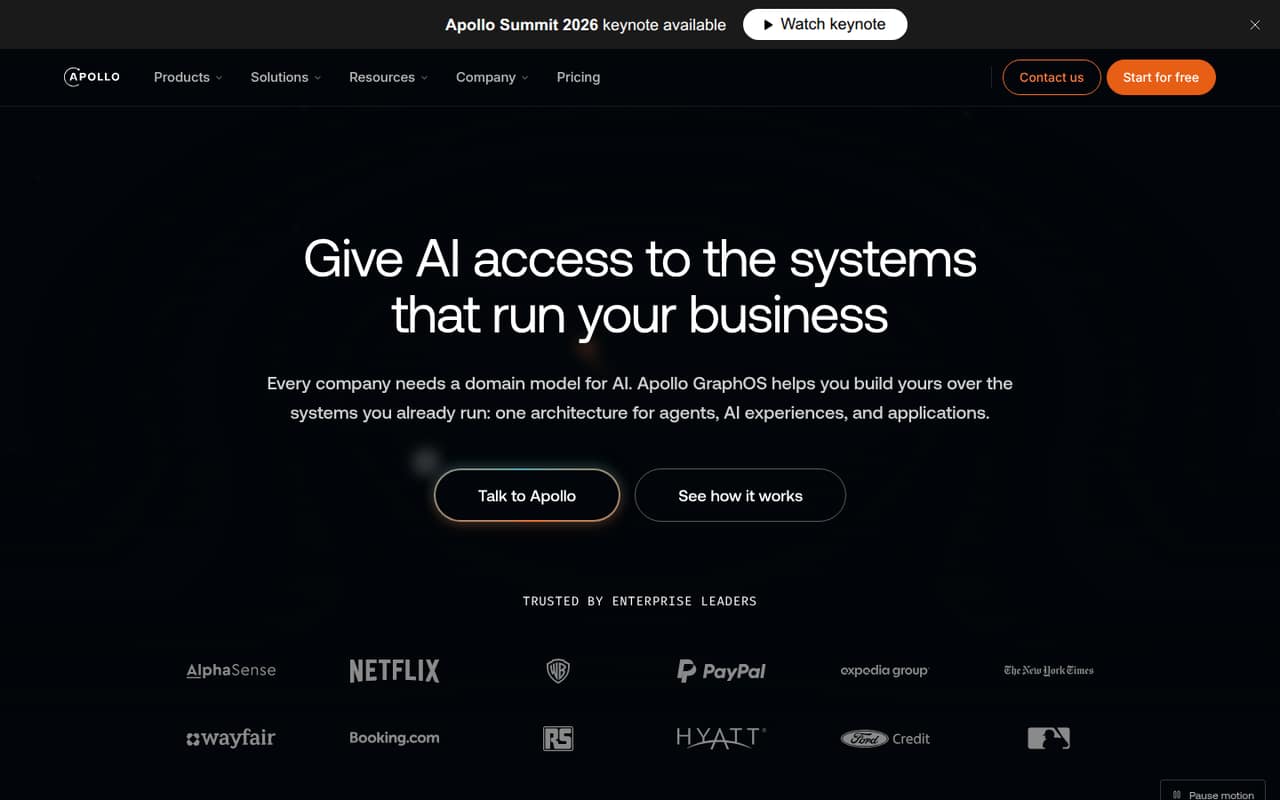
Apollo GraphOS is a platform for connecting business APIs into a shared domain model. Federation, access policies and observability address the work of making services available to applications and agents under consistent controls.
Agent Services adds MCP-based discovery, agent identity and auditing. The Free plan is limited to three developers, one-day data retention and 60 requests per minute; paid Developer pricing starts at $5 per million requests per month. Confirm SDK support, hosting options and production limits with Apollo before adopting it.
Good fit if
- Teams federating business APIs
- Agents needing governed API discovery
- Organizations standardizing service access
Skip it if
- Projects needing a documented self-hosted GraphOS
- Teams requiring published SDK details
- Hobby projects exceeding free-tier limits
ScoresHow it rates
What works
- Federates business APIs into a shared graph
- Describes data and operations with domain semantics
- Enforces access policies across services
- Agent Services supports discovery through MCP
- Free plan available without a credit card
What doesn't
- Free Router limit is 60 requests per minute
- Developer plan retains data for seven days
- Standard and Enterprise pricing is custom
- Federated subscriptions and response caching are separately metered
- Hosting, licensing and data export need vendor confirmation
01What Apollo GraphOS is, technically
Apollo GraphOS is a platform for building and operating a domain model over a company’s APIs and services. Its central architecture is a federated graph: multiple business APIs are brought together as a shared model that describes data, operations and their relationships. GraphOS adds access policies, performance features and observability around that graph.
In a stack, it sits between services and the applications or agents that need to use them. Instead of each consumer integrating with every service independently, the graph provides a common point for discovering capabilities and governing requests. GraphOS Agent Services extends that model to agents through MCP, with discovery, identity, access policy and auditing features.
Apollo describes GraphOS as a platform, not as a standalone library or CLI. The product description does not establish whether GraphOS runs only as a hosted service or can be self-hosted; confirm deployment options with Apollo before designing around it.
02Apollo GraphOS API, SDKs and docs
The named integration surfaces are GraphQL federation for composing a unified graph and MCP for agents using GraphOS Agent Services. The product description also names APIs and services as the systems a team connects, but it does not give endpoint formats or a setup sequence. It describes Agent Services features—Search, Identity, Access policy and Auditing—rather than a language-specific client workflow.
Apollo does not name SDKs, programming languages, a CLI, webhooks or plugins in the product description. Check Apollo’s docs for current SDK and language support, as well as the exact federation configuration and MCP connection requirements, before estimating implementation effort. The docs should also answer how to test policy behavior, propagate agent identity and inspect audit records.
The integration model makes architectural sense for teams already using GraphQL federation. Teams with REST services or non-GraphQL consumers should confirm how those systems connect and what changes they need; the product description does not outline those steps.
03Apollo GraphOS pricing for developers
The Free plan costs $0 per month and includes up to three developers, one-day data retention, community support and a Router limit of 60 requests per minute. It requires no credit card. That limit makes Free a constrained evaluation or hobby tier, not an unbounded production allowance.
Developer starts at $5 per million requests per month, with up to 10 developers, seven-day retention, a $50 signup usage credit and 8×5 developer support with no SLA. Apollo lists monthly billing with automatic volume discounts; annual billing is not listed. Standard is custom-priced for up to 30 developers, with 90-day retention and 8×5 support with an SLA. Enterprise is custom-priced, with unlimited developers, 18-month retention and 24×7×365 business support with an SLA.
Performance and subscription update events each start at $2 per million for the first 250 million monthly units, then list lower per-tier rates. Federated subscriptions and response caching are metered separately on paid plans. Ask Apollo for those rates and thresholds before forecasting spend.
04Apollo GraphOS: open source, self-hosting and lock-in
Apollo refers to downloads of its open-source software, but that does not establish that GraphOS itself is open source. The vendor does not publish GraphOS licensing terms, self-hosting instructions or data-export details in its product description. Ask Apollo which GraphOS components, if any, can run in your environment and what license applies to each.
The federation model may make service boundaries explicit, but it does not by itself guarantee a portable graph configuration or an easy exit. Before adopting GraphOS, ask how to export schema definitions, policies, audit records and observability data, and whether those exports remain usable without Apollo services. Also identify any application or agent integrations that depend on Agent Services or MCP-specific behavior. If your architecture needs a self-hosted control plane or a defined migration path, get those terms in writing before rollout.
05Apollo GraphOS in production
The published limit to watch first is the Free Router cap of 60 requests per minute. Paid plans price usage per million requests, but the published plan details do not give production request-rate limits. Confirm those limits, how throttling behaves and whether they vary by plan before sizing a service. Developer includes seven-day data retention; Standard lists 90 days and Enterprise 18 months.
GraphOS describes access policies enforced on requests, with Agent Services offering field-by-field controls, identity tracking and activity auditing. Confirm how policies interact with each service and how audit records can be exported. For support, Developer is 8×5 with no SLA; Standard lists 8×5 support with an SLA, while Enterprise lists 24×7×365 business support with an SLA. Those support terms are not a substitute for checking the platform’s uptime commitment. Ask Apollo about availability, compliance requirements, incident response, usage alerts and the separately metered features you plan to use.
Questions people ask
What does Apollo GraphOS do?
Apollo GraphOS connects APIs and services into a shared domain model. That model describes data and operations, governs access and provides a common layer for applications and agents. GraphOS also includes federation, performance, security and observability features.
How does GraphOS Agent Services connect to agents?
Apollo says Agent Services lets agents discover and use services in the domain model through MCP. Its named capabilities are Search, Identity, Access policy and Auditing. Confirm connection requirements and supported agent frameworks in Apollo’s docs.
Can I use Apollo GraphOS for free?
Yes. The Free plan costs $0 per month, supports up to three developers and includes one-day data retention, community support and a Router limit of 60 requests per minute. Apollo says no credit card is required.
Does Apollo GraphOS include an SLA?
The Developer plan has 8×5 developer support with no SLA. Standard lists 8×5 support with an SLA, and Enterprise lists 24×7×365 business support with an SLA. Ask Apollo for the applicable service commitment before choosing a plan.
Can Apollo GraphOS be self-hosted?
Apollo’s product description does not state whether GraphOS can be self-hosted. Ask the vendor which components can run in your environment, what the deployment requirements are and whether any parts of the platform require Apollo-hosted services.