
We may earn a commission if you buy through links on this page. It never changes a score or a ranking. How we make money
The bottom line
Pinot offers SQL analytics on fresh data, with a substantial self-hosting and operations commitment.
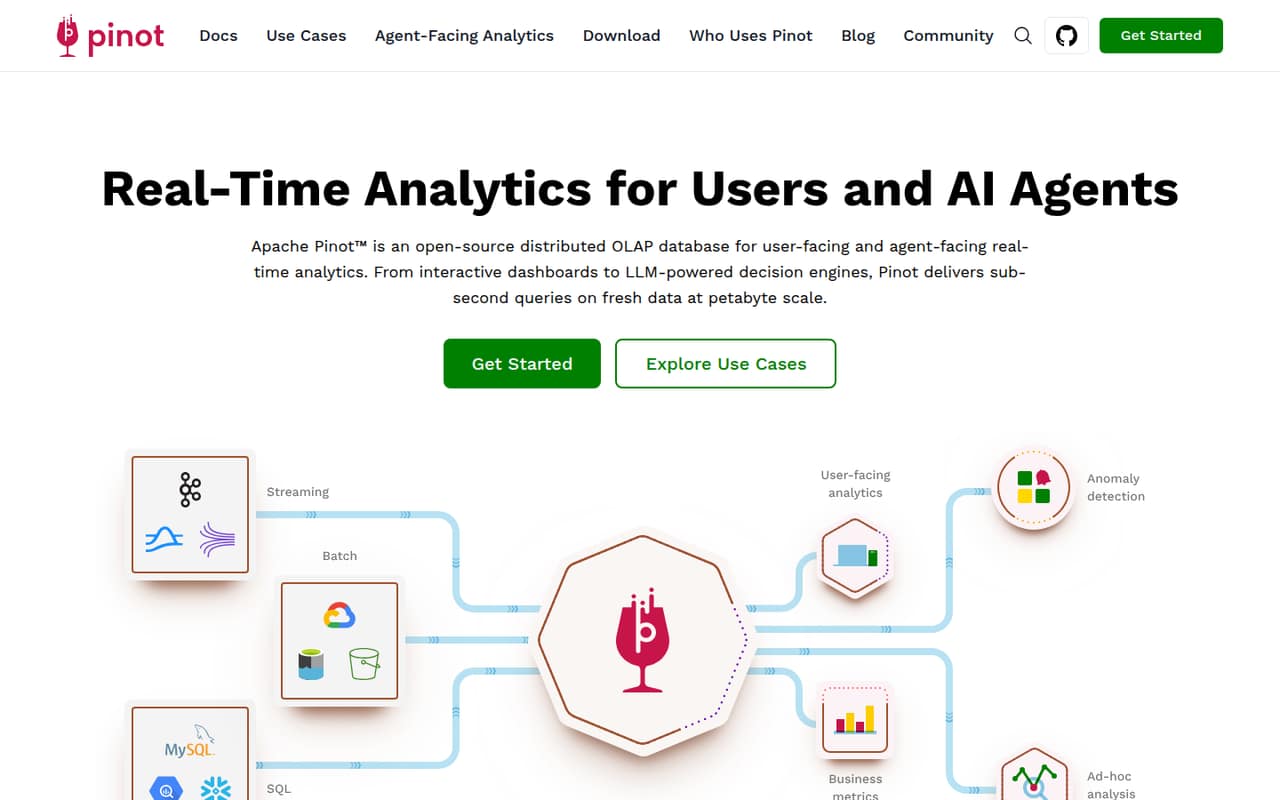
Apache Pinot is an open-source distributed OLAP database for applications that need interactive analytics on fresh data. It combines streaming and batch ingestion, SQL queries, indexes and upserts; the project describes it as suitable for high concurrency and sub-second queries.
The trade-off is operational responsibility. Pinot is free under the Apache License 2.0, but the project publishes no monthly or annual rates, usage limits or seat limits. Reddit discussions flag cluster management and operational complexity as concerns, so smaller teams should weigh the infrastructure work alongside the software cost.
Good fit if
- User-facing real-time analytics
- Teams operating distributed databases
- Fresh-data SQL for applications
Skip it if
- Teams wanting zero infrastructure work
- Small workloads needing minimal operations
- Buyers requiring published service pricing
ScoresHow it rates
What works
- Open-source Apache License 2.0
- SQL access through a query editor and REST API
- Streaming ingestion from Kafka, Pulsar and AWS Kinesis
- Combines batch and streaming sources in one table
- Built-in upserts resolve repeated records to the latest value
What doesn't
- Self-hosting requires operating a distributed system
- No published monthly or annual rates
- Seat and usage limits are not published
- Homepage does not name SDKs or programming languages
- Reddit users report operational complexity and firefighting
01What Apache Pinot is, technically
Apache Pinot is an open-source, distributed OLAP database that sits between data ingestion and the application or agent making an analytical query. It is not a hosted API or a SaaS application in the project’s open-source form: the homepage provides a Docker command to run Pinot locally and points to a getting started guide. Teams can use it as a serving layer for analytics over fresh event and batch data.
The database targets user-facing workloads such as embedded dashboards, customer analytics and metrics APIs, as well as agent-facing queries over live data. The homepage describes SQL queries over data ingested from streaming and batch sources, with indexes and upserts available for query workloads. It claims sub-second queries and high concurrency; those are workload goals, not a guarantee for every schema, query or deployment. Pinot is a fit when an application needs low-latency aggregates on current data and the team is prepared to run a distributed database.
02Apache Pinot API, SDKs and docs
The homepage names a SQL query interface, a built-in query editor and a REST API. That gives application teams a direct query surface and a browser-based way to explore queries. The homepage also provides a Docker quick start using the Apache Pinot image and links to a full getting started guide.
For ingestion, Pinot supports real-time input from Apache Kafka, Apache Pulsar and AWS Kinesis. Batch sources include Hadoop, Spark and AWS S3, and the homepage says teams can combine batch and streaming sources in one table. The listed integration surfaces are database ingestion connectors and SQL over the REST API; the homepage does not name a CLI or programming-language SDK. Confirm SDK availability and language support in the vendor’s docs before choosing a client library. Teams should also validate their query patterns, ingestion setup and schema choices against the documentation before building a production integration.
03Apache Pinot pricing for developers
Apache Pinot is open source, and the pricing information available lists an Open Source option under the Apache License 2.0. There is no published monthly or annual price, so there is no vendor starting price to compare with a managed database. Seat limits, usage limits and commercial billing terms are not published either.
For a self-hosted deployment, the software price is only one part of the cost. Your team must account for the infrastructure and engineering work needed to operate the distributed database. The project’s homepage describes horizontal scaling and fault tolerance, but gives no deployment bill, compute rate or usage-based price. It also does not publish overage rates or add-on prices. Before planning a production budget, estimate infrastructure for your ingestion and query workload, then ask any commercial provider for pricing, included limits, support terms and what happens when usage exceeds those limits. Do not assume that open-source availability includes managed hosting or support.
04Apache Pinot: open source, self-hosting and lock-in
Apache Pinot is open source. The pricing information lists the Open Source option under the Apache License 2.0, and the homepage provides a Docker command for running Pinot locally. That makes self-hosting an option rather than requiring a vendor-hosted service.
The homepage describes SQL access through a REST API and ingestion from common streaming and batch systems. Those interfaces give teams ways to connect applications and data pipelines, but they do not by themselves define a complete exit plan. The project does not publish data-export guarantees or a migration procedure in the pricing details. Before committing, check the docs for how to export stored data, preserve schemas and indexes, and move queries to another engine. Lock-in depends on how much application logic relies on Pinot-specific query behavior, indexing and ingestion configuration—not just on whether the source code is open.
05Apache Pinot in production
The homepage describes Pinot as horizontally scalable and fault-tolerant and cites high-concurrency production use. These are project claims, not published service-level commitments. It does not give general rate limits, availability targets, security certifications or compliance terms. Teams should verify those requirements against their deployment model and the current documentation, then test the failure modes that matter to their workload: ingestion lag, node loss, query spikes, schema changes and recovery.
Operational complexity is the clearest concern in the Reddit material. One thread raises the number of components involved in a self-hosted setup, and commenters describe Pinot as demanding to manage. Another user says self-hosting ended after two months of firefighting; these are individual reports, not a measure of typical experience. Plan for ownership of cluster operations, upgrades and monitoring, or evaluate a managed option if that work does not fit your team. Pinot’s headline latency and concurrency claims still need validation with your data and query mix.
From the threadsWhat users say
Reddit sentiment is mixed but leans negative on self-hosting effort. Users acknowledge Pinot’s performance potential while warning that operating it can require substantial engineering work.
Pinot is a beast, both in performance and in management
We tried to self-host and gave up after two months of firefighting
Managing clusters, ensuring high availability, and dealing with schema evolution is a full-time job for a dedicated team
while the query performance is great
Questions people ask
What is Apache Pinot used for?
Apache Pinot is a distributed OLAP database for user-facing and agent-facing analytics on fresh data. The homepage describes use cases including embedded dashboards, customer analytics, metrics APIs, retrieval of real-time context and decision engines. It targets applications that need interactive SQL queries over streaming or batch data.
Is Apache Pinot free?
The open-source option is listed under the Apache License 2.0, with no published monthly or annual rate. The project does not publish seat or usage limits in the pricing information. Self-hosting still involves infrastructure and engineering costs, and commercial billing terms are not published.
How do applications query Apache Pinot?
The homepage names a SQL query interface available through a built-in query editor and a REST API. It does not name specific programming-language SDKs. Check the vendor’s docs for client libraries and language support that fit your application before settling on an integration approach.
Which data sources can Apache Pinot ingest?
The homepage lists Apache Kafka, Apache Pulsar and AWS Kinesis for real-time streaming ingestion. Batch sources include Hadoop, Spark and AWS S3. It also says batch and streaming sources can be combined in one table. Check the current documentation for connector details and configuration requirements.
Is Apache Pinot practical to self-host?
The project provides a Docker quick start, so teams can run Pinot themselves. Production self-hosting is a larger commitment: Reddit users report management complexity and firefighting. Evaluate your team’s capacity for cluster operations, monitoring, upgrades and recovery, and validate the setup against your workload before depending on it.
Sources
- Apache Pinot homepage
- Apache Pinot pricing, compiled via web search from softwr.com, ksolves.com, pingcap.com
- Reddit: Clickhouse and Apache Pinot
- Reddit: Apache Pinot reviews? Is the operational complexity worth it for most teams?
- Reddit: Apache Pinot alternatives? Struggling with operational complexity for user-facing analytics.
- Reddit: Sub-second query on Iceberg data lakes using Apache Pinot's indexes