
We may earn a commission if you buy through links on this page. It never changes a score or a ranking. How we make money
The bottom line
Ray-based GPU orchestration with transparent hourly rates and production details to confirm.
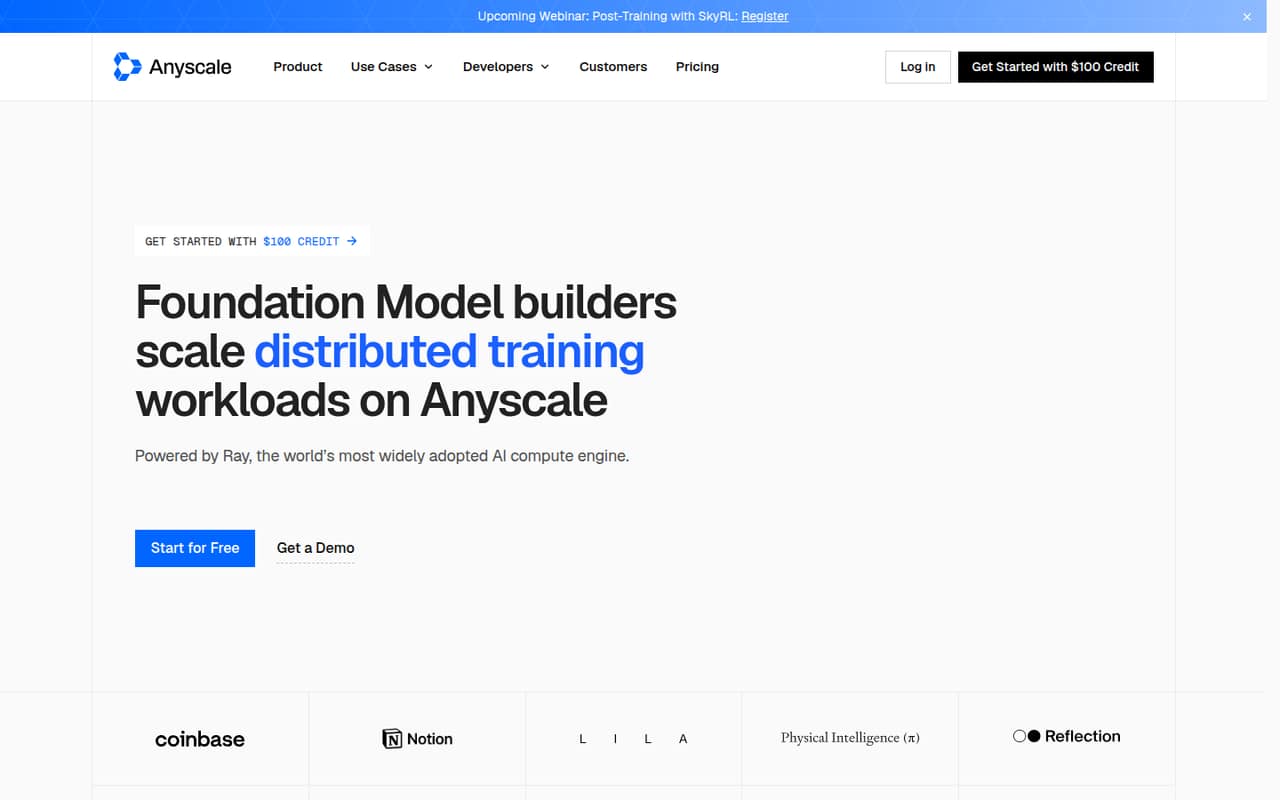
Anyscale Platform is a managed platform for running Ray workloads across GPU clusters. Its Python APIs cover distributed training, multimodal data pipelines, embedding generation, and post-training work, with execution across AWS, GCP, Azure, Nebius, CoreWeave, and Kubernetes clusters.
The pay-as-you-go plan has no monthly fixed fee and lists hourly compute rates, plus a $100 credit to get started. The trade-off is operational diligence: confirm credit terms, production capacity, service commitments, and the platform’s self-hosting and data-export terms before routing critical jobs through it.
Good fit if
- Teams scaling Ray workloads across GPUs
- Python teams building AI data pipelines
- Organizations pooling GPUs across clouds
Skip it if
- Teams needing a REST-only integration
- Small workloads without distributed compute
- Buyers requiring published service limits
ScoresHow it rates
What works
- Python Ray APIs cover training, data, and inference workloads
- Runs across AWS, GCP, Azure, Nebius, and CoreWeave
- Pay-as-you-go compute has no monthly fixed fee
- Ray is an open-source compute engine
- GPU governance includes SSO, SAML, SCIM, and audit logs
What doesn't
- Committed-contract pricing is custom and unpublished
- H/B/GB GPU-family pricing requires contacting sales
- Free-plan credit limits and terms need confirmation
- Production rate limits and service commitments need confirmation
- Platform licence and self-hosting terms need confirmation
01What Anyscale Platform is, technically
Anyscale Platform is a managed execution and operations layer for Ray workloads, not a model API or a standalone training library. Teams write workload code against Ray, then use the platform to run and scale it across GPU clusters. It sits between application code and compute infrastructure: workloads can use GPUs across AWS, GCP, Azure, Nebius, CoreWeave, and Kubernetes clusters.
The target workloads are data-intensive AI jobs: distributed training, multimodal data curation, batch embedding generation, and post-training inference or training. Ray handles the distributed compute; Anyscale provides a platform for running and optimizing those jobs, including GPU pooling and governance controls. The vendor also describes elastic scaling, data preprocessing, and GPU observability for training. This is a fit for teams whose bottleneck is coordinating compute and data pipelines across GPUs. It is less compelling for a small service that only needs a single model endpoint or a conventional REST inference API.
02Anyscale Platform API, SDKs and docs
The main integration surface shown is Python code using Ray APIs. Examples use ray.data for reading Parquet, mapping batches, and writing results; ray.train and TorchTrainer for distributed training; and Ray remote actors for GPU-backed work. The platform also targets existing libraries including PyTorch, vLLM, SGLang, and XGBoost, and names SkyRL and veRL for post-training workloads.
This is a code-first workflow: define the data or training job in Python, specify workers and GPU use, then run it across a cluster. The examples include S3 paths for input and output, including Parquet datasets. The homepage does not establish a general REST API, a CLI, or a specific SDK package beyond Ray’s Python APIs. Check Anyscale’s developer docs for current CLI and SDK support, deployment configuration, authentication, and version compatibility before choosing an integration path. Teams already using Ray should have a more direct route than teams adopting a new execution model.
03Anyscale Platform pricing for developers
Anyscale lists a free plan and a $100 credit to get started. The credit’s expiry, eligibility, and usage limits are not published, so confirm those terms before treating it as a sustained free tier. The Pay as you go plan has no monthly fixed fee and bills for compute used, by the hour.
Listed rates are CPU-only at $0.0135/hour; NVIDIA one thread at $0.5682/hour; NVIDIA L4 at $0.9542/hour; NVIDIA A10G at $1.3635/hour; and NVIDIA A100 at $4.9591/hour. A continuously running GPU worker will accrue hourly compute charges for its runtime; distributed jobs multiply that cost across workers. The vendor does not publish a fixed monthly platform fee for this plan.
Committed contracts offer volume discounts and can use GPU reservations, but pricing is custom. H/B/GB GPU families require a sales quote. Before estimating production spend, confirm how worker runtime is counted, whether the listed rates cover the full platform and infrastructure bill, and how the $100 credit applies to each GPU family.
04Anyscale Platform: open source, self-hosting and lock-in
Ray, the compute engine underneath Anyscale Platform, is open source. That gives teams a path to build workloads using Ray outside the managed platform, though it does not by itself establish that Anyscale’s management layer can be self-hosted. The platform’s own licence and self-hosting terms are not published; ask Anyscale which control-plane components, if any, can run in your environment.
The platform is designed to run jobs on GPUs across clouds, regions, and Kubernetes clusters, which can keep compute infrastructure under a team’s control. The homepage’s examples also show Ray Data writing Parquet output to S3, a conventional data format and destination. Ray-based job code may be portable, but deployment configuration, governance, and platform-specific operations can still create migration work. Before adopting it, test whether your jobs can run on open-source Ray and agree on a process for exporting logs, metadata, and other platform-managed state.
05Anyscale Platform in production
Anyscale describes elastic scaling, GPU observability, and GPU pooling across clouds, regions, and Kubernetes clusters. Its listed governance controls include access controls, SSO, SAML, SCIM, and audit logs. Those features address cluster operations and identity management, but teams should verify which controls apply to each deployment and workload, and how they map to internal security requirements.
The vendor does not publish rate limits, capacity guarantees, or an SLA on the homepage; ask for those terms and the escalation path before putting time-sensitive training or inference jobs into production. Validate how the platform handles GPU shortages, worker failures, job retries, and cluster maintenance, especially for long-running distributed training. Compute is billed by the hour on Pay as you go, so worker count and runtime both affect spend. Also confirm what the $100 credit covers, what telemetry is retained, and how to export operational data. Production readiness depends on these details as much as on Ray’s ability to distribute the workload.
Questions people ask
What is Anyscale Platform?
Anyscale Platform is a managed platform for running Ray workloads across GPU clusters. It targets distributed model training, multimodal data curation, batch embedding generation, and post-training inference or training. Teams write Python code with Ray APIs and run jobs across supported cloud and Kubernetes infrastructure.
What programming language and APIs does Anyscale Platform use?
The integration examples use Python and Ray APIs, including ray.data, ray.train, TorchTrainer, and Ray remote actors. Anyscale also names integrations with PyTorch, vLLM, SGLang, and XGBoost. Check the vendor’s developer docs for current CLI, SDK, and deployment details.
Which clouds does Anyscale Platform support?
Anyscale lists AWS, GCP, Azure, Nebius, and CoreWeave, as well as Kubernetes clusters. It says teams can run the same code across these environments and pool GPUs across clouds, regions, and clusters. Confirm the exact GPU availability and deployment configuration for your intended region.
How much does Anyscale Platform cost?
Pay as you go has no monthly fixed fee and charges by compute hour. Listed rates range from $0.0135/hour for CPU-only to $4.9591/hour for an NVIDIA A100. Anyscale also offers a $100 starting credit; committed contracts and H/B/GB GPU-family prices require a sales conversation.
Can I run Anyscale Platform on my own GPUs?
The platform is described as running workloads on GPUs across clouds, regions, and Kubernetes clusters, and the vendor positions it for teams using their own GPUs. That does not establish that the Anyscale management layer itself is self-hostable. Confirm deployment and control-plane requirements with Anyscale.