
We may earn a commission if you buy through links on this page. It never changes a score or a ranking. How we make money
The bottom line
A broad AI governance and deployment layer, but public pricing and integration specifics are thin.
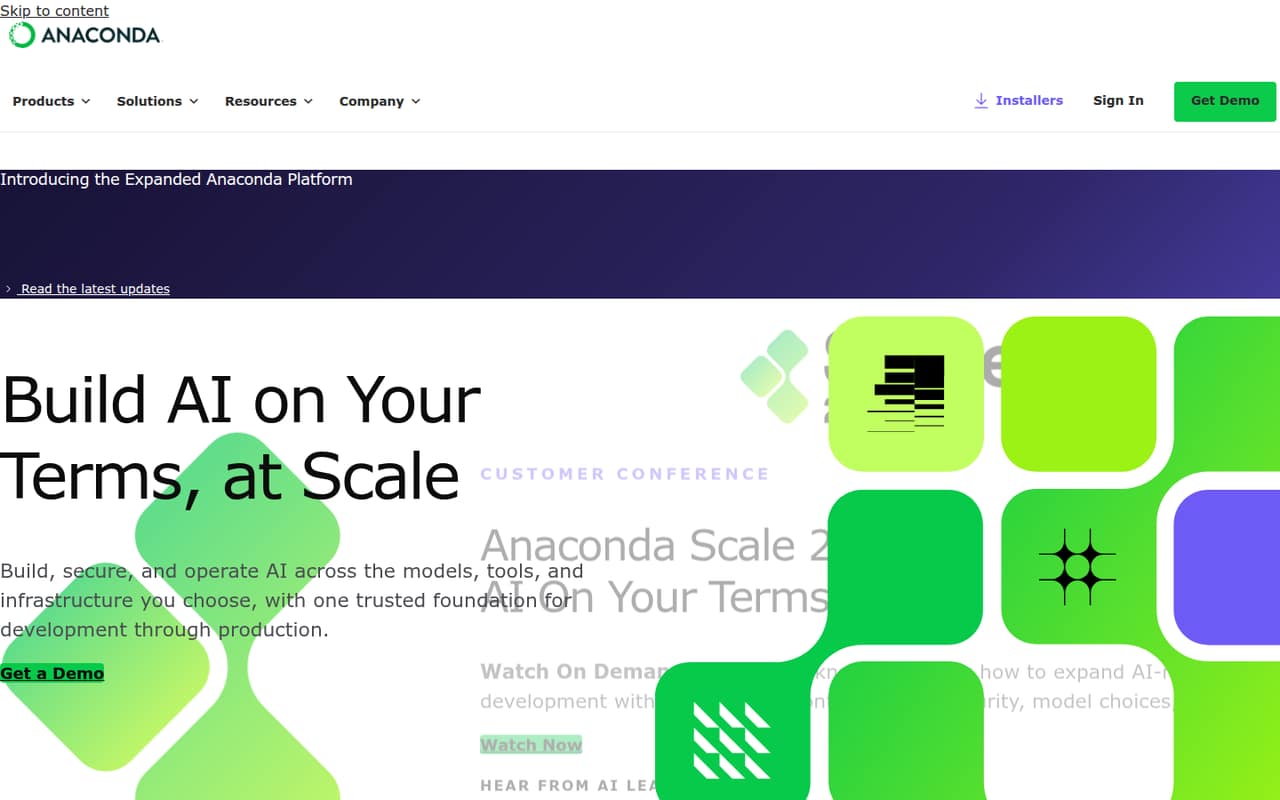
Anaconda Platform connects AI workspaces, security guardrails, orchestration and governed artifacts in a foundation for development through production. Teams can choose their models, tools and infrastructure, with managed cloud, self-hosted cloud and on-premises deployment listed as options.
The fit is clearest for organizations that need controls and audit evidence across AI workflows. The vendor lists no free plan or public rate, and the product overview names no specific SDK, language or API contract. Get a quote and confirm integration requirements before planning a rollout.
Good fit if
- Organizations governing AI workflows
- Teams with hybrid deployment needs
- Enterprises requiring audit evidence
Skip it if
- Developers seeking a free tier
- Teams needing published API specifications
- Projects requiring public usage-based pricing
ScoresHow it rates
What works
- Offers managed cloud, self-hosted cloud and on-premises deployment
- Connects development, security and production workflows
- Lists model and provider access controls
- Includes audit logs, SSO/OIDC/SCIM and SLA
- Allows teams to choose models, tools and infrastructure
What doesn't
- Organization pricing is not published
- No free plan or free trial is listed
- No public usage, seat or compute rates
- SDK and language support need confirmation
- Platform license and data export terms need confirmation
01What Anaconda Platform is, technically
Anaconda Platform is a governed AI development and operations platform, not a single model API or programming language. It connects AI workspaces, security guardrails, orchestration and governed artifacts in one layer intended to span development through production. The vendor lists managed cloud, self-hosted cloud and on-premises deployment, and describes workflows running across cloud, hybrid, on-premises and sovereign environments.
In a stack, it sits above the infrastructure and model providers teams choose, coordinating workspaces, security checks and repeatable production workflows. The stated goal is to let teams keep their chosen models, tools and infrastructure while adding access controls and audit evidence. The Platform plan also lists model and provider access controls, audit logs and SSO/OIDC/SCIM. This is an enterprise governance proposition; teams evaluating it as a developer platform should confirm how its workspaces and orchestration connect to their existing code, deployment pipeline and identity systems.
02Anaconda Platform API, SDKs and docs
The Platform overview describes AI workspaces with agentic tools, model choice and orchestration that turns projects into repeatable workflows. It also names deployment across cloud, hybrid, on-premises and sovereign environments. Those are the integration surfaces the vendor presents; the overview does not establish a particular REST API, CLI, plugin system or webhook contract.
Before building a direct integration, confirm supported SDKs, languages, API contracts and authentication flows in Anaconda's documentation. The Platform plan lists SSO/OIDC/SCIM and model and provider access controls, but that is not a substitute for implementation details such as endpoint behavior, versioning or error handling. The homepage separately describes Kilo, an open-source coding agent available in an IDE, CLI, cloud, Slack and code review. Those Kilo surfaces should not be treated as Platform APIs without confirmation. Teams should ask Anaconda for integration examples, supported environments and the documented path from workspace development to production orchestration.
03Anaconda Platform pricing for developers
The pricing page lists one plan, Anaconda Platform, priced per organization. It includes everything in Anaconda Core Business, has no tiers or feature gating, and can be deployed as managed cloud, self-hosted cloud or on-premises. Model and provider access controls, audit logs, SSO/OIDC/SCIM, an SLA and dedicated support are listed as included.
The vendor does not publish monthly or annual rates, so we cannot calculate a starting price or compare total cost at a particular team size. The pricing details list no free plan and no free trial. They also do not list per-seat, request, model-token or compute charges, usage allowances, overages or add-ons. That is not evidence that every deployment has identical operating costs: ask for a written quote covering organization scope, deployment, support and any usage-based charges. Developers should also establish which infrastructure costs apply to their chosen self-hosted or on-premises setup before approving a production budget.
04Anaconda Platform: open source, self-hosting and lock-in
Anaconda describes its AI artifacts as secured and governed open-source building blocks. That statement concerns the artifacts, not the Platform itself: confirm the Platform's license and source availability with Anaconda before treating it as open source. The pricing page lists managed cloud, self-hosted cloud and on-premises deployment, so the product is not limited to a vendor-hosted setup.
The vendor says teams can keep their chosen models, tools and infrastructure, and positions the Platform as avoiding lock-in. That choice can reduce dependence on a single model provider, but it does not establish how easily workspace configurations, audit records or orchestration workflows can be exported. Data export formats and migration procedures are not covered in the published pricing details. Ask for export documentation, contract terms and a migration path for governed artifacts and audit evidence before making the Platform a control plane for production AI.
05Anaconda Platform in production
The production case rests on security checks before release, runtime protection, audit-ready evidence and orchestration across cloud, hybrid, on-premises and sovereign environments. The plan lists model and provider access controls, audit logs, SSO/OIDC/SCIM, an SLA and dedicated support. These are useful enterprise controls, but the public pricing details do not give the SLA's service levels or describe incident response, recovery objectives or support response times.
Before depending on it, ask Anaconda for the operational limits that affect your workload: request or orchestration quotas, concurrency, model and agent testing coverage, audit-log retention, and runtime enforcement behavior. Confirm how upgrades work in self-hosted deployments and what evidence is available for your compliance process. The vendor lists no public usage rates or overage schedule, so establish whether any capacity or usage charges apply in your quote. Finally, validate the integration and export path for your identity provider, models and production deployment targets.
Questions people ask
What does Anaconda Platform do?
Anaconda Platform brings together AI workspaces, security guardrails, orchestration and governed artifacts. The vendor positions it as a foundation for development through production, with controls and audit evidence and deployment across managed cloud, self-hosted cloud and on-premises environments.
Does Anaconda Platform have a free plan?
The pricing details list no free plan and no free trial for Anaconda Platform. The separately described Kilo product has a free starting option, but that does not make the Platform itself free. Ask Anaconda whether it offers an evaluation arrangement.
Can Anaconda Platform run on premises?
Yes. The pricing details list managed cloud, self-hosted cloud and on-premises deployment. The vendor also describes orchestration across cloud, hybrid, on-premises and sovereign environments. Confirm the infrastructure requirements and deployment responsibilities with Anaconda.
What APIs and SDKs does Anaconda Platform support?
The Platform overview names workspaces, agentic tools, model choice and orchestration, but does not establish an API or SDK contract. Confirm supported SDKs, languages, authentication and API behavior in Anaconda's documentation before planning an integration.
How much does Anaconda Platform cost?
The plan is priced per organization, but monthly and annual rates are not published. It includes everything in Anaconda Core Business, with no tiers or feature gating. Request a quote and confirm whether your deployment has additional usage or infrastructure costs.