
We may earn a commission if you buy through links on this page. It never changes a score or a ranking. How we make money
The bottom line
A broad cloud and edge platform for businesses, with pricing and integration details to confirm before rollout.
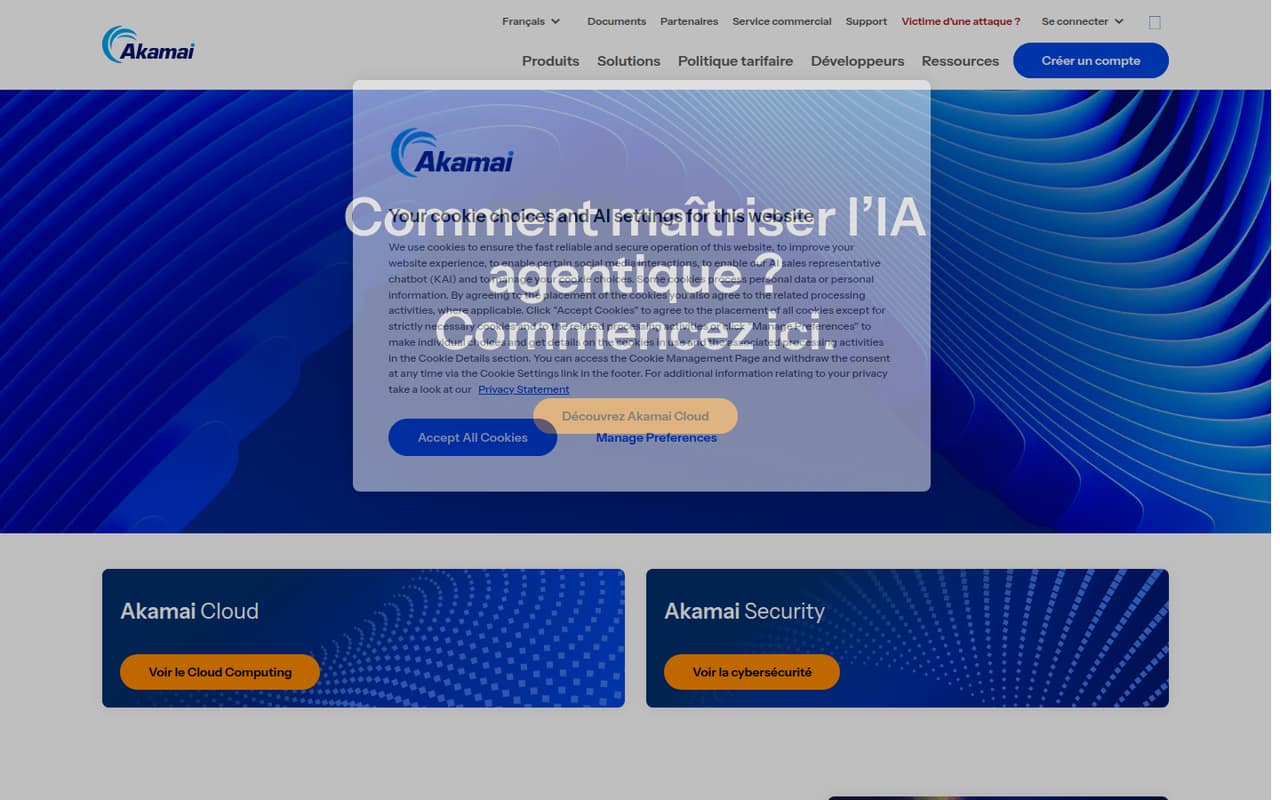
Akamai is a provider-operated distributed cloud and edge platform spanning compute, cybersecurity and content delivery. Its homepage also positions Akamai Inference and Agent Sandbox for AI workloads and agents.
The fit is strongest for businesses that need these services at scale. Public pricing is product-specific, and the homepage does not name APIs, SDKs or languages, so confirm technical integration paths and costs with Akamai before building around the platform.
Good fit if
- Businesses with distributed workloads
- Teams combining delivery and security
- AI workloads near customers
Skip it if
- Projects needing a published free tier
- Teams requiring clear self-hosting terms
- Developers seeking documented SDK choices upfront
ScoresHow it rates
What works
- Combines compute, cybersecurity and content delivery
- Distributed cloud and edge infrastructure
- Akamai Inference targets AI applications
- Agent Sandbox supports running AI agents
- Some users report effective bot controls
What doesn't
- Homepage names no APIs, SDKs or languages
- Most product prices are not published
- No free plan is listed
- GPU plans have no bundled transfer or egress
- Self-hosting and data export terms need confirmation
01What Akamai is, technically
Akamai is a provider-operated distributed cloud and edge platform, not a library, CLI or self-hosted server. It combines cloud compute, cybersecurity and content delivery across Akamai’s cloud platform and edge network. The homepage frames the platform around building applications, securing them and delivering them closer to customers.
For an application team, Akamai can sit beneath or alongside application workloads: compute runs the application, security services protect applications and data, and content delivery moves experiences closer to users. Akamai Inference and Agent Sandbox extend the platform toward AI inference and agent execution, according to the homepage. The specific deployment architecture depends on which services a team adopts. Treat Akamai as a collection of cloud and edge services rather than assuming one uniform runtime or integration model. Before committing, map each required capability to a product and confirm its deployment model, interfaces and operational responsibilities with Akamai.
02Akamai API, SDKs and docs
The homepage describes cloud computing, security, content delivery, Akamai Inference and Agent Sandbox, but it does not name an API style, SDK, programming language, CLI or integration protocol. That leaves an important implementation question open: how your application provisions services, configures delivery and security policies, and sends workloads to inference or agent execution.
Before selecting Akamai, confirm the relevant service API, SDK support, language coverage, CLI and documentation with the vendor. Check whether configuration can be managed as code, how credentials are issued, and whether the services your stack needs share an integration surface. The homepage directs prospective customers to contact a sales consultant, rather than outlining a developer onboarding path. That is a reason to request product-specific integration documentation early, especially if you need to automate deployment or connect Akamai to existing observability and release workflows.
03Akamai pricing for developers
The pricing page lists no free plan, free trial or starting price. Costs vary by product, and the listed services are billed hourly or monthly, with invoices generally issued the following month. As a compute example, a 1 GB CPU virtual machine is listed at $0.0075 per hour, or $0.18 for 24 hours. Infrastructure management is $100 per compute instance per month.
GPU plans include NVIDIA GPUs but no bundled transfer or egress. Older CPU plans may include 0–20 TB of monthly transfer, depending on family and size; transfer overage rates are not published here. Object Storage includes monthly outbound transfer before overage, but its price and overage rate are not published. Block Storage, Backups, Images, managed databases and NodeBalancers also have no published prices in the listed information. Akamai offers no annual billing option in this pricing information. Ask for a workload-specific estimate that includes compute, storage, transfer and management before forecasting production spend.
04Akamai: open source, self-hosting and lock-in
Akamai presents its services as a distributed cloud platform and edge network operated by the provider. The homepage does not describe the platform as self-hosted or identify an open-source licence. Ask Akamai whether any components you plan to use are open source, which licences apply, and whether a customer-managed deployment is available for your use case.
Data export and migration terms also need confirmation. The product spans compute, delivery and security, so the work to leave could depend on which services hold application state, configuration or traffic policies. Before adopting it, establish how to export data and configurations, what formats are available, and whether workloads can run elsewhere without Akamai-specific dependencies. Get those answers alongside service-level migration and termination terms; do not assume portability from the distributed architecture alone.
05Akamai in production
Akamai’s distributed cloud and edge network are positioned to deliver applications closer to customers, but production planning still depends on the exact service, region, workload and contract. Confirm service-specific limits, rate limits, availability commitments, security responsibilities and support terms with Akamai. The pricing information also flags transfer exposure: GPU-accelerated plans have no bundled transfer or egress, and older plans may incur transfer overages.
Reddit feedback is mixed but includes positive reports from enterprise security users. Commenters describe Botman and fingerprint-based blocking as useful, while another says Akamai’s portal feels old-school and onboarding can be less straightforward. A web scraping thread reports aggressive blocking that sometimes affected normal browsing on airline sites. Those accounts are individual reports, not a measure of platform-wide reliability. Test your own traffic patterns and security rules, and agree on monitoring, escalation and rollback procedures before routing critical production traffic.
From the threadsWhat users say
Reddit sentiment skews positive among some enterprise security users, particularly around bot controls and fingerprinting. Other comments point to onboarding friction and aggressive blocking in some sites, so the experience appears use-case dependent.
Generally Akamai is better for large companies. Cloudflare is great for smaller scale things
Botman works pretty well and blocking Fingerprints and other indicators is pretty straightforward
Akamai is a little old school with the portal but once setup isn’t really something you have to worry about too much
The blocking is so aggressive that sometimes even normal browsing on my local machine throws errors
Questions people ask
What is Akamai?
Akamai provides cloud computing, cybersecurity and content delivery through a distributed cloud platform and edge network. Its homepage also identifies Akamai Inference for AI applications and Akamai Agent Sandbox for running AI agents. The services are aimed at building applications, securing them and delivering them closer to customers.
Is Akamai a cloud service?
Yes. Akamai describes Akamai Cloud as a cloud computing platform and edge network. Its cloud services include compute and managed products such as Kubernetes, storage and databases, alongside security and content delivery offerings. Confirm the deployment model and service details for the specific products your workload needs.
Does Akamai offer a free plan?
The pricing information lists no free plan or free trial. It also gives no starting price for the platform as a whole. Some product prices are published, including a 1 GB CPU virtual machine at $0.0075 per hour, while many other services require a quote or further pricing details.
Can I self-host Akamai?
Akamai presents its cloud and edge services as a provider-operated platform, not a self-hosted server. The available information does not establish whether any individual components can run in a customer-managed environment. Ask Akamai about deployment options, open-source components and licence terms for the services you plan to use.
Who is Akamai best suited to?
Akamai is positioned for businesses that need cloud compute, security and content delivery across a distributed infrastructure. Reddit commenters often describe it as an enterprise fit, while also noting that onboarding and portal usability can be less straightforward. Evaluate the specific services, integration requirements and commercial terms for your team.