
We may earn a commission if you buy through links on this page. It never changes a score or a ranking. How we make money
The bottom line
A self-hostable AI coworker platform with useful integrations, but limited published developer-interface detail.
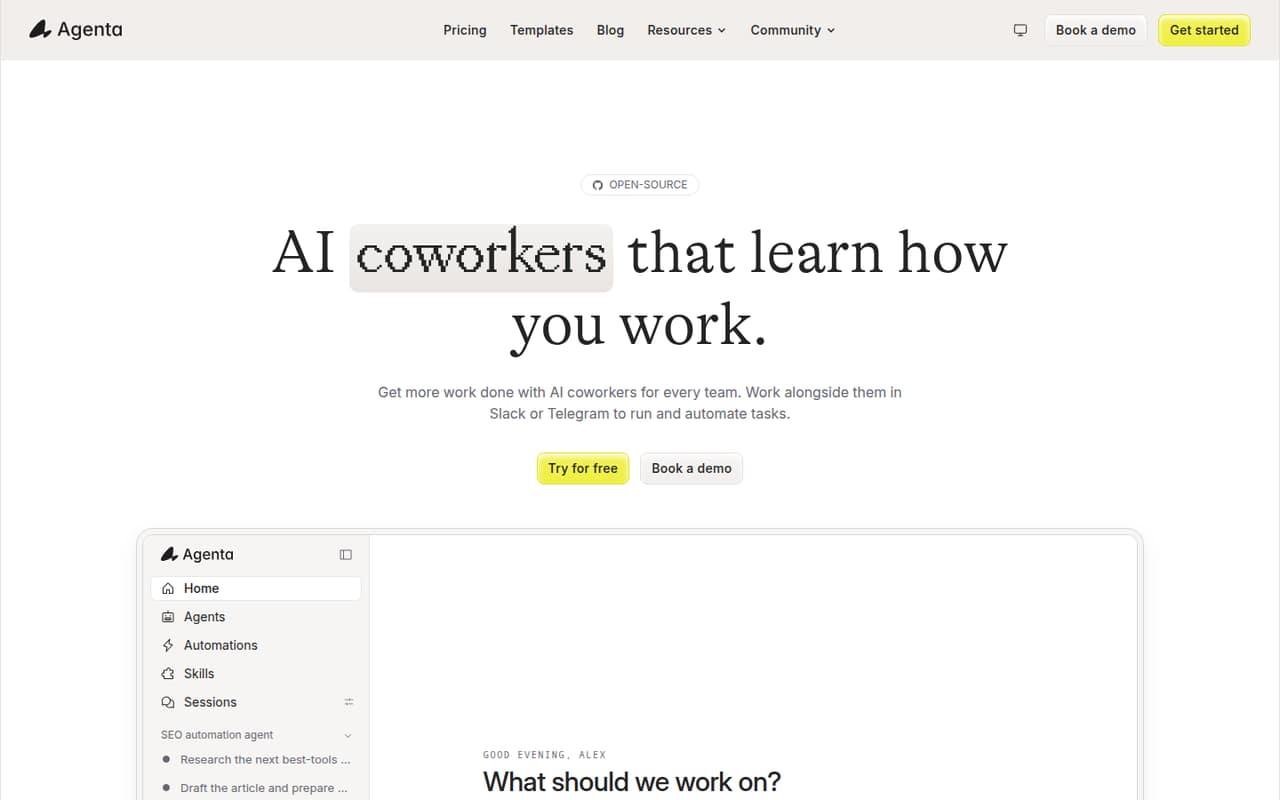
Agenta is an AI coworker platform for building agents that use connected tools and run in Slack or Telegram, on schedules, or when connected-tool events occur. It offers hosted plans and an MIT-licensed self-hosted option deployed with Docker Compose.
The free plans make it easy to start, while paid cloud usage is credit-based and includes concurrency limits. The homepage does not document an API, SDKs, supported programming languages, or rate limits, so teams building custom integrations should confirm those details and data-export options with Agenta before adopting it.
Good fit if
- Teams automating work from Slack
- Developers who need self-hosting
- Teams connecting agents to tools
Skip it if
- Teams requiring a documented public API
- Projects needing published rate limits
- Buyers requiring a stated export path
ScoresHow it rates
What works
- MIT-licensed self-hosted option with Docker Compose
- Agents can work in Slack or Telegram
- More than 1,000 integrations are listed
- Approvals let teams gate selected actions
- Starter and Business offer credit add-ons
What doesn't
- API, SDK, language and CLI details aren't published
- Cloud credits and concurrency limit usage
- Annual pricing isn't published
- Enterprise plan prices aren't published
- Data export and migration details aren't published
01What Agenta is, technically
Agenta is an AI coworker application offered as a hosted service, with a self-hosted deployment option. It is not presented as a standalone programming library or command-line tool. Teams build agents with shared context and connected tools, then use them in Slack or Telegram, or schedule them to run when a connected-tool event occurs.
In a stack, Agenta sits between a team's users and the models and work tools an agent needs. The homepage lists model options including a ChatGPT subscription, OpenRouter, Ollama, Gemini and xAI, along with connections such as Slack, Notion, GitHub, HubSpot, Google Drive, Linear and Zendesk. The product also describes a browser and file workspace for agents. Teams can configure which actions run automatically and which require approval. For organizations that want to operate the platform themselves, Agenta lists Docker Compose deployment under its open-source plan. The homepage does not describe a public API architecture, so confirm how custom services should connect before designing around one.
02Agenta API, SDKs and docs
Agenta's visible integration surfaces are its hosted workspace, Slack and Telegram chat, connected tools, and agent tools. The homepage says the platform connects to more than 1,000 integrations and shows examples such as GitHub, Linear, Notion and HubSpot. A Reddit post from the founder also describes agents with instructions, skills and tools/MCPs. These surfaces can support team workflows, but they are not a substitute for a documented developer API when a service needs to create or manage agents programmatically.
The homepage links to documentation, a changelog and a roadmap, but does not name SDKs, programming languages, a CLI, REST endpoints or webhooks. We recommend confirming SDK availability and the supported integration method in Agenta's docs before estimating custom integration work. The homepage also presents a browser and file workspace where agents can research and save files. For a deployment, check the docs for setup, authentication, permissions and failure handling; those specifics matter more than the integration count when an agent writes to production systems.
03Agenta pricing for developers
Agenta lists a free Hobby cloud plan with 500 signup credits, 75 free credits a day for up to 10 days monthly, two concurrent tasks, one project and two team members. Starter costs $29 per month and includes 2,900 monthly credits, the same daily-credit offer, 20 concurrent tasks and unlimited projects and team members. Business is $299 per month with 32,000 monthly credits, 50 concurrent tasks, SSO and role-based access control, and a SOC 2 Type II report. Annual pricing is not published.
Starter and Business can add credits: 1,000 for $10, 2,500 for $25, or 10,000 for $100. The pricing page says there are no overage charges, so usage beyond included credits means buying an add-on rather than incurring listed overages. Hobby is capped at two concurrent tasks; the open-source plan instead lists unlimited users, projects, agents and automations, but requires teams to bring their own models and credentials and manage data retention. Enterprise cloud and self-hosted plans have custom pricing. Ask Agenta how credits map to model and tool usage before forecasting a production bill.
04Agenta: open source, self-hosting and lock-in
Agenta describes its open-source offering as MIT-licensed and lists Docker Compose deployment. That gives teams the option to operate the platform on their own infrastructure, use their own models and credentials, and manage data retention themselves. The open-source plan lists unlimited users and projects, agents and automations. Organizations that want commercial self-hosted support can request the separate Enterprise plan, which includes deployment and upgrade support, security and architecture reviews, and a dedicated support channel.
Self-hosting reduces dependence on Agenta's hosted service, but it does not by itself establish how portable agent configurations, conversation data or connected-tool state are. The vendor does not publish a data-export or migration path in the published product materials. Before building a large agent library, ask whether configurations and run data can be exported in reusable formats, and what happens to hosted data when an account is closed. The MIT license also does not remove operational work: your team owns infrastructure, upgrades and self-managed retention.
05Agenta in production
The published cloud limits to plan around are credits and concurrent tasks: two on Hobby, 20 on Starter and 50 on Business. The pricing page lists no overage charges for Starter and Business and offers credit add-ons, but it does not publish API rate limits or production reliability targets. Ask the vendor about task queuing, retries, timeout behavior and model or integration failures before routing critical work through scheduled agents.
Business lists SSO, role-based access control and a SOC 2 Type II report. The Enterprise cloud plan adds custom data retention, audit logs, custom domains and a custom SLA; these controls are not listed for Hobby or Starter. Self-hosted teams control their deployment and retention, but also own availability and upgrades. Reddit discussion shows interest in choosing models and harnesses, alongside setup questions: one commenter said they were unsure how to connect a model, and the founder replied with provider configuration guidance for Ollama, OpenAI, DeepSeek and OpenRouter. Treat that as a signal to validate setup and provider support against current docs, not as a complete compatibility list.
From the threadsWhat users say
Reddit discussion is interested in Agenta's flexibility and general-purpose agent use, but includes questions about model setup. Much of the discussion comes from the founder's product posts, so it offers limited independent evidence about reliability or long-term use.
We built a self-hosted, more flexible, alternative to Claude Cowork
Both are very specialized for coding. Agenta is more general , you can use it for coding but also general work
I am not sure how to connect this to my LLM, Seems like only local llama and Anthropic is supported
So far I only do suport for Ollama, OpenAI, DeepSeek, and OpenRouter
Questions people ask
Can I self-host Agenta?
Yes. Agenta lists an open-source plan with Docker Compose deployment, under the MIT license. The plan includes unlimited users and projects, agents and automations; you bring your own models and credentials and manage data retention. A separate self-hosted Enterprise plan offers commercial deployment and upgrade support.
How much does Agenta cost?
Hobby is free. The cloud Starter plan is $29 per month and Business is $299 per month. Starter and Business include monthly credits, with additional packs listed at $10 for 1,000, $25 for 2,500 or $100 for 10,000 credits. Annual pricing and Enterprise prices are not published.
Does Agenta provide an API or SDK?
The homepage links to documentation but does not name a public API, SDK, programming language or CLI. It highlights Slack and Telegram chat, connected tools and a browser-and-file workspace. Check Agenta's current docs or ask the vendor which supported integration surface fits your application before planning custom development.
Which models and tools can Agenta connect to?
The homepage lists a ChatGPT subscription, OpenRouter, Ollama, Gemini and xAI as model options, and shows integrations such as Slack, GitHub, Notion, HubSpot, Google Drive, Linear and Zendesk. It also says there are more than 1,000 integrations. Confirm current provider availability and any plan restrictions in Agenta's docs.
What are Agenta's task limits?
The cloud plans list two concurrent tasks on Hobby, 20 on Starter and 50 on Business. Hobby includes 500 signup credits and daily free credits for up to 10 days monthly; Starter and Business have monthly credits plus the same daily-credit offer. Published API rate limits are not listed, so ask Agenta about request throttling and task queue behavior.
Sources
- Agenta homepage
- Agenta pricing page
- Reddit: Agenta: an open-source Claude Cowork alternative where you can use self-hosted models (and any harness)
- Reddit: I'm building agenta an AI agent that runs fully on your own machine
- Reddit: Agenta: an open-source Claude Cowork alternative where you can choose your harness and model
- Reddit: Agenta: an open-source Claude Cowork alternative where you can choose your harness and model