
We may earn a commission if you buy through links on this page. It never changes a score or a ranking. How we make money
The bottom line
Broad no-code QA coverage, offset by undisclosed prices and a thin public developer interface.
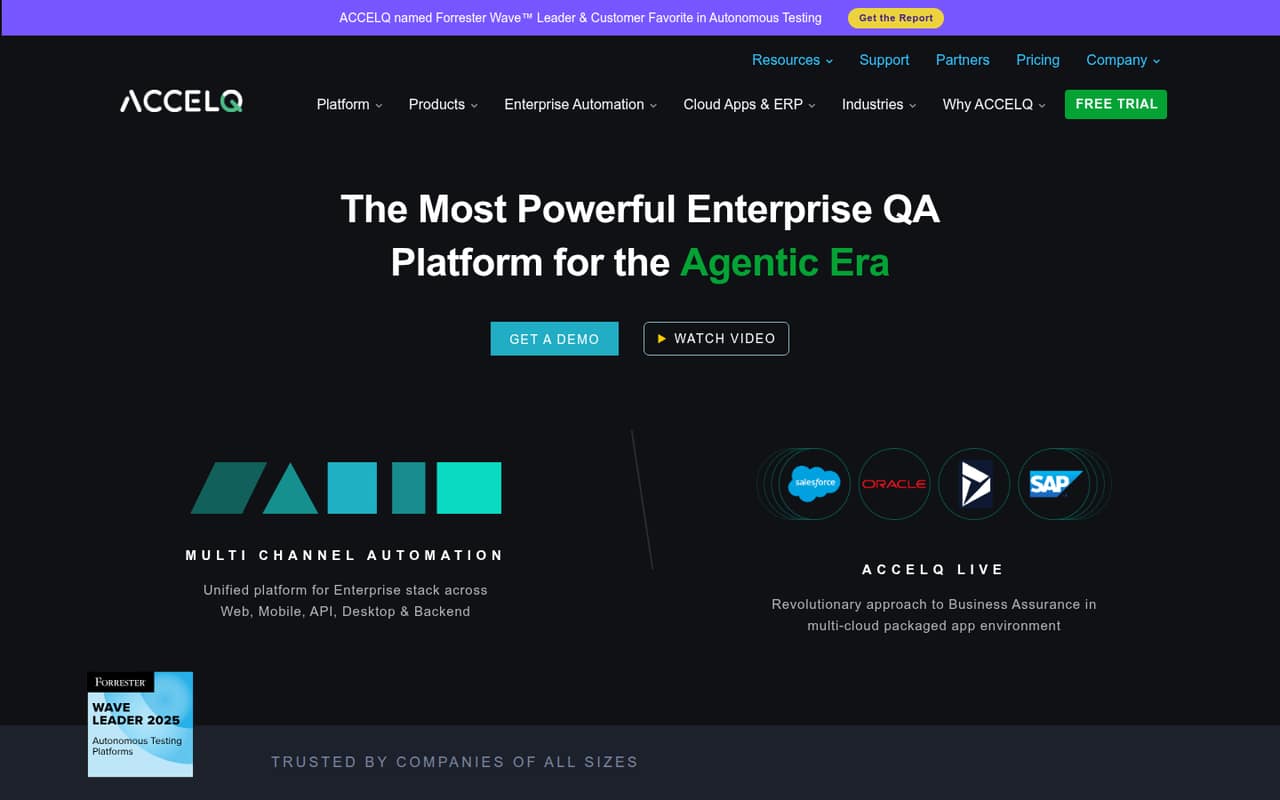
ACCELQ is a no-code QA platform for web, mobile, API, desktop and backend testing, with business-process automation and manual-testing collaboration. The Enterprise plan lists unlimited execution agents and one-year test-result retention; on-premises deployment requires a minimum 10-license subscription.
The main drawback for engineering teams is uncertainty: pricing, seat limits and platform SDKs or APIs are not published on the homepage. Reddit feedback is mixed, including a Salesforce team reporting slow runs and restart issues. Get a product walkthrough and confirm technical and commercial details before committing.
Good fit if
- Enterprise teams testing packaged apps
- QA teams adopting no-code automation
- Teams unifying manual and automated testing
Skip it if
- Teams needing documented SDKs
- Buyers requiring transparent usage pricing
- Teams prioritizing portable test code
ScoresHow it rates
What works
- Covers web, mobile, API, desktop and backend testing
- No-code approach targets non-developer QA contributors
- Business-process-focused automation spans application stacks
- Manual testers and automation engineers can collaborate
- Enterprise plan lists unlimited execution agents
What doesn't
- Starting prices and seat limits are not published
- Homepage names no SDKs, languages or CLI
- Public data-export and migration details are unclear
- Enterprise on-premises deployment requires at least 10 licenses
- A Salesforce user reports slow runs and restart problems
01What ACCELQ is, technically
ACCELQ is an enterprise QA platform for building and managing automated tests across an application stack. The homepage positions it as a cloud-based automation platform, including a cloud-based mobile automation offering, and the pricing information lists a separate Cloud Lab execution-infrastructure add-on. ACCELQ also lists on-premises deployment for Enterprise customers, with a minimum 10-license subscription.
In a software stack, it sits alongside the applications and services under test: web, mobile, API, desktop, backend, packaged apps and mainframes. Its stated focus is no-code, business-process-based automation, with quality lifecycle management from test design through change management. Manual testers, automation engineers, product owners and QA managers are intended to collaborate around test design, execution and results. That puts ACCELQ closer to a managed QA platform than a test library or command-line framework. Teams evaluating it should establish how test assets connect to their existing source control, CI/CD and deployment workflows before deciding how it fits their toolchain.
02ACCELQ API, SDKs and docs
ACCELQ's homepage presents a no-code interface for creating and scaling automation, rather than a developer-first library or CLI. It describes test automation for APIs, microservices, SSH, backend systems, MQ and ESB; these are testing targets, not documentation of an API for controlling the ACCELQ platform. The homepage also mentions integrations for its manual-testing tool, but does not name specific connectors.
The homepage lists no REST endpoints, webhooks, SDKs, programming languages or CLI. It links to a Help Center and Q Academy, but does not identify supported code samples or integration protocols. Before adoption, ask ACCELQ for its current platform API, SDK and language support, CI/CD integrations, source-control workflow, and documentation for exporting or triggering runs. Confirm these details against the vendor's docs rather than assuming the product's API-testing capability means it exposes an automation API. Teams that need test definitions in code should also ask how those assets are versioned and reviewed.
03ACCELQ pricing for developers
ACCELQ does not publish a starting price, billing unit or seat limits for its paid plans. The listed options include AUTOMATE Web, Mobile and API; AUTOMATE Manual for Teams; ACCELQ Unified; Enterprise; and ACCELQ Cloud Lab for web and mobile execution infrastructure. Free trials are listed for several plans, but their duration is not published.
The listed free option is AUTOMATE Manual – Individuals, described as free for life for an individual user. Other limits are not published, so treat it as a manual-testing offer rather than a free automation tier. The Enterprise plan lists unlimited execution agents and one-year test-result retention; on-premises deployment requires a minimum 10-license subscription. Cloud Lab is an add-on, with its price and limits not published.
The pricing page does not provide enough information to calculate how costs grow with seats, test runs, execution capacity or retention. Ask for a quote covering expected users, environments, execution agents, Cloud Lab usage, support and renewal terms. Confirm whether trials include the same capabilities as paid plans.
04ACCELQ: open source, self-hosting and lock-in
ACCELQ does not publish an open-source license or source-availability terms on its homepage. The Enterprise plan lists on-premises deployment, so ACCELQ is not limited to cloud deployment; that option requires a minimum 10-license subscription. The exact deployment model, infrastructure responsibilities and feature differences between cloud and on-premises need confirmation with the vendor.
The homepage does not describe data-export formats or a process for moving test assets elsewhere. That leaves migration effort hard to estimate, particularly if tests are authored in ACCELQ's no-code environment rather than in portable code. Before committing, ask for the contract's data ownership and export terms, a sample export, retention and deletion policies, and a migration plan. Also confirm whether exported tests can run in another tool or whether they need to be rebuilt. Without those details, budget for some platform-specific work if you later switch.
05ACCELQ in production
ACCELQ targets broad enterprise testing, but the public details are not enough to size a production rollout. The Enterprise plan lists unlimited execution agents and one-year test-result retention; the vendor does not publish numerical concurrency or rate limits in the pricing information. Ask about execution queues, parallel runs, regional availability, recovery behavior and what happens when an agent or application under test fails.
One Salesforce thread describes slow runs and trouble restarting a script after failure; the poster was unsure whether the script design contributed. That is an individual report, not a general reliability measure, but it makes run duration, retries and failure recovery worth testing in a proof of concept. The homepage does not establish security certifications or compliance coverage. Request current security and compliance documentation, data residency options, access controls, audit logs and incident commitments. Test representative workflows across the applications and environments you plan to support before relying on ACCELQ for release gates.
From the threadsWhat users say
The limited Reddit discussion is mixed: one past user says ACCELQ was good, while a Salesforce team reports slow execution and restart issues. Another QA engineer describes relying on the licensed tool as a constraint on broader job opportunities.
I used to test using AccelQ 3 years ago and it's pretty good
it also has issues restarting the script where it failed
I have mostly worked on a licensed tool(ACCELQ) and have not gained much experience in Selenium
Questions people ask
What does ACCELQ automate?
ACCELQ lists automation across web, mobile, API, desktop and backend systems, as well as packaged apps and mainframes. Its homepage also describes testing for microservices, SSH, MQ and ESB. The platform emphasizes no-code, business-process-focused automation and quality lifecycle management.
How much does ACCELQ cost?
ACCELQ does not publish paid-plan prices, billing units or most seat limits. AUTOMATE Manual – Individuals is listed as free for life for one individual user. Several paid plans list a free trial, but its duration is not published. Ask ACCELQ for a quote based on users, execution needs and deployment.
Does ACCELQ support on-premises deployment?
The Enterprise plan lists on-premises deployment with a minimum 10-license subscription. The vendor should confirm which features are available on-premises, what infrastructure your team must operate, and how the deployment differs from its cloud offering.
Does ACCELQ provide an API, SDK or CLI?
The homepage does not list a platform REST API, SDKs, programming-language bindings or a CLI. It describes API and backend testing as product capabilities, which are separate from an API for controlling ACCELQ. Ask the vendor for current platform API and CI/CD integration documentation.
Can I export ACCELQ tests and results?
ACCELQ's homepage does not describe test-asset or result export formats. Before purchase, ask for a sample export, data-retention and deletion terms, and whether exported tests can run in another tool. Those details will help you estimate migration effort and platform lock-in.
Sources
- ACCELQ homepage
- ACCELQ pricing, compiled via web search from conversiongems.com, bug0.com, accelq.com, thetoolregister.com, tuskr.app
- Reddit: Codeless Automation Tools - help!
- Reddit: Low-code/no-code test automation tool
- Reddit: Tool for Automation Testing
- Reddit: QA Automation Engineer with 5 years of experience- Should I switch to Dev role?