
We may earn a commission if you buy through links on this page. It never changes a score or a ranking. How we make money
The bottom line
A hosted realtime API for teams that want delivery and sync without operating the infrastructure.
Ably is a managed realtime infrastructure service: applications use its APIs and SDKs for messaging, chat, collaboration, agent sessions and state sync. Its product range covers more than basic Pub/Sub, with integrations for cloud functions, databases and stream processors.
The free plan includes up to 500 MAUs and access to all products. Paid plans start at $29 per month billed annually, but MAU overages and rate limits need clarification before production use. Ably is positioned as hosted infrastructure, so confirm source availability, data export and exit options early.
Good fit if
- Apps needing managed realtime delivery
- Teams building chat or collaboration
- AI applications with live sessions
Skip it if
- Teams requiring self-hosted infrastructure
- Projects needing predictable uncapped costs
- Apps with strict portability requirements
ScoresHow it rates
What works
- Products cover Pub/Sub, chat, AI transport and state sync
- SDKs span JavaScript, Python, Java, Go and more
- Integrations include Kafka, AMQP and cloud functions
- Free plan includes up to 500 MAUs
- Business plan includes HIPAA BAA and regional routing
What doesn't
- MAU overage pricing is not published
- Paid plans require annual billing
- No self-hosting option is described
- Source availability and licence terms are not published
- Rate limits require confirmation before production
01What Ably is, technically
Ably is a managed realtime infrastructure service, not a library or a server you install in your own environment. Applications connect to Ably’s APIs and SDKs; Ably handles message delivery, ordering and failover. It sits between application backends and connected clients, carrying events and synchronizing state without requiring each team to build and operate its own realtime messaging layer.
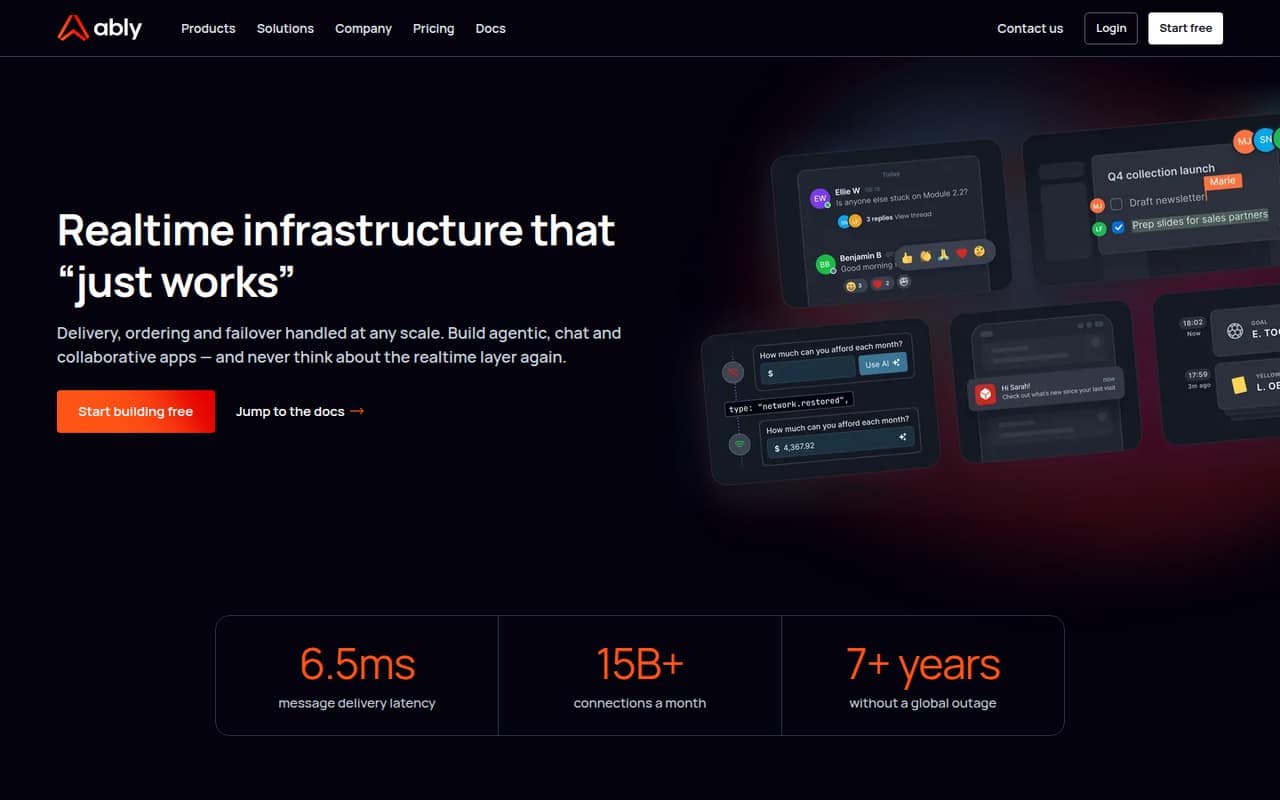
The product set includes Pub/Sub, Chat, AI Transport, LiveObjects, Spaces and LiveSync. Those cover message distribution, chat features, continuous agent sessions, shared application state, collaborative environments and database-to-frontend updates. The service is aimed at interactive applications where clients need updates as events happen, rather than only through repeated requests. Ably says its infrastructure handles 15B+ connections a month and reports 6.5ms message delivery latency; those are vendor-stated figures, not a workload-specific guarantee. The published offer is for a hosted service, so teams should evaluate it as a dependency in their application stack.
02Ably API, SDKs and docs
Ably provides APIs and SDKs, with named SDKs for JavaScript, React, Python, Java, .NET, Ruby, Flutter, Obj-C, Swift, PHP, Go and C#.NET. The vendor says the SDKs offer a consistent, idiomatic API across supported platforms. Its product pages describe APIs for Pub/Sub, Chat, AI Transport, LiveObjects, Spaces and LiveSync; check the documentation for the specific API surface and protocol your application needs.
The integration catalog names webhooks, Amazon Lambda functions, Azure Functions, Cloudflare Workers, Google Cloud Functions, AMQP, Amazon Kinesis, Amazon SQS, Kafka, IFTTT, Zapier, Apache Pulsar and Terraform. Treat Ably primarily as an API integration, not a CLI workflow; check the docs for supported protocols and any CLI tooling. For a production design, confirm SDK support for each client and server runtime, authentication and connection patterns, and how integrations handle retries and errors. The homepage links to documentation and an SDK catalog, but teams should validate their target stack there before implementation.
03Ably pricing for developers
The Free plan costs $0 and includes up to 500 MAUs, all Ably products and features, and best-effort community and email support. It has no commitment, making it useful for development and small-scale evaluation. Pro costs $29 per month for 1K MAUs and is billed annually; it includes an email support SLA under one business day and a 99.999% uptime SLO. Business costs $349 per month for 1K MAUs, also billed annually, with a 99.999% uptime SLA, SOC 2 report, HIPAA BAA and EU/US/AUS routing. Enterprise uses custom MAUs and annual billing.
The published prices do not explain how charges change above a plan’s MAU allowance, or how other usage dimensions affect the bill. Ask Ably for the MAU definition, overage policy, rate limits and any message or connection charges before forecasting production spend. Dedicated cluster and PrivateLink/VPN are paid add-ons, but their prices are not published. Free has no commitment; Pro and Business are billed annually.
04Ably: open source, self-hosting and lock-in
Ably is presented as a managed hosted service, not as software to deploy on your own infrastructure. The vendor does not publish source availability or licence terms in its product overview, and it does not describe a self-hosting path there. Teams with requirements for open-source dependencies or infrastructure control should ask Ably directly about both before choosing it.
The product handles message delivery, ordering and failover, so moving away is more than swapping a client library: application code may depend on Ably’s APIs, SDK behavior and product-specific features such as Chat, LiveObjects or Spaces. The vendor does not publish data-export terms in the overview. Before adoption, identify which data Ably stores, how to retrieve it, and whether your event formats and application state can be moved to another provider. Keeping an application-owned event model and isolating provider-specific calls can reduce migration work, but it does not remove the need to plan an exit.
05Ably in production
Ably says its infrastructure is designed for delivery, ordering, failover and regional and global redundancy. The homepage reports 7+ years without a global outage and 99.999999% message survivability by design. Pro lists a 99.999% uptime SLO; Business lists a 99.999% uptime SLA. These terms differ, so teams should read the applicable contract and confirm what qualifies for service credits or other remedies.
Before launch, test how your application behaves during disconnects, reconnects, delayed events and duplicate handling. Confirm MAU measurement, rate limits, message limits, overages and regional routing with Ably; the published plan prices specify MAUs but do not settle those implementation details. Business includes a SOC 2 report, HIPAA BAA and EU/US/AUS routing. Enterprise lists SAML/SCIM/Okta SSO and support SLAs, including critical support under 15 minutes. Check which security, compliance and support terms apply to your plan, and whether dedicated clusters or PrivateLink/VPN are needed.
Questions people ask
What is Ably software?
Ably is a managed realtime infrastructure service. Applications connect through Ably APIs and SDKs to send messages, power chat and collaboration, synchronize application state, or support continuous AI agent sessions. Ably handles message delivery, ordering and failover; it is not a self-hosted server described as part of its standard product offer.
How do developers integrate Ably?
Developers use Ably APIs and SDKs. Named SDKs include JavaScript, React, Python, Java, .NET, Ruby, Flutter, Obj-C, Swift, PHP, Go and C#.NET. Ably also lists integrations such as webhooks, Kafka, AMQP, cloud functions and Terraform. Check the docs for the API protocols and runtime support your application requires.
Is Ably free to use?
Ably’s Free plan costs $0 and includes up to 500 MAUs, access to all Ably products and features, and best-effort community and email support. It has no commitment. Ask Ably how it handles usage above the MAU allowance and whether any usage limits affect your intended workload.
What does Ably cost for production?
Pro is $29 per month for 1K MAUs, billed annually. Business is $349 per month for 1K MAUs, also billed annually. Enterprise has custom MAUs and annual billing. The published prices do not explain overage charges, so confirm expected production costs with Ably.
Does Ably offer an uptime guarantee?
Pro lists a 99.999% uptime SLO, while Business lists a 99.999% uptime SLA. These are not interchangeable commitments. Review the terms for your plan to understand the measurement period, exclusions and remedies. Enterprise support and service terms should be confirmed with Ably.