
We may earn a commission if you buy through links on this page. It never changes a score or a ranking. How we make money
The bottom line
Useful session-level debugging, but confirm integration details and production costs before rollout.
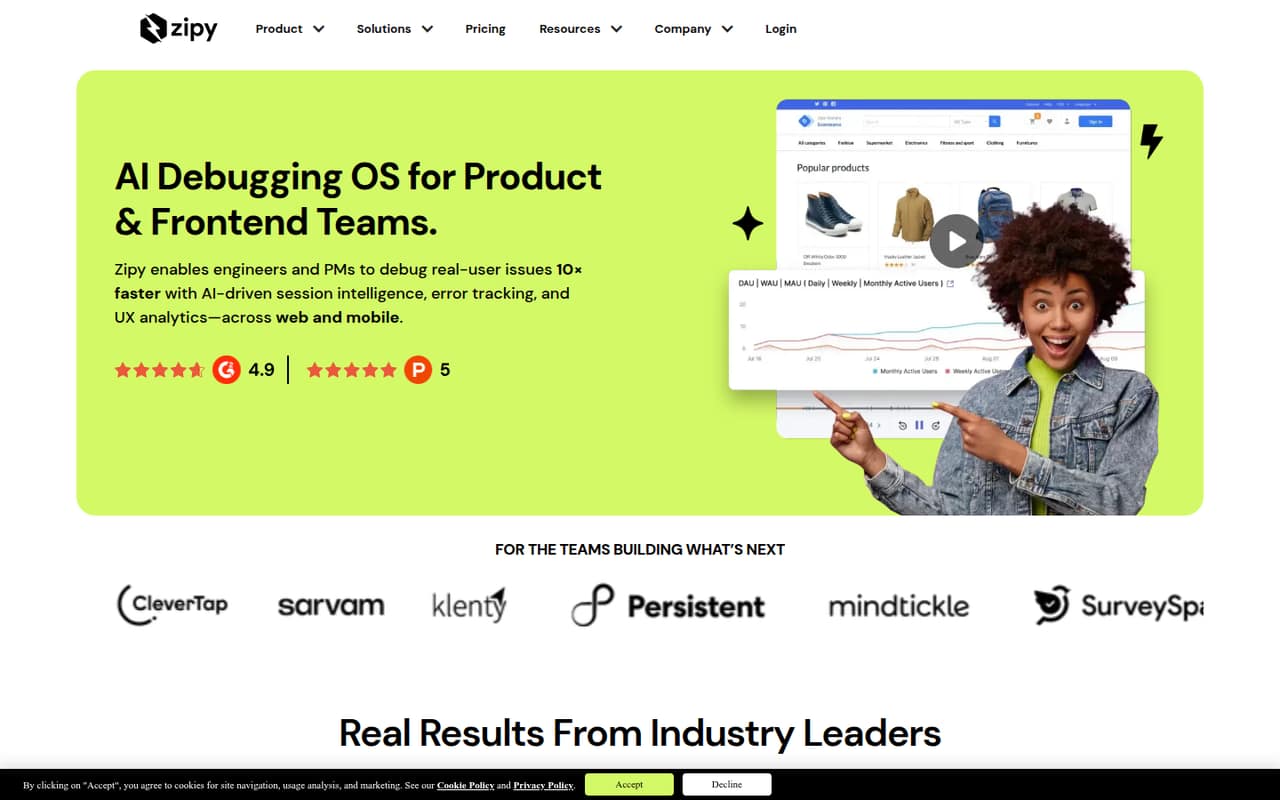
Zipy is a hosted platform for session replay, error tracking, product analytics and performance monitoring across web and mobile apps. Its Oopsie AI Agent and AI summaries aim to surface friction and help teams reproduce issues without reviewing every session manually.
The free plan covers 1,000 sessions a month, two projects and 15 days of retention. Growth starts at $30 per month, or $25 per month billed annually, but add-on pricing and several implementation details need confirmation before a production rollout.
Good fit if
- Teams debugging real-user issues
- Product teams tracking user friction
- Small projects evaluating session replay
Skip it if
- Teams requiring self-hosted observability
- Buyers needing published API specifications
- Projects needing predictable add-on costs
ScoresHow it rates
What works
- Combines replay, errors, analytics and performance monitoring
- Free plan includes 1,000 sessions monthly
- Mobile replays are included on Free
- Framework and mobile platform coverage is broad
- Growth includes unlimited users
What doesn't
- Add-on prices are not published
- SDK and API details need vendor confirmation
- Free retention is limited to 15 days
- No self-hosting option is published
- Export and migration details are not published
01What Zipy is, technically
Zipy is a hosted product analytics and debugging platform, not a self-hosted server or command-line tool. Teams add it to web and mobile apps to review real-user sessions alongside errors, console and network logs, and product behavior. Its feature set also includes API performance monitoring, heatmaps, funnels and page-speed monitoring.
That puts Zipy beside an application’s existing frontend monitoring and analytics tools. It is intended to connect user actions to production problems: session replay provides context, error tracking surfaces JavaScript and API failures, and AI summaries or the Oopsie AI Agent highlight possible friction and issues to prioritize. The vendor also describes Repro Steps for reproducing issues and Ask AI for querying product data.
This combination can reduce the need to switch between separate tools, but it means Zipy will handle detailed session data. Teams should assess what their instrumentation captures and how that data fits their privacy and retention requirements before enabling it across production traffic.
02Zipy API, SDKs and docs
The homepage lists ReactJS, VueJS, Angular, NextJS, jQuery, JavaScript, Ember, TypeScript, Svelte and PHP, plus Flutter, React Native, Android and iOS for mobile. It also lists a Chrome Plugin and integrations with Sentry, Segment, Rollbar and Raygun. These are the named integration surfaces; the homepage does not give API endpoints or an API protocol.
The vendor describes session replay with DOM, console and network logs, and error tracking with stack traces and network logs. That gives engineering teams useful debugging context, but implementation details such as initialization, source-map setup, data masking and release tracking should be checked in Zipy’s technical docs.
The listed languages and platforms do not, by themselves, establish which SDK packages are available or how they are versioned. Confirm SDK support, installation steps and compatibility with your framework versions in the vendor’s docs before choosing a rollout path. The homepage also does not list a CLI or webhook integration, so ask the vendor about those if they are part of your deployment workflow.
03Zipy pricing for developers
Zipy has a free plan at $0 with 1,000 sessions per month, 15 days of data retention, up to two projects, mobile replays and email support within 72 hours. That is enough to evaluate the workflow or cover a small app, but session volume and retention are the first constraints for production use.
Growth starts at $30 per month billed monthly or $25 per month billed annually. It lists 7.5k–500k sessions per month, one month of retention, up to 10 projects, unlimited users and email support within 24 hours. The listed session range makes it important to check the price for your expected volume; the pricing page does not give a single price for every volume.
Rule-based alerts, Oopsie AI and Funnels are marked as add-ons, with prices not published. The plan builder also offers selectable session volumes and add-ons including errors, heatmaps, API performance and page performance; prices vary by sessions and are not published. Enterprise has custom pricing, custom retention and session volumes. A 14-day free trial is listed. Ask about overages and add-on charges before forecasting a full production bill.
04Zipy: open source, self-hosting and lock-in
Zipy is presented as a hosted service. The vendor does not publish an open-source licence or a self-hosting option in the product material, so teams that require source access or deployment inside their own environment should confirm both directly before adopting it.
The vendor also does not publish data-export details here. Ask what session, event and error data can be exported, in which formats, and whether exports include enough context to move to another replay or analytics tool. Without a documented export path, migration could mean rebuilding instrumentation and dashboards and losing access to historical data when the service ends.
The named Sentry, Segment, Rollbar and Raygun integrations may fit into an existing stack, but they do not settle portability. Treat data ownership, export frequency, retention after cancellation and deletion timing as procurement questions, not assumptions.
05Zipy in production
The published plan limits give teams a starting point for capacity planning: Free allows 1,000 sessions a month and 15 days of retention; Growth lists 7.5k–500k sessions monthly and one month of retention. Enterprise offers custom volume and retention. The pricing material does not publish overage rates, so get the cost and behavior at the session ceiling in writing before relying on it at scale.
The vendor does not publish service-level uptime, rate limits or detailed reliability commitments in the product material. Enterprise lists priority email and chat support, with email support within six hours; Free and Growth list email responses within 72 and 24 hours respectively. Ask what those response windows cover and whether they are contractual.
Because replay includes DOM, console and network logs, check data masking, consent controls, access controls, encryption, regional storage and compliance coverage with Zipy before recording production sessions. Confirm SDK compatibility and how instrumentation affects sensitive routes. These are particularly important where sessions may contain personal or regulated data.
Questions people ask
What does Zipy do?
Zipy is a hosted platform that combines session replay, error tracking, product analytics and performance monitoring for web and mobile apps. It captures session context, including DOM, console and network logs, and offers AI summaries and the Oopsie AI Agent to highlight friction and issues for teams to investigate.
How much does Zipy cost?
Zipy’s Free plan costs $0 and includes 1,000 sessions per month. Growth starts at $30 per month billed monthly or $25 per month billed annually. Enterprise pricing is custom. Oopsie AI, Funnels and rule-based alerts are marked as add-ons, and their prices are not published.
What are Zipy’s free-plan limits?
The Free plan includes 1,000 sessions per month, 15 days of data retention, up to two projects, mobile replays and email support within 72 hours. Teams expecting higher session volume or needing more retention should compare Growth or ask Zipy how its session-volume pricing applies.
Which frameworks and mobile platforms does Zipy list?
The homepage lists ReactJS, VueJS, Angular, NextJS, jQuery, JavaScript, Ember, TypeScript, Svelte and PHP. For mobile it lists Flutter, React Native, Android and iOS. Confirm SDK availability, setup instructions and version compatibility in Zipy’s technical docs before integrating.
Can I self-host Zipy or export my data?
Zipy is presented as a hosted service, and the vendor does not publish a self-hosting option, open-source licence or data-export details in its product material. Ask Zipy which data can be exported, in what format, and what happens to historical data after cancellation before committing.