
We may earn a commission if you buy through links on this page. It never changes a score or a ranking. How we make money
The bottom line
Multi-model coding and work agents, with credit costs and production limits to verify first.
Zencoder coordinates agents for planning, coding, testing and review across desktop, IDE and CI/CD workflows. It can also connect work automations to tools such as Jira, Slack and GitHub, with enterprise deployment options that include on-premise and hybrid.
The breadth is useful, but this is an agent platform rather than a clearly documented API-first developer service. The vendor lists monthly credits and paid top-ups, while Reddit users report inconsistent request costs and slow responses. Confirm usage behavior, integrations and deployment controls for your workload.
Good fit if
- Teams coordinating coding agents
- Multi-repository development teams
- Automating code review and maintenance
Skip it if
- Developers seeking a public SDK
- Teams needing published rate limits
- Projects requiring open-source tooling
ScoresHow it rates
What works
- Plans, builds, tests and reviews code
- Orchestrates Claude, Gemini and Codex
- Works across desktop, IDE and CI/CD
- Supports multi-repository indexing
- Enterprise deployment includes on-premise and hybrid
What doesn't
- No named public API or SDK
- Free plan limits are not published
- Credit use per task is unclear
- No open-source licence is listed
- Reddit users report slow or inconsistent requests
01What Zencoder is, technically
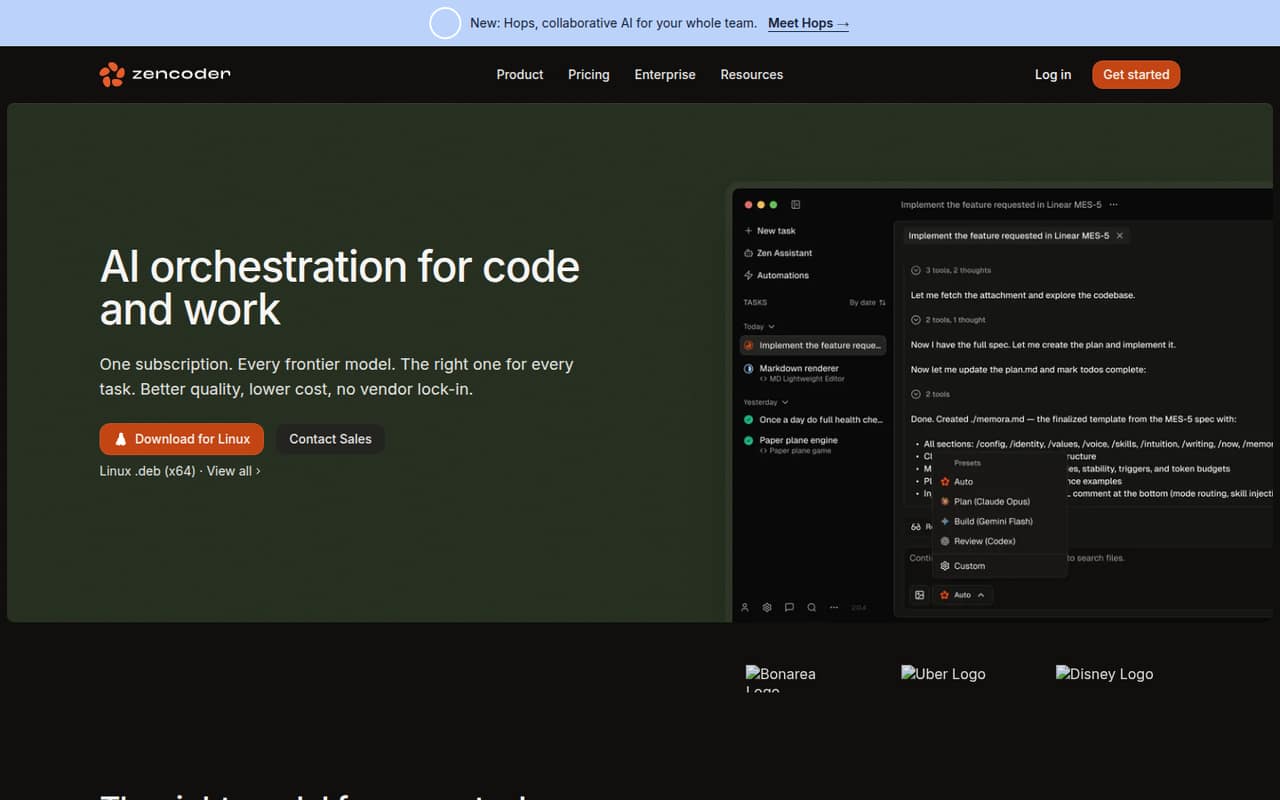
Zencoder is an AI agent platform for coding and work, delivered through a desktop app, IDE integrations and CI/CD workflows. It sits above your repositories and connected work tools: agents use codebase context to plan changes, implement features, fix bugs, refactor code, run verification and route work for review.
Its model orchestration assigns different stages to different models. The vendor describes Claude Opus for planning, Google Gemini for building and OpenAI Codex for review. Agents can work in parallel across files, modules and repositories in isolated environments. The platform also offers work automations that connect to tools such as Jira, Slack, Notion and GitHub.
This is not just an autocomplete plugin. It coordinates multi-step tasks and verification, so it can affect how code changes are proposed, tested and reviewed. Enterprise deployment options include cloud, on-premise and hybrid. Teams should establish where agent execution and repository data reside in their chosen deployment before connecting production code.
02Zencoder API, SDKs and docs
The documented integration surfaces are the desktop app, IDE agents for VS Code and JetBrains, CI/CD workflows, integrations and MCP. In the IDE, agents can edit files, run tests, search across repositories and connect to Jira, GitHub, Slack or a custom MCP endpoint. The Work app connects automations to tools including Jira, Slack, Notion, Gmail and Calendar; its homepage also describes communication through Slack, Telegram and Discord.
The homepage does not name a public API style, SDK, programming language or CLI. Confirm SDK support and the supported integration methods in the vendor's docs before planning a custom application integration. Pro lists 2,000+ integrations, while the Work app describes connections to 100+ tools; check that the specific systems and actions your team needs are supported.
The product emphasizes workflows and editor integrations rather than a language-specific library. Teams can encode coding standards and architectural patterns as reusable Skills, then use approval and review steps to keep agent changes under developer control.
03Zencoder pricing for developers
The Free plan supports BYOK, but the vendor does not publish a credit allowance or other usage limit for it. Pro costs $45 per user monthly or $40 per user per month with annual billing, and includes 30,000 monthly credits, unlimited BYOK usage, desktop and IDE plugins, frontier models, and 2,000+ integrations. Pro Plus is $95 monthly or $85 annually per user for 80,000 credits, shared team credits, multi-repository indexing, analytics, SSO and audit logs. Pro Max is $195 monthly or $175 annually per user for 180,000 credits and priority support.
Enterprise pricing is custom and includes prepaid usage plans, unlimited multi-repository indexing, private deployment and professional services. The pricing page lists credit top-ups at a $20 minimum; they are non-refundable, and top-up credits remain usable. The vendor does not publish how many credits a typical task consumes or a rate-limit schedule, so estimate your monthly workload before choosing a seat tier. Reddit users report that requests can consume several credits and that slow requests may take a long time; those reports do not establish current plan behavior.
04Zencoder: open source, self-hosting and lock-in
The vendor does not list an open-source licence, so teams should treat Zencoder as proprietary unless sales confirms otherwise. It is not limited to a hosted-only deployment: Enterprise includes private deployment, and the product offers cloud, on-premise and hybrid options. Confirm what each option covers, including where models run and what data leaves your environment.
The vendor does not publish a data-export process. Before adoption, ask how to export repository indexes, workflow definitions, Skills, audit records and connected-tool data, and whether these exports remain usable outside Zencoder. Code changes can be reviewed and accepted in your editor or workflow, which gives teams a route to retain changes in their repositories. However, agent workflows, model routing and integrations may need to be rebuilt if you migrate. Lock-in risk is therefore higher in orchestration and automation than in the code itself.
05Zencoder in production
Zencoder describes verification with tests, linting and code review, plus approval gates, role-based permissions and audit trails for enterprise use. These controls help teams govern agent changes, but they do not replace review of the actual diff or a check that tests cover the intended behavior. Confirm the deployment's security and compliance terms, data retention, model routing and access controls before connecting sensitive repositories; named compliance certifications are not published.
The vendor does not publish a rate-limit schedule or a predictable credit cost per task. That matters when agents run in CI/CD or process work on a schedule: establish how failed, repeated and parallel tasks affect credits, and what happens when a team pool is exhausted. Enterprise offers prepaid usage plans, but custom pricing makes cost planning a sales discussion.
Reddit reports are mixed. Some users praise code verified by multiple agents; others report slow-mode waits, unclear credit accounting or requests consuming credits quickly. These are individual reports, not a published reliability measure. Run a representative pilot and agree on usage alerts and escalation paths before making the system a production dependency.
From the threadsWhat users say
Reddit sentiment is mixed: some users value multi-agent verification, while others complain about slow responses and unclear credit behavior. The reports are anecdotal and do not establish current plan performance.
While the gens are slower, the code you get back once a request is complete is often better because it's going through multiple agents to verify the generated code
Not recommend,in slow mode 20min about AI response,Like a joke
You'll run out of tokens very quickly, that's the main problem
not a fan. It used to be pretty good, but I canceled my subscription
Questions people ask
What is Zencoder used for?
Zencoder coordinates AI agents for software planning, implementation, bug fixes, refactoring, testing and code review. It also supports automations across work tools, where agents gather context, draft a deliverable and route it for review. Teams can use it through desktop, IDE and CI/CD workflows.
Which AI models does Zencoder use?
The vendor describes a workflow that uses Claude Opus for planning, Google Gemini for building and OpenAI Codex for review. Zencoder presents this as model orchestration across a task. Confirm available models and routing controls for your plan and deployment before relying on a specific model.
Does Zencoder work with VS Code and JetBrains?
Yes. The vendor lists IDE agents for VS Code and JetBrains. They can edit files, run tests, explore code and connect to Jira, GitHub, Slack or a custom MCP endpoint. Check the vendor's docs for current plugin support and any IDE-specific requirements.
Can Zencoder run on-premise?
The vendor lists cloud, on-premise and hybrid deployment options, with private deployment included in Enterprise. Ask sales which components run in your environment, how model calls are routed, and what repository or workflow data is processed outside the deployment.
Is Zencoder free?
Zencoder lists a Free plan that supports BYOK. The vendor does not publish a credit allowance for that plan. Paid Pro starts at $45 per user monthly, or $40 per user per month with annual billing, and includes 30,000 monthly credits.