
We may earn a commission if you buy through links on this page. It never changes a score or a ranking. How we make money
The bottom line
Postgres branching for parallel work, with self-hosting and standard tooling but details to verify.
Xata is a PostgreSQL platform that creates isolated, copy-on-write branches without full database copies. It targets pull request previews, development and AI-agent workflows, while keeping standard Postgres drivers and tools in the stack.
The $0 Open Source plan is self-managed; managed Xata Cloud starts at $9/month, with storage billed separately. Branching and scale-to-zero are included, but confirm API limits, the applicable open-source license and export procedures before choosing it for production.
Good fit if
- Teams running parallel migrations
- Per-PR database previews
- Agents needing isolated Postgres
Skip it if
- Teams needing published rate limits
- Buyers requiring a known license
- Workloads with heavy bulk writes
ScoresHow it rates
What works
- Copy-on-write branches avoid full database copies
- Branches hibernate when idle
- Vanilla PostgreSQL supports standard tooling
- Self-managed deployment starts at $0
- Agents can branch through API or MCP
What doesn't
- Managed storage adds $0.28/GB/month
- API rate limits are not published
- Open-source license needs confirmation
- Data export procedures are not published
- Reddit users raise bulk-write questions
01What Xata is, technically
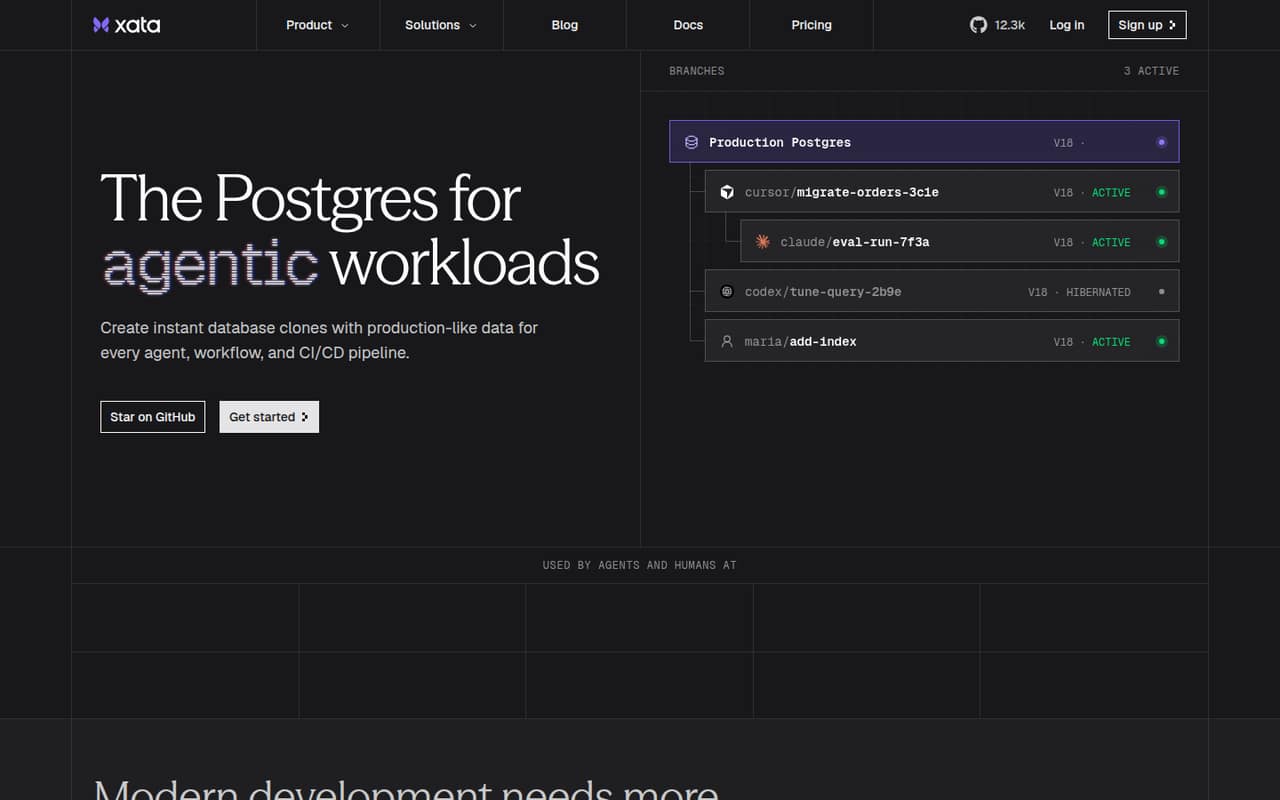
Xata is a PostgreSQL platform, not an ORM or a replacement query language. It runs vanilla Postgres and adds isolated database branches in the storage layer. Branches share parent data through copy-on-write storage and keep their own schema, compute and production-like data, rather than copying the entire database.
That makes Xata a database infrastructure layer for development and deployment workflows. A team can create branches for pull requests, preview deployments, developers or coding agents, run migrations and tests against them, then remove them when work ends. Xata says it can create a production clone while production remains on existing infrastructure, or host production itself.
Deployment options include self-managed infrastructure, Xata Cloud and BYOC. Idle branches hibernate and use no compute, then wake on the first query. Applications still connect using PostgreSQL drivers and tooling, so Xata sits beneath the application’s database access layer rather than requiring a proprietary data model.
02Xata API, SDKs and docs
The homepage describes agent workflows through Xata’s API or MCP: agents can create isolated branches, modify schemas and data, and clean up when finished. It does not name a specific API protocol or language SDK. Confirm supported SDKs, authentication, branch lifecycle calls and MCP setup in Xata’s docs before choosing an integration path.
For database access, Xata lists psql, Prisma, Drizzle, SQLAlchemy, node-postgres and pg_dump, alongside standard PostgreSQL extensions and tools. The homepage also names JSONB, transactions, CTEs, window functions, full-text search, pgvector, PostGIS, PL/pgSQL and logical replication. These are familiar integration surfaces for teams already using Postgres.
The documented workflow is branch-oriented: connect a pull request or preview deployment to its own branch, run migrations and tests, then remove the branch after merge or task completion. We would verify how branch creation connects to your CI system and whether your chosen SDK has Xata-specific guidance in the vendor’s docs.
03Xata pricing for developers
The Open Source plan costs $0 per month for teams self-managing Postgres. It includes branching and scale-to-zero, but you provide the infrastructure and get community support. That is not the same as free managed cloud. Xata Cloud starts at $9/month for a micro instance, listed at $0.012/hour, plus storage at $0.28/GB/month. Storage is billed by the minute; Xata Cloud is pay-as-you-go.
The instance ladder rises from micro to small at $0.024/hour ($18/month), medium at $0.048/hour ($35/month), and larger sizes up to 8xlarge at $1.536/hour ($1,121/month). Storage and active compute are the main listed usage costs; idle branches scale to zero. There is no seat-based charge in the listed pricing.
BYOC has a custom fee based on a percentage of Xata-managed cloud spend; the rate is not published. Team, Company, Platform and Hyperscale plans have custom pricing and list concurrent branch limits from 1,000 up to 100,000+. Ask Xata about API rate limits, billing details for your workload and any applicable overages.
04Xata: open source, self-hosting and lock-in
Xata lists an Open Source plan for self-managed Postgres on your own infrastructure, priced at $0 per month. The plan includes branching and scale-to-zero. Xata also offers managed Cloud and BYOC deployments, so self-hosting is an option rather than the only deployment model.
The plan name and a Reddit thread title describe Xata as open source, but the license is not published on the vendor's site. Confirm the specific license, repository scope and any restrictions before building around self-hosting.
Xata runs vanilla PostgreSQL and lists standard tools such as psql and pg_dump, which gives teams familiar options for database access and dumps. However, the vendor does not publish a specific data export or migration procedure here. Branch management and copy-on-write storage are Xata’s infrastructure layer, so ask how to export production data and move branches before adopting the platform.
05Xata in production
Xata’s homepage lists automatic failover to read replicas and point-in-time recovery backups. It displays 99.99% uptime and 4ms P99 latency, but treat those as vendor-stated figures and ask for the service-level terms that apply to your deployment. Managed Cloud lists an approximately one-second wake-up time; the self-managed plan lists approximately 10 seconds. Test how hibernation and wake-up behavior fit your connection pools and job deadlines.
Managed Cloud lists SOC 2 and GDPR; BYOC lists advanced anonymization for HIPAA, 24/7 support and a dedicated solutions engineer. Confirm the scope of compliance commitments and support response times for your plan. Published plan tiers list concurrent branch counts, but API rate limits are not published; ask Xata about branch creation bursts and other service quotas.
A PostgreSQL Reddit commenter called copy-on-write branching useful for parallel end-to-end testing, while asking how it handles large bulk writes. That is a workload to validate with Xata. Another Reddit discussion reflects uncertainty about Xata’s fit and alternatives, rather than broad production feedback.
From the threadsWhat users say
Reddit feedback is limited and mixed: one PostgreSQL commenter sees branching value for parallel tests but asks about bulk writes. Other discussion reflects low familiarity with Xata and interest in self-managed database options.
Copy-on-write branching sounds very useful for parallel end-to-end testing, not just for agents
I wonder how well it fares with large bulk-write operations
I only have experience with Supabase, never heard of Tigris or Xata
Just take Postgres in Docker? Create some backup crons, that is it?
Questions people ask
How does Xata database branching work?
Xata creates isolated branches from a production database without copying the full database. Its copy-on-write storage lets branches share parent data and store only changes. Each branch has its own schema and compute, making it suitable for pull requests, preview deployments, development and agent tasks.
Can I self-host Xata?
Yes. Xata lists a $0-per-month Open Source plan for teams running Postgres on their own infrastructure, with branching and scale-to-zero included. The plan lists community support and an approximately 10-second wake-up time. Confirm the applicable license and deployment requirements with Xata before adopting it.
How much does Xata Cloud cost?
Xata Cloud starts at $9 per month for a micro instance, listed at $0.012 per hour. Storage costs $0.28 per GB per month and is billed by the minute. Larger instance sizes cost more, and Xata lists pay-as-you-go pricing. Idle branches hibernate and use no compute.
Can AI agents create Xata branches?
Yes. Xata says agents can create isolated branches through its API or MCP, modify schemas and data, and clean up when the task finishes. The homepage does not name a specific API protocol or language SDK, so confirm client support, authentication and branch lifecycle details in Xata’s docs.
Does Xata work with standard PostgreSQL tools?
Xata says it runs vanilla PostgreSQL and lists psql, Prisma, Drizzle, SQLAlchemy, node-postgres and pg_dump. It also names standard extensions and PostgreSQL features. Confirm that your specific extension, driver version and operational workflow are supported for your chosen Xata deployment.