
We may earn a commission if you buy through links on this page. It never changes a score or a ranking. How we make money
The bottom line
A hosted model-routing API that cuts integration work, with production costs and limits to check.
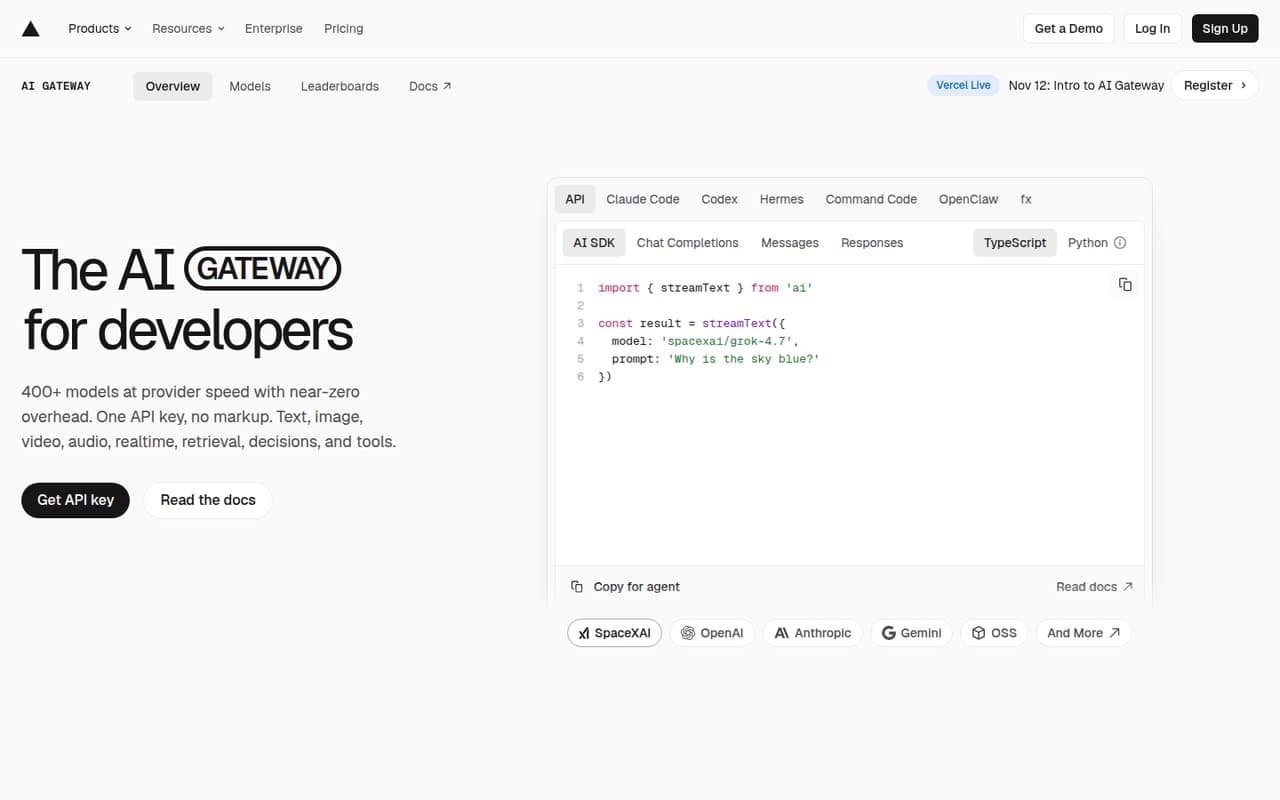
Vercel AI Gateway is a hosted API for routing requests to 400+ models through one endpoint and API key. It supports provider-price billing with no platform fee on tokens, plus routing, fallbacks, usage visibility and spend controls.
It fits teams that want to swap models or providers without maintaining separate integrations. The free tier has $5 in monthly credits but restricts model eligibility, rate limits and BYOK; production teams should budget for provider usage and optional controls.
Good fit if
- Teams integrating multiple model providers
- Apps needing provider failover
- Developers already using AI SDK
Skip it if
- Teams requiring self-hosted gateways
- Workloads needing published rate limits
- Buyers seeking one fixed monthly price
ScoresHow it rates
What works
- One API key and endpoint for 400+ models
- Provider-price token billing, with no platform fee
- Automatic fallback to another provider
- Budgets and usage visibility at several scopes
- OpenAI and Anthropic SDKs can use a base URL swap
What doesn't
- Free tier is limited to eligible models
- Free tier has lower per-model rate limits
- Paid usage requires purchased credits
- Custom rate limits are not included as a published figure
- Gateway self-hosting and source licence are not published
01What Vercel AI Gateway is, technically
Vercel AI Gateway is a hosted API service, not a self-hosted gateway server or a language library. It sits between an application and model providers: the app sends requests to one endpoint using one AI Gateway API key, and the service routes requests across more than 400 models. That replaces separate provider connections and billing paths with a shared integration surface.
The gateway supports routing by availability, cost or latency. If a provider degrades, Vercel says it can fail over to the same model through another provider. The service also centralizes usage visibility, budgets and data-handling controls. It covers text, image, video, audio, realtime, retrieval, decisions and tools, according to the homepage.
This architecture can reduce provider-specific code, but it adds a hosted intermediary to the request path. Teams should account for that dependency, verify model and provider behavior for their workloads, and plan how the application behaves if the gateway or a route is unavailable.
02Vercel AI Gateway API, SDKs and docs
The homepage presents one API endpoint and key, and says existing OpenAI, Anthropic and AI SDK integrations can move over with a base URL swap. It names OpenAI Chat Completions, OpenAI Responses, Anthropic Messages and Open Responses. The Vercel AI SDK example uses TypeScript and the streamText function; TypeScript and Python are shown as languages. The AI SDK is described as an open-source toolkit for React, Next.js, Vue, Svelte, Node.js and more.
For other codebases, the documented integration surface is the API endpoint and compatible request formats; confirm SDK support and exact protocol details in Vercel’s docs. The homepage links to docs but does not name a standalone Gateway SDK for each language. API key management is available from the dashboard, CLI or API. The service also lists short-lived OIDC tokens, BYOK, and a Custom Reporting API for tagging requests and analyzing spend. Teams can start with the single endpoint, then validate request compatibility and streaming behavior for each model.
03Vercel AI Gateway pricing for developers
The Free tier costs $0 and includes $5 in monthly credits. It is restricted to Free Tier eligible models, has lower per-model rate limits and does not include BYOK. The Paid tier is pay as you go: teams purchase credits with no renewal commitment, can use all available models, and can access custom rate limits and BYOK. Enterprise has custom pricing and offers invoice billing, with no payment processing fees on invoices. Annual billing is not listed.
Gateway token charges use provider list rates with zero markup; total spend therefore varies by model and usage. Payment processing fees may apply outside invoice billing. Optional charges include Custom Reporting at $0.075 per 1,000 writes and $5 per 1,000 queries; team-wide provider allowlists at $0.10 per 1,000 successful requests on Pro and Enterprise; and team-wide ZDR at $0.10 per 1,000 requests. Trace Drains cost $0.05 per 1,000 traces plus $0.50 per GB of trace egress. Custom volume discounts are available.
04Vercel AI Gateway: open source, self-hosting and lock-in
Vercel presents AI Gateway as a hosted API. Its homepage calls the AI SDK an open-source toolkit, but that does not establish that the Gateway itself is open source. Vercel does not publish a Gateway source licence or self-hosted deployment option in the product details. Teams that require a self-managed routing layer should ask Vercel about deployment and licensing before committing.
The homepage describes a Custom Reporting API for sending tagged request data to your own systems, but does not publish a general usage-data export format or migration procedure. The Gateway’s OpenAI and Anthropic compatibility and base URL swap can reduce the effort of moving an existing integration onto it. Moving away still means changing the endpoint and credentials, and potentially adapting provider-specific features or routing logic. Keep provider access and application-level model configuration separable if portability matters.
05Vercel AI Gateway in production
Vercel lists budgets at team, project and API-key level, request logs, and dashboards for spend, requests, TTFT and token counts. Its controls include routing only to ZDR providers, no-training provider routing and provider allowlists. These controls can help teams set guardrails, but check which are included in your plan and whether optional per-request charges apply. The free tier has lower per-model rate limits; Vercel says custom rate limits are available on the Paid tier, without publishing a general limit figure in the pricing details.
Vercel says the Gateway can fail over to the same model through another provider when a provider degrades. Confirm which providers support the model you need and test how your app handles retries and route changes. A Reddit post describes a ten-run GPT-4 TTFT comparison and claims about 25% faster average results through the Gateway; treat that as an individual report, not a guarantee. Another commenter emphasizes testing with your own workload. Vercel says latency varies by region, traffic and prompt length.
From the threadsWhat users say
Reddit discussion is limited and mixed: one post reports faster Gateway results, while commenters point to workload-specific testing and tail latency. The available discussion does not establish broad buyer satisfaction.
From this round of testing, the Vercel AI Gateway showed noticeably fast and consistent results
Good reminder to test with your own workload
For agent workflows, p90 and tail latency matter a ton because one slow tool call can drag the whole run
A new stealth model was rolled out for free - stealth/glyph-cluster:free
Questions people ask
How does Vercel AI Gateway work?
Your application sends model requests to Vercel AI Gateway using one endpoint and API key. The service routes requests to supported models and providers, with options for routing by availability, cost or latency. Vercel also lists automatic fallbacks, usage visibility, budgets and data-handling controls.
Does Vercel AI Gateway add a markup to model tokens?
Vercel says Gateway token charges use provider list rates with zero markup and no platform fee on tokens. Your bill still varies with the model and amount of usage. Payment processing fees may apply, except for invoices, which Vercel lists as having no payment processing fees.
Can I use my existing OpenAI or Anthropic SDK?
Vercel says existing OpenAI and Anthropic integrations can move to AI Gateway with a base URL swap, without rewriting the same calls. The homepage names OpenAI Chat Completions, OpenAI Responses and Anthropic Messages. Confirm compatibility for the particular SDK version and model in Vercel’s docs.
Does Vercel AI Gateway support BYOK?
BYOK is not included in the Free tier. Vercel lists it as available on the Paid tier, and says existing provider commitments can flow through when using your own keys. Check the provider-specific setup and billing behavior in the docs before switching production traffic.
Can I self-host Vercel AI Gateway?
Vercel presents AI Gateway as a hosted API and does not publish a self-hosted deployment option or Gateway source licence in its product details. The AI SDK is described separately as open source; that does not make the Gateway itself an open-source or self-hostable service.
Sources
- Vercel AI Gateway homepage
- Vercel AI Gateway pricing page
- Reddit: Vercel AI Gateway, Glyph Cluster Investigation - Microsoft MAI?
- Reddit: OpenAI API vs Vercel AI Gateway A Quick Performance Check
- Reddit: Vercel AI Gateway vs. OpenAI Direct: Benchmarking TTFT Performance with Blackbox AI
- Reddit: Vercel AI Gateway models