
We may earn a commission if you buy through links on this page. It never changes a score or a ranking. How we make money
The bottom line
Upstash bundles serverless data services behind hosted APIs, but brings cloud dependence and usage costs.
Upstash is a hosted platform for Redis, vector search, HTTP messaging, workflows, AI-agent containers and file storage. Its APIs and SDKs fit serverless applications that need managed data services without operating the backing infrastructure.
The free Redis tier is useful for prototypes, while production costs depend on data, bandwidth, commands and optional add-ons. Treat it as a set of managed services, not a self-hosted platform; confirm each product’s limits and migration options before making it a core dependency.
Good fit if
- Serverless apps needing managed Redis
- HTTP-based background tasks and schedules
- Teams consolidating managed data services
Skip it if
- Self-hosting every infrastructure component
- Complex, high-volume analytical workloads
- Teams requiring published export guarantees
ScoresHow it rates
What works
- Managed Redis includes persistence, backups and scaling
- TypeScript and Python examples for Redis
- QStash sends messages over HTTP
- Blob supports S3-compatible access
- Free Redis plan supports small prototypes
What doesn't
- Hosted services add cloud-provider dependence
- Redis usage can incur bandwidth and storage charges
- No self-hosting path is published
- Data export and migration details need confirmation
- Reddit users question QStash completion notifications
01What Upstash is, technically
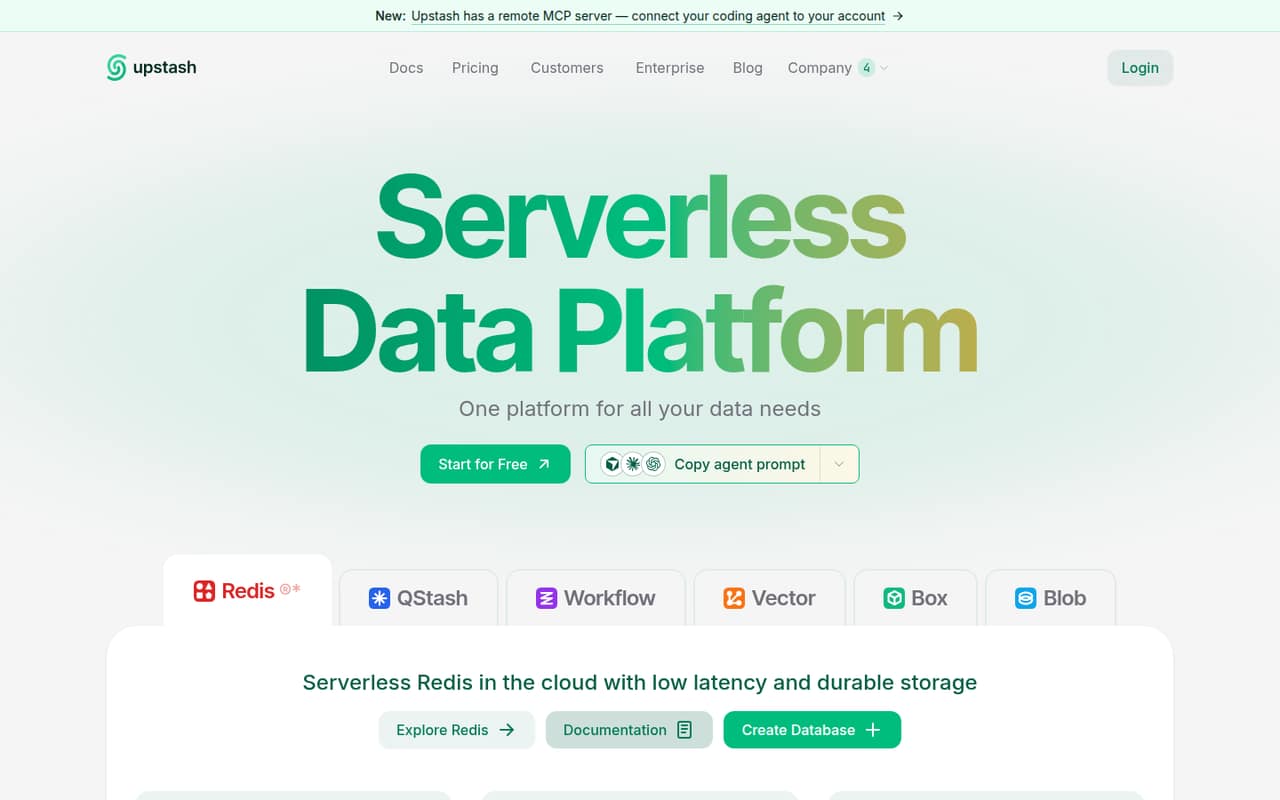
Upstash is a hosted, serverless data platform: you call cloud services through APIs and SDKs rather than deploying Upstash servers into your own infrastructure. Its products include managed Redis, a vector database, QStash messaging and scheduling, Workflow orchestration, Box containers for AI agents, and Blob file storage.
In a typical stack, Upstash sits beside your application runtime. Your functions or services send Redis commands, publish HTTP messages, run vector queries, or store files through Upstash’s service endpoints. The platform handles the underlying service infrastructure; the homepage lists automatic scaling and no server management for Redis.
That scope makes Upstash more than a Redis provider, but the products are separate building blocks rather than one database that covers every data workload. A Reddit user looking for real-time analytics noted that Upstash suits key-value use cases but not complex analytical queries or high-volume analytics ingestion. Choose a purpose-built analytics system for that job.
02Upstash API, SDKs and docs
Upstash exposes product APIs and SDKs. The homepage shows TypeScript and Python examples for Redis, plus TypeScript package examples for @upstash/redis, @upstash/qstash, @upstash/vector and @upstash/search. The Redis examples use a URL and token or Redis.fromEnv(); QStash publishes JSON to an HTTP URL, and Vector upserts records through its SDK.
QStash is messaging and scheduling via HTTP, including CRON tasks and configurable retries. Blob supports the AWS SDK and S3 tools, direct browser uploads, signed URLs and React hooks. The homepage also offers a CLI for resource management from a terminal or CI/CD, an MCP server for resource management and debugging in an editor, and packaged instructions for SDKs and CLI use. It lists Claude Code, OpenAI Codex and Cursor among supported agent integrations.
The vendor links product documentation from its homepage. Confirm the current SDK and language support for each product in those docs before standardizing on an integration; the examples above are not a promise that every service has the same client coverage.
03Upstash pricing for developers
The Redis pricing page lists a Free plan at $0 per month with 250 MB of data, 10 GB monthly bandwidth, 500K monthly commands and one database. Pay as You Go charges $0.20 per 100K commands, with a 100 GB maximum data size and bandwidth free up to 200 GB per month. Storage is free for the first 1 GB, then $0.25/GB; bandwidth beyond the allowance is $0.03/GB.
Fixed Redis plans start at $10/month for Fixed 250MB, which includes 50 GB bandwidth and unlimited commands. Fixed 1GB is $20/month; tiers rise to $1,500/month for Fixed 500GB. Fixed plans include 10,000 or 16,000 commands/sec depending on tier. The pricing page lists Enterprise as custom pricing.
Budget for add-ons: fixed-plan read regions cost $5–$750/month per region, and Prod Pack is $200/month per database. Paid accounts get the first 10 databases without a per-database charge; each additional database costs $0.50/month, up to 100. These figures are for Redis; check pricing for other Upstash services separately.
04Upstash: open source, self-hosting and lock-in
Upstash presents its products as cloud services, and the vendor does not publish a self-hosting path or an open-source license for the platform on its homepage. Do not plan to run an Upstash-compatible server under your own control unless the vendor confirms that option and its terms.
Your application can use product SDKs and APIs, but relying on Upstash-specific endpoints and features creates migration work. Redis is a familiar data model, yet changing providers still means checking command compatibility, authentication, networking and application configuration. QStash, Workflow, Vector, Box and Blob each add their own service-specific integration points.
The vendor does not publish data-export or migration guarantees on the homepage. Before storing production data, ask about export formats, bulk extraction, retention after cancellation, and any product-specific limits. S3 compatibility for Blob can ease integration with AWS SDKs and S3 tools, but it is not a general export guarantee for the other services.
05Upstash in production
The homepage states a 99.99% uptime guarantee for Redis and lists automatic backups, persistence and multi-region replication options. Confirm which plan and add-ons are needed for the availability, encryption and compliance controls your system requires: the pricing page lists the $200/month-per-database Prod Pack with uptime SLA, multi-zone HA, encryption at rest, SOC 2, monitoring and Insights. Enterprise lists HIPAA compliance.
The Redis pricing tiers publish data, bandwidth and command-rate limits; Pay as You Go also caps request size at 10 MB and record size at 100 MB. Model command volume, egress and database count, and use alerts to catch a bill that grows with traffic. The free plan’s 500K monthly commands can be consumed by local development as well as production, a concern raised by a Reddit commenter.
Reddit reports are mixed and anecdotal. One QStash thread asks about latency and completion notifications; a commenter said it had not seemed slow but had not benchmarked it. Another said they used Ably for completion notifications, rather than relying on native subscriptions. Validate latency, retry behavior and completion signaling against your own workload.
From the threadsWhat users say
Reddit discussion is mixed and use-case specific. Developers describe Upstash as a practical starting point for rate limiting and Redis-backed tasks, while raising questions about free-tier headroom, QStash latency and notifications, and analytics fit.
I think Vercel KV and Upstash is a good start for rate limiting
the upstash free tier *might* be enough to start, but it really depends on how aggressive you want to be with the rate limits & how much traffic you anticipate
It hasn't seemed slow, but I did not benchmark it against others
it's not designed for complex analytical queries or high-volume data ingestion for analytics
Questions people ask
What is Upstash for Redis?
Upstash Redis is a hosted, serverless Redis service accessed through APIs and SDKs. The homepage lists automatic scaling, persistence, backups and multi-region replication options. It is intended for Redis-style workloads such as caching, sessions, rate limiting, leaderboards and chat.
Is Upstash free to use?
The Redis Free plan costs $0 per month and includes 250 MB of data, 10 GB of monthly bandwidth, 500K monthly commands and one database. Usage beyond a plan’s allowances can add charges, so check the current pricing page before deploying a workload with variable traffic.
Is Upstash open source?
Upstash presents its products as hosted services. The vendor does not publish an open-source license or self-hosting path for the platform on its homepage. Ask Upstash about source availability and licensing if you need to operate the service yourself.
Can I migrate data out of Upstash?
The vendor does not publish general data-export or migration guarantees on its homepage. Before adopting a service, ask about export formats, bulk extraction, retention after cancellation and product-specific migration steps. Blob’s S3 compatibility does not establish export behavior for Redis, Vector or other products.
Does QStash notify my app when a task completes?
QStash sends messages over HTTP, schedules CRON tasks and retries failed tasks. A Reddit commenter reported using Ably for completion notifications and did not believe QStash offered native subscription updates. Confirm current callback and event options in the QStash docs.