
We may earn a commission if you buy through links on this page. It never changes a score or a ranking. How we make money
The bottom line
A no-code sync platform with broad connectors, but limited public detail on developer interfaces and pricing.
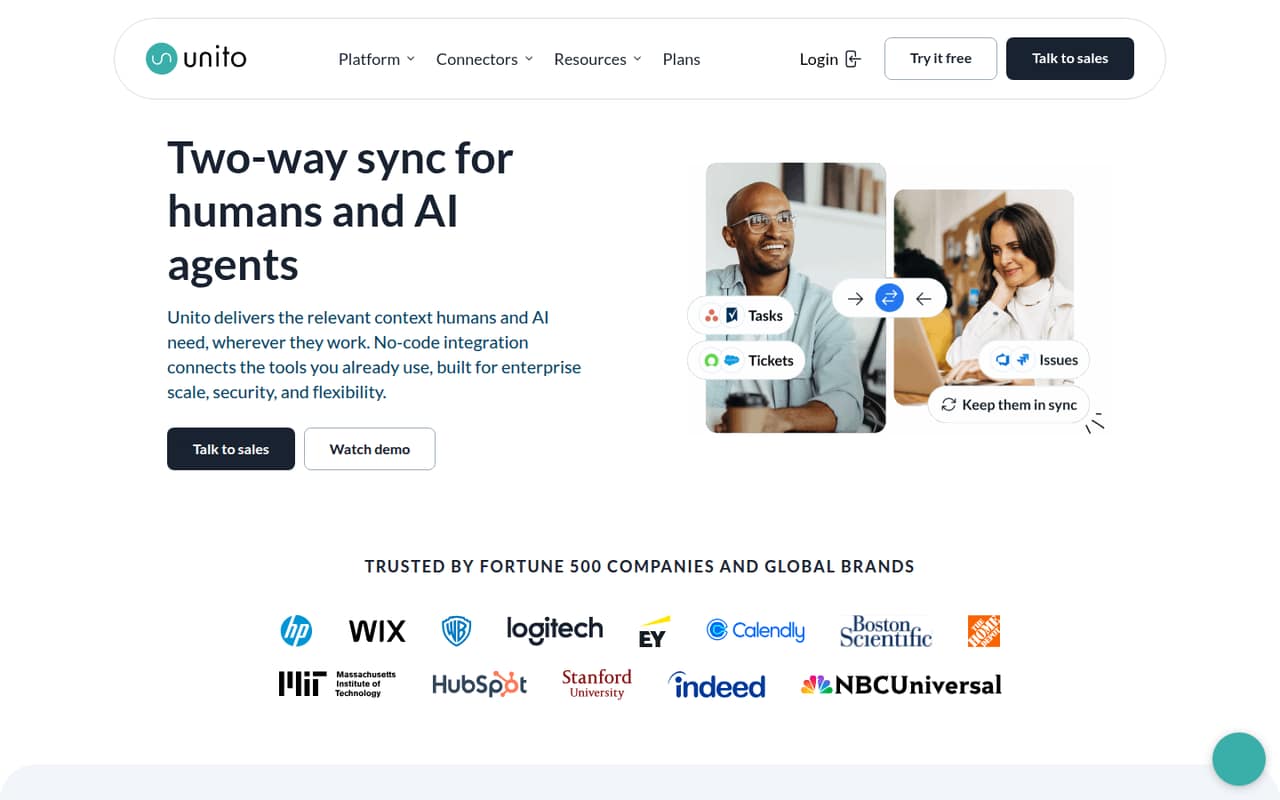
Unito is a no-code integration platform for two-way sync between business tools. Rules and field mappings control what moves between apps, and the vendor says it supports more than 60 integrations plus custom connectors for AI and traditional workflows.
The trade-off is limited public detail for developers evaluating it as infrastructure: plan prices are not published, and API, SDK and deployment specifics need confirmation with Unito. Basic and Pro list 5–15-minute updates; Enterprise lists live and historical syncing.
Good fit if
- Teams syncing project and business tools
- AI workflows needing cross-tool context
- Organizations wanting configurable no-code integrations
Skip it if
- Teams requiring a documented public API
- Projects needing known usage-based costs
- Teams requiring self-hosted integration software
ScoresHow it rates
What works
- Two-way sync with configurable rules and field mappings
- More than 60 business app connectors
- No-code setup and integration management
- Enterprise plan lists live and historical syncing
- SOC 2 Type 2 certification stated by vendor
What doesn't
- Basic, Pro and Enterprise prices are not published
- No public SDK or programming-language details
- No stated API rate limits or uptime SLA
- No published self-hosting or source licence details
- Basic and Pro updates run every 5–15 minutes
01What Unito is, technically
Unito is a no-code integration platform for syncing data between business applications. It sits between systems teams already use, rather than acting as a library, CLI or self-hosted server. Users configure connections, rules and field mappings to control which records and fields sync and how they stay aligned.
The vendor positions it for both traditional business workflows and AI agents: syncing business data can provide cross-tool context for AI workflows. Its homepage says the platform connects more than 60 business apps out of the box and can be extended with custom connectors. That makes Unito an integration layer for teams that need data to move between tools without building and maintaining each connection themselves. Enterprise plans also list on-prem connectors, which is distinct from running the Unito platform on your own infrastructure.
02Unito API, SDKs and docs
The primary integration surface Unito describes is its no-code platform: connect supported apps, set rules, map fields and monitor integrations. The homepage promotes more than 60 out-of-the-box business app integrations and says teams can extend the platform with custom connectors. It does not name a REST API, webhook interface, CLI, SDK or supported programming language.
That makes Unito easier to assess as a configurable integration service than as a developer toolkit. If your codebase needs programmatic control, custom connector development or automation through an API, confirm the available interfaces and SDK support in Unito’s docs or with its team before designing around them. The Enterprise plan lists developer platform access, but the public plan details do not explain its endpoints, authentication, limits or supported languages. The homepage emphasizes setup without complex scripting, which can reduce integration work, but it does not replace checking how custom connectors fit your deployment and release process.
03Unito pricing for developers
Unito lists Basic, Pro and Enterprise, but monthly and annual prices are not published. Self-serve pricing appears in-app, while Enterprise pricing is sales-quoted, so there is no confirmed starting price to use in a project estimate. The pricing page does not list a free plan or trial terms, although the homepage has a “Try it for free” call to action; confirm eligibility and duration with Unito.
Basic and Pro list standard cloud connectors, 5–15-minute updates, chat and email support, and credit-card payment under online terms. Enterprise adds standard, premium and on-prem connectors, advanced syncing, live and historical data syncing, a dedicated integration consultant, enterprise procurement, SSO and developer platform access. The vendor does not publish a billing formula tied to seats, requests, sync volume or compute, nor does it list overage charges or add-ons. Ask for a quote based on your connector mix, required update frequency and expected scale before treating the integration cost as predictable.
04Unito: open source, self-hosting and lock-in
Unito’s public product information does not state an open-source licence or offer source code, so teams should not plan on modifying and building the platform themselves. It is presented as an integration platform with cloud connectors; the Enterprise plan also lists on-prem connectors. That describes connector options, not a self-hosted Unito deployment, so confirm hosting and data-path requirements with the vendor.
Unito does not publish a data-export process or describe how to move integration rules and field mappings to another platform. Those configurations are part of the integration layer you would need to replace during a migration. Before adopting it for critical workflows, ask what data can be exported, in what format, and whether custom connectors or configuration can be transferred. Without those answers, the effort to migrate depends on the connectors and workflows you build.
05Unito in production
Update frequency is a key production constraint to check. Basic and Pro list 5–15-minute updates, while Enterprise lists live and historical data syncing without publishing a specific latency target. The vendor does not publish API rate limits or an uptime SLA in its plan details. Confirm expected sync delays, retry behavior, conflict handling and incident support for workflows where stale or duplicated data has operational consequences.
The homepage says Unito is SOC 2 Type 2 certified, complies with global privacy laws and does not store sensitive data. Treat those as vendor claims to validate against your security and data-retention requirements, especially when syncing records into AI workflows. Enterprise lists on-prem connectors, SSO and a dedicated integration consultant. Before production rollout, confirm connector coverage, the security scope, audit requirements and what happens when either connected app changes its API or permissions.
Questions people ask
What does Unito do?
Unito syncs data between business applications using configurable two-way connections. Teams choose what data moves with rules and field mappings. The vendor says it supports more than 60 business apps and can extend the platform with custom connectors. It also positions synced business data as context for AI workflows.
How much does Unito cost?
Unito lists Basic, Pro and Enterprise plans, but does not publish monthly or annual prices. Its pricing details say self-serve prices appear in-app and Enterprise pricing is sales-quoted. The listed features include 5–15-minute updates for Basic and Pro; ask Unito for a quote based on your connectors and requirements.
Does Unito have a free plan or trial?
The plan details do not list a free plan or trial terms. Unito’s homepage has a “Try it for free” call to action, but it does not state the eligibility, duration or limits there. Confirm current trial access and any restrictions with Unito before planning a proof of concept.
Does Unito provide an API or SDK?
Unito’s homepage describes a no-code platform, app integrations and custom connectors, but does not name a public API, SDK, CLI or programming language. Enterprise includes developer platform access, without public details on its interface or limits. Check Unito’s docs or ask its team to confirm what your integration requires.
Can I self-host Unito?
Unito’s plan details list cloud connectors for Basic and Pro and on-prem connectors for Enterprise. They do not describe a self-hosted Unito deployment. On-prem connectors do not by themselves mean the integration platform runs on your infrastructure, so confirm hosting, data flow and security requirements directly with Unito.