
We may earn a commission if you buy through links on this page. It never changes a score or a ranking. How we make money
The bottom line
A capable TypeScript workflow platform with a free tier and self-hosting option; budget for compute and run usage.
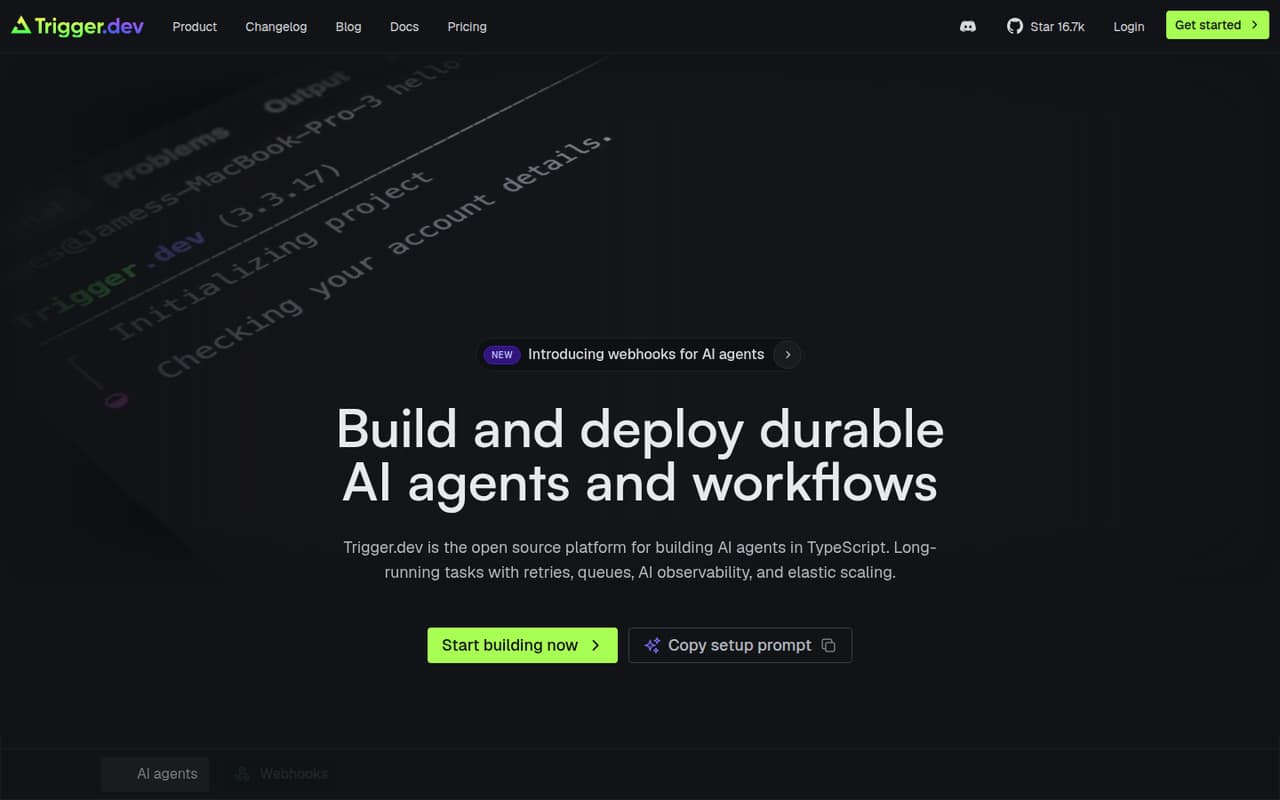
Trigger.dev is an open-source TypeScript platform for durable tasks, workflows and AI agents. Its hosted service handles execution, retries, queues, scaling and run observability; the vendor also offers self-hosting.
The feature set covers scheduled tasks, webhooks, streaming and human approval steps. A free plan and monthly compute credits make it accessible to start, but production costs can include compute, run invocations and paid capacity. Confirm the self-hosting licence and data-export path before making it a core dependency.
Good fit if
- TypeScript teams building durable workflows
- AI agents with approval steps
- Apps needing task status and streaming
Skip it if
- Python-first workflow codebases
- Teams needing published migration guarantees
- Workloads requiring predictable flat pricing
ScoresHow it rates
What works
- Durable tasks include retries, queues and checkpointing
- AI agents support tool calling and human approval
- Realtime status and streams can reach the frontend
- Free plan includes $5 monthly compute credits
- Self-hosting is an available deployment option
What doesn't
- Compute and run invocations add usage-based charges
- Some production capacity and features cost extra
- The main platform is TypeScript-first
- The vendor does not publish a data-export path
- Support details are limited outside Enterprise plan features
01What Trigger.dev is, technically
Trigger.dev is an open-source TypeScript platform for running durable background tasks and workflows. In the hosted setup, your application defines tasks and sends work to Trigger.dev, which runs that work on its infrastructure. The platform handles queues, retries, long-running execution, scaling and run observability. The vendor also offers self-hosting, so it can sit on your own infrastructure rather than only as a hosted service.
It fits between an application and the work that should not run inside a short-lived request: scheduled jobs, webhook-triggered tasks, media processing and multi-stage workflows. For AI applications, tasks can call tools, stream responses and pause for human approval. The homepage says tasks are written in a Trigger folder and describes atomic deploy versions, so started tasks are not affected by code changes. It is workflow infrastructure, not a model provider or a general-purpose queue library. Teams should assess its task model and operational needs against the job system already in their stack.
02Trigger.dev API, SDKs and docs
The homepage presents Trigger.dev as a TypeScript platform where you write tasks as code in a Trigger folder. Its AI-agent example uses TypeScript, chat.agent, typed tools and run; the example also integrates Anthropic through anthropic("claude-sonnet-4-5") and streaming through streamText. Those are example integrations, not a requirement to use that model provider.
The documented integration surfaces named on the homepage include webhooks, a Realtime API for task status and streams, React hooks, an MCP Server and Python support. Python scripts can run with automatic package installation through requirements.txt; the main platform is described as being for TypeScript. Build customization includes esbuild plugins, Prisma, Puppeteer, FFmpeg, apt-get and additional packages. The homepage also lists durable schedules, waits, batch triggering and typed, validated payloads. It does not name a CLI or enumerate SDK packages, so confirm SDK and CLI support, authentication details and current API contracts in the vendor's docs before choosing an integration.
03Trigger.dev pricing for developers
The Free plan costs $0 per month and includes $5 in monthly compute credits, 20 concurrent runs, unlimited tasks, five team members and 10 schedules. Hobby costs $10 per month, with $10 in monthly credits, 50 concurrent runs, five team members, 100 schedules and seven-day log retention. Pro starts at $50 per month and includes $50 in credits, 200+ concurrent runs, 25+ team members, 1,000+ schedules and 30-day log retention. Enterprise pricing is custom.
The bill can grow beyond the plan price. The pricing page lists compute at $0.0000169–$0.0006800 per second, depending on machine, and run invocations at $0.000025 each. Pro add-ons include $10 per additional 50 concurrent runs above 200, $20 per seat above 25, and $10 per 1,000 schedules above 1,000. Extra preview branches, dashboards and Realtime connections are also $10 each at their listed thresholds. A HIPAA BAA is $500 per month. Prices are monthly; annual billing or discounts are not published.
04Trigger.dev: open source, self-hosting and lock-in
Trigger.dev describes itself as open source, and its community post points to the project’s GitHub repository and a Docker self-hosting tutorial. The vendor’s homepage also says self-hosting is an option. The licence name and any licence-specific restrictions are not stated on the homepage or pricing details, so check the repository’s current licence before using or modifying the code in a commercial deployment.
Self-hosting gives teams an alternative to relying entirely on the hosted service, but it also means operating the infrastructure. The vendor does not publish a data-export path in the materials reviewed for this page; ask how to export run history, task state and relevant metadata before adoption. Workflow code is TypeScript, which can reduce the cost of moving task logic, but Trigger-specific task APIs, retries and run state may require rewriting or a migration plan. Treat portability of in-flight runs as a separate question from portability of source code.
05Trigger.dev in production
The vendor describes elastic scaling, retries, queues, alerts, advanced run filtering and atomic deploy versions. Its homepage also promotes multi-region workers, static IPs and AWS PrivateLink. The Pro plan lists 200+ concurrent runs, 1,000+ schedules and 30-day log retention; check the exact limits and any add-on costs for your tier before sizing a production workload. The homepage’s “no timeouts” claim should be validated against the task types and operational guarantees your application needs.
For security and compliance, Enterprise lists SSO and RBAC, while the pricing page lists a HIPAA BAA for $500 per month. Confirm data handling, retention and recovery commitments with the vendor for your workload. Reddit feedback is sparse but includes a TypeScript user praising setup and a commenter noting that Trigger.dev charges by job invocation rather than step. Another Reddit thread raised questions about how the system works, a reminder to verify its execution model and deployment fit rather than treating it as a drop-in queue. The vendor does not publish a service-level commitment in the details reviewed here.
From the threadsWhat users say
The small set of Reddit comments is mostly positive about Trigger.dev’s fit for TypeScript background jobs and its invocation-based pricing. Discussion is limited, and one commenter asked for a clearer explanation of how the system works.
Trigger doesn't charge per step but rather per job invocation - this doesn't force you to make suboptimal code design
appreciate how straightforward it is to set up and run background tasks
The readme didn't really explain that
We did a test of trigger-dev and started using it
Questions people ask
What is Trigger.dev used for?
Trigger.dev runs durable background tasks and workflows written in TypeScript. Common use cases include scheduled jobs, webhook handling, media processing and multi-stage workflows. It also supports AI agents with tool calling, streaming and human approval steps, and provides run status and observability features.
Does Trigger.dev support Python?
The platform is described as an open-source TypeScript platform, but the homepage also lists Python support. It says you can execute Python scripts with automatic package installation through requirements.txt. Confirm the current Python integration and its limitations in the vendor’s docs before making it the main language for workflow code.
Can I self-host Trigger.dev?
Yes. The vendor says self-hosting is available, and its community post points to a Docker self-hosting tutorial. Before deploying, check the current repository licence, infrastructure requirements and operational responsibilities. Self-hosting can reduce dependence on the hosted service, but it means your team must run and maintain the deployment.
How does Trigger.dev pricing work?
The Free plan is $0 per month and includes $5 in monthly compute credits. Paid plans start with Hobby at $10 per month and Pro at $50 per month. Compute and run invocations are separately priced, and Pro add-ons can raise costs as you exceed listed capacity thresholds.
Can Trigger.dev replace a background-job queue?
It is designed to run background tasks and workflows, with queues, retries and scheduling, so it may fit a queueing use case. Whether it replaces an existing queue depends on your deployment model, task semantics and operational requirements. Compare its run model and migration path with your current system before switching.
Sources
- Trigger.dev homepage
- Trigger.dev pricing page
- Reddit: Inngest pricing model (and others like trigger.dev and more)
- Reddit: Is there a Python equivalent to Trigger.dev for simple background job scheduling?
- Reddit: Does anyone here use dbos.dev or trigger.dev?
- Reddit: Trigger.dev - Open-source background jobs for NextJS, Remix, Astro, and many more!