
We may earn a commission if you buy through links on this page. It never changes a score or a ranking. How we make money
The bottom line
A capable distributed SQL foundation, but check compatibility, licensing and production costs before committing.
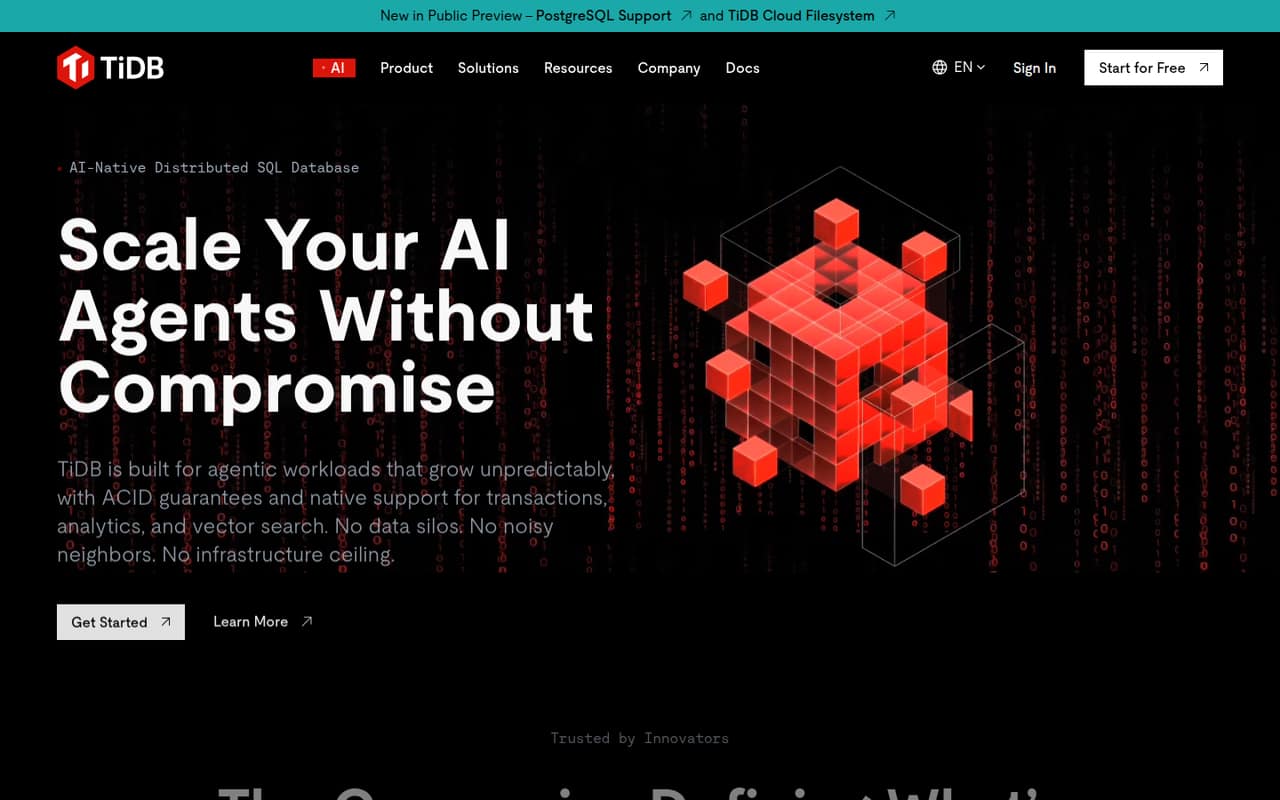
TiDB is an open-source distributed SQL database that can run as a managed cloud service or on your own infrastructure. It combines transactions, analytics and vector search, with SQL interfaces for familiar MySQL or PostgreSQL tools and integrations for AI application frameworks.
The free Starter tier is useful for development and smaller applications, but it has storage and Request Unit allowances. Production costs can include compute, storage, backups, data transfer and separate analytics charges. TiDB is worth evaluating when a unified database and horizontal scaling matter; confirm compatibility and the exact open-source license before choosing a deployment.
Good fit if
- Teams combining SQL and vector search
- Applications with uneven workload demand
- MySQL or PostgreSQL tool users
Skip it if
- Projects needing a simple fixed bill
- Teams requiring published SDK guarantees
- Deployments with unverified license requirements
ScoresHow it rates
What works
- Open-source database with self-managed deployment
- Transactions, analytics and vector search together
- SQL queries can join vector results with transactional data
- Starter includes monthly storage and Request Unit allowances
- Premium lists 99.99% availability with multi-zone protection
What doesn't
- Exact open-source license needs confirmation
- SDK and language support needs verification
- Production storage and backup charges are extra
- Lake compute and cloud services bill separately
- Rate limits and export options need confirmation
01What TiDB is, technically
TiDB is an open-source distributed SQL database, available as a self-managed server or as TiDB Cloud, a managed service. It sits in the data layer behind applications: services send SQL queries to store transactional records, run analytics, or retrieve vector-search results. The vendor also offers TiDB Cloud Lake, a managed analytics and search warehouse.
The architectural pitch is to combine transactions, analytics and vector search rather than move data among separate systems. TiDB supports joining vector similarity results directly with transactional data. For agent workloads, the vendor describes ACID consistency across workflow steps and distributed nodes, tenant-scoped data separation, and dedicated throughput. Its elastic scaling is described as adapting from zero when idle to peak demand. Those features may reduce the need for separate data stores, but the actual deployment choice matters: managed TiDB Cloud and self-managed TiDB put different infrastructure and operational responsibilities on the team.
02TiDB API, SDKs and docs
The primary integration surface is SQL. The homepage says developers can use familiar MySQL or PostgreSQL tools, and describes TiDB as a distributed SQL database. It also lists integrations for MCP, pytidb, LangChain and LlamaIndex. The homepage does not name programming-language SDKs; confirm supported languages and client compatibility in the vendor's documentation before selecting a stack.
For AI agents, PingCAP provides an MCP server connection example using npx mcp-remote and https://tidb.link/mcp. The example configures an MCP client to connect to TiDB Cloud and describes actions such as creating a branch, running a SQL query and viewing slow queries. This is an integration example, not a general TiDB command-line interface. The homepage links to a Developer Hub and documentation, but teams should verify the exact APIs, SDK versions, connection methods and operational guidance there. Online DDL and zero-downtime schema changes are listed as developer features.
03TiDB pricing for developers
TiDB Cloud Starter costs $0 per month and includes 25 GiB of row storage, 25 GiB of columnar storage, 250 million Request Units monthly, and allowances across up to five eligible instances. Usage beyond those allowances starts at $0.10 per million RUs, $0.20 per GiB-month for row storage and $0.05 per GiB-month for columnar storage.
Essential starts at $400 per month for compute; Premium starts at $1,800. Both charge extra for storage, backups, data transfer and other services, with prices varying by region, configuration and usage. Dedicated TiDB Cloud clusters start at $1,376 per month, with final pricing depending on provider, region, configuration and services. For TiDB Cloud Lake, Personal compute starts at $1.60 per hour and Business at $2.40; storage is $23 per TB-month, with cloud-service charges per 10,000 API requests. Lake compute is billed by the second while running. Data integration costs extra, and BYOC adds TiDB Cloud service and support fees on top of cloud-provider infrastructure. No annual billing is listed.
04TiDB: open source, self-hosting and lock-in
PingCAP describes TiDB as open source and offers TiDB Self-Managed for deployment on your own infrastructure. The homepage does not name the software license, so check the repository and license terms before using TiDB in a product or distributing modified versions. Self-hosting avoids a managed-service dependency, but your team is responsible for the infrastructure and operations; the published pricing details do not provide a self-hosting cost estimate.
SQL access through familiar MySQL or PostgreSQL tools may help reduce application-level migration work, but it does not establish full compatibility or guarantee a straightforward move. The vendor's homepage does not describe data-export formats or a migration path away from TiDB Cloud. Ask PingCAP about export tooling, supported formats, consistency during export and any limits on moving data between managed and self-managed deployments. Check how application code uses vector search and TiDB-specific features before estimating lock-in.
05TiDB in production
The Starter tier has defined monthly allowances, but the pricing details do not publish request-rate limits. Essential lists autoscaling within a compute limit and point-in-time recovery; Premium lists isolated compute, storage and network, private connectivity, customer-managed keys, and 99.99% availability with multi-zone protection. Confirm which options apply to your region and configuration, and what service-level terms accompany the availability figure.
The vendor describes scaling from zero to peak and independent scaling of compute and storage. Model the bill against actual workload patterns: storage, backups, data transfer and other services can be extra, while TiDB Cloud Lake has separate compute, storage and cloud-service charges. Encryption in transit and at rest is listed for Essential. The homepage does not list compliance attestations or rate-limit figures, so ask for the relevant security documents and quota details before a production launch. For self-managed deployments, plan for the infrastructure and operational work that the managed plans include.
Questions people ask
Is TiDB an HTAP database?
TiDB is presented as a distributed SQL database for transactional and AI applications, and the vendor describes combining transactions with analytics and vector search. That supports a combined transactional and analytical use case. Confirm the specific workload and query requirements against TiDB's documentation before treating it as a fit for your HTAP design.
Does TiDB support triggers?
PingCAP's homepage does not state whether TiDB supports triggers. Check the compatibility documentation for the exact TiDB version and deployment you plan to use, especially if you are moving an application that depends on MySQL or PostgreSQL trigger behavior.
Is TiDB free?
TiDB Cloud Starter is listed at $0 per month, with 25 GiB each of row and columnar storage and 250 million monthly Request Units across up to five eligible instances. Usage beyond the free allowance is billed separately. TiDB is also described as open source and can be self-managed, though infrastructure costs still apply.
Can I run TiDB on my own infrastructure?
Yes. PingCAP lists TiDB Self-Managed as an option to deploy on your own infrastructure. Check the repository and documentation for the license, supported deployment requirements, operational guidance and any differences from the managed TiDB Cloud service.
Does TiDB support PostgreSQL tools?
The homepage says developers can use familiar MySQL or PostgreSQL tools, and it announces PostgreSQL support in public preview. Check the documentation for the current preview scope, compatibility details and any production-use limitations before relying on PostgreSQL tooling.