
We may earn a commission if you buy through links on this page. It never changes a score or a ranking. How we make money
The bottom line
Durable workflow orchestration with a self-hosted path and usage-based Cloud pricing.
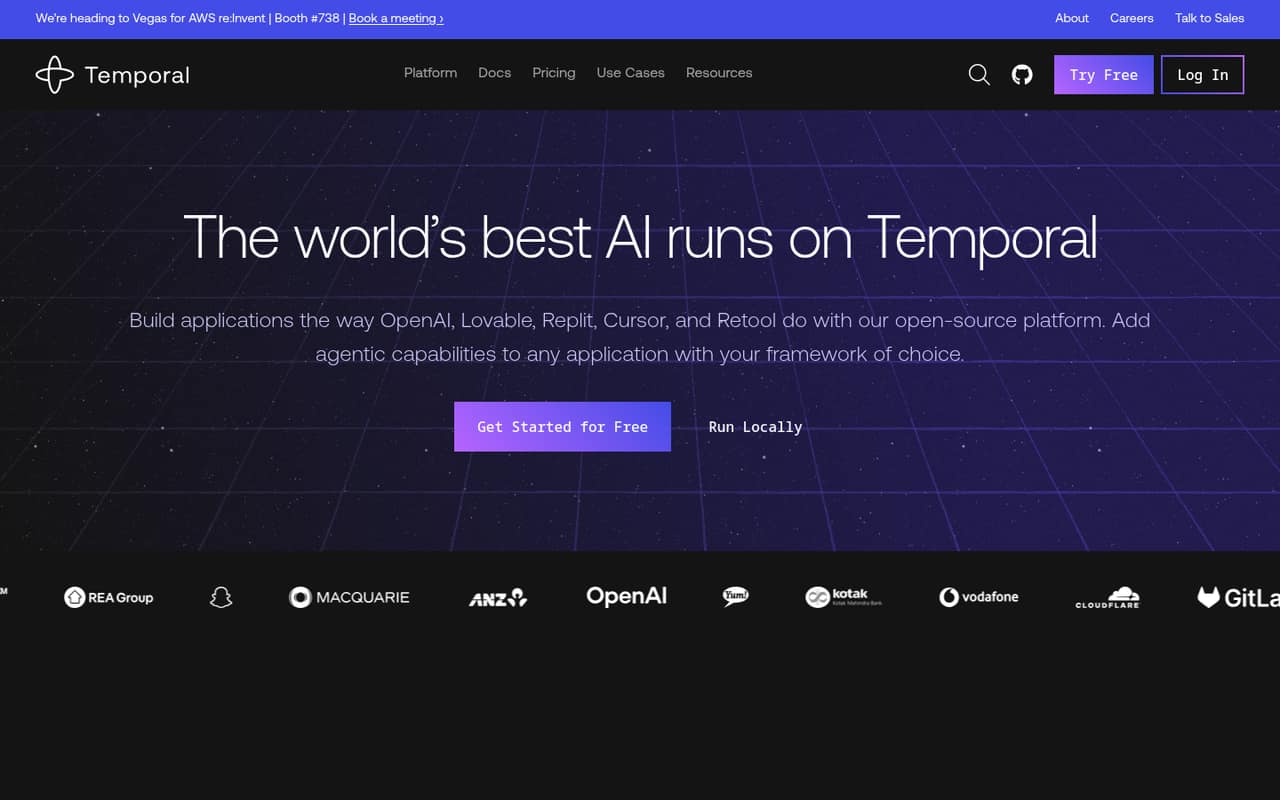
Temporal Cloud is the hosted option for Temporal, an open-source platform that runs workflows as code and persists their state through failures. Native SDKs let teams write workflow logic in their existing programming languages; the vendor's homepage does not name those languages, so confirm SDK support for your stack.
The main trade-off is operational simplicity versus a bill that grows with actions and storage. There is no free plan, but the pricing page lists $150 in credits for 90 days. Teams that need more control can self-host the MIT-licensed project. Reddit discussion offers little evidence of broad user sentiment: one thread asks about privacy and security, while a Temporal community post describes security options.
Good fit if
- Long-running workflows that must recover
- Teams with failure-prone service calls
- Developers wanting hosted orchestration
Skip it if
- Simple jobs needing only a queue
- Teams requiring a free Cloud plan
- Stacks without a supported SDK
ScoresHow it rates
What works
- Persists workflow state through failures
- Retries failure-prone Activities automatically
- Includes task queues, signals, and timers
- Offers hosted and self-hosted deployment
- MIT-licensed open-source project
What doesn't
- No free Cloud plan
- Actions and storage are billed separately
- SDK languages are not named on the homepage
- Data export and migration details need confirmation
- Reddit material offers little independent user feedback
01What Temporal Cloud is, technically
Temporal Cloud is the hosted version of the Temporal Service: a durable workflow orchestration service that sits behind application code. Developers write business logic as Workflows and failure-prone operations as Activities using Temporal's native SDKs. The service persists workflow state and provides task queues, signals, timers, retries, and execution visibility. When an Activity or a connected service fails, the workflow can recover, replay, or pause rather than losing its recorded progress.
That makes Temporal a control plane for long-running application processes, not a general-purpose database or a drop-in job queue. It is aimed at flows such as order processing, financial transactions, infrastructure deployment, and AI pipelines, where steps may span services or run for days or longer. Teams can use Temporal Cloud or host the open-source Temporal Service themselves. Cloud removes the need to operate that service, while application code still needs to be structured around Temporal Workflows and Activities.
02Temporal Cloud API, SDKs and docs
The core integration surface is Temporal's native SDKs: business logic is written as Workflows, with failure-prone functions modeled as Activities. The homepage says teams can use programming languages they already use, but does not name the languages. Before adopting it, confirm that Temporal provides an SDK for your language and check the vendor docs for the client and service interaction details your deployment needs.
The programming model includes workflow state persistence, automatic Activity retries, task queues, signals, and timers. Temporal also provides visibility into the state of workflow executions. These features shape how application code handles retries and long-running work; they are not just settings on an external scheduler. The homepage links to documentation, a demo, and a Code Exchange, but does not identify a CLI, REST API, or specific third-party integrations. Teams should verify current SDK versions, supported language features, and operational guidance in the Temporal docs before committing to a stack.
03Temporal Cloud pricing for developers
Temporal Cloud has no free plan. The listed Pay-As-You-Go rate is $50 per million actions, with no monthly base fee, plus $0.042/GBhr for active storage and $0.00105/GBhr for retained storage. New customers can get $150 in credits for 90 days. The open-source project is a separate self-hosting option, not a free Cloud tier.
For higher volume, self-service Volume Discounts go down to $25 per million actions; larger discounts are available via a commit. Business Support costs the greater of $500 per month or 10% of usage and includes 2.5M actions, 2.5 GB active storage, 100 GB retained storage, and a 2-hour P0 SLA during business hours. Enterprise and Mission Critical pricing is custom; its listed package includes 10M actions, 10 GB active storage, and 400 GB retained storage. Storage is billed by usage, and support or SCIM can add cost. Annual billing is not listed.
04Temporal Cloud: open source, self-hosting and lock-in
Temporal says its open-source project is MIT-licensed and can be hosted in your own environment. Temporal Cloud is the managed hosting path for the Temporal Service; the vendor says it does not see your code. Self-hosting avoids the Cloud service bill, but your team takes on the infrastructure and operations required to run the service.
Using the open-source project gives you an alternative to remaining on Temporal Cloud, though moving a production deployment will involve operating a Temporal Service and validating your workflows and SDK setup there. Temporal's homepage does not describe data export formats or a migration process. Ask the vendor what workflow history and execution data can be exported, how long it is retained, and what is required to move an existing Cloud deployment. The MIT license applies to the open-source project; it does not remove the need to plan a migration.
05Temporal Cloud in production
The production case is durable state and automatic retries for workflows that span unreliable services or run for long periods. Before depending on it, confirm how action usage is metered for your workloads, how active and retained storage will grow, and what throughput or rate limits apply. The listed plans describe action and storage allowances, but production teams should ask Temporal about limits and behavior beyond those allowances. Also verify the security, compliance, retention, and recovery requirements for your workload with the vendor.
A Temporal community Reddit post describes keeping encryption keys with the customer while Temporal sees ciphertext, outbound-only workers, access controls, and private connectivity options including AWS PrivateLink and GCP PSC. Treat those as vendor-posted claims to validate against current documentation and your plan. A separate Reddit thread asks whether Temporal Cloud is suitable for privacy and security; it does not provide user reports or a recommendation. The available Reddit discussion is too limited to establish broad customer sentiment.
From the threadsWhat users say
The available Reddit discussion is too thin to establish customer consensus. One thread raises a privacy and security question; a Temporal community post describes security controls but is not independent user feedback.
Would anyone recommend Temporal cloud for privacy and security?
you keep the keys; we see ciphertext
Outbound-only workers so you can keep inbound ports closed
Private connectivity options when you need them (AWS PrivateLink, GCP PSC)
Questions people ask
Does Temporal Cloud have a free plan?
No. The pricing page lists no free plan, but says new customers can get $150 in credits for 90 days. The open-source Temporal project can be self-hosted, which avoids the Cloud service charge but requires your team to operate the service and its infrastructure.
How does Temporal Cloud pricing work?
Pay-As-You-Go is $50 per million actions, with no monthly base fee. Active storage starts at $0.042/GBhr and retained storage at $0.00105/GBhr. Higher-volume teams can get self-service rates down to $25 per million actions, with larger discounts available via a commit.
Can I host Temporal myself instead?
Yes. Temporal says its open-source project is MIT-licensed and can be hosted in your own environment. Self-hosting means your team is responsible for operating the Temporal Service. Ask the vendor about migration steps and what workflow history or execution data can be exported from Cloud.
Which SDK languages does Temporal support?
Temporal's homepage describes native SDKs and says developers can use programming languages they already use, but it does not name the languages there. Check the Temporal docs for the current SDK list, language versions, and supported features before choosing a production stack.
What security controls should I check?
A Temporal community Reddit post describes customer-held encryption keys, outbound-only workers, access controls, and private connectivity options including AWS PrivateLink and GCP PSC. Confirm availability and configuration for your plan, and ask Temporal about compliance and data-retention requirements for your workload.